

1942 USS Lexington & the Battle of the Coral Sea... Midway...
Item # 723552Sorry, but this item is no longer available. Please be in touch at info@rarenewspapers.com if you would like to be placed on a want list or are interested in a potential alternate issue.
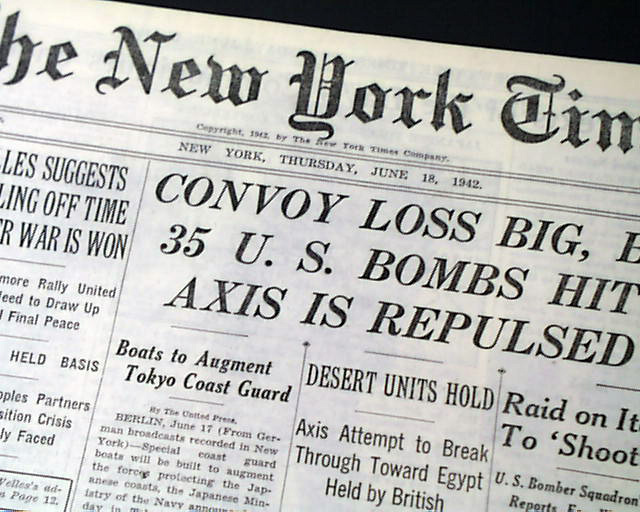
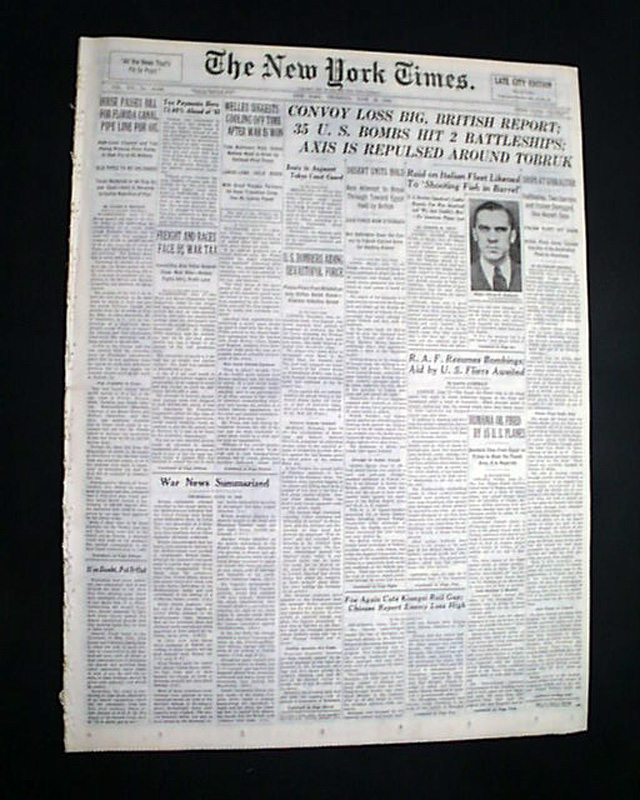
June 18, 1942
THE NEW YORK TIMES, June 18, 1942
* USS Lexington & the Battle of the Coral Sea
* Chicago Tribune journalist Stanley Johnston
* Battle of Midway aircraft carriers - sailors
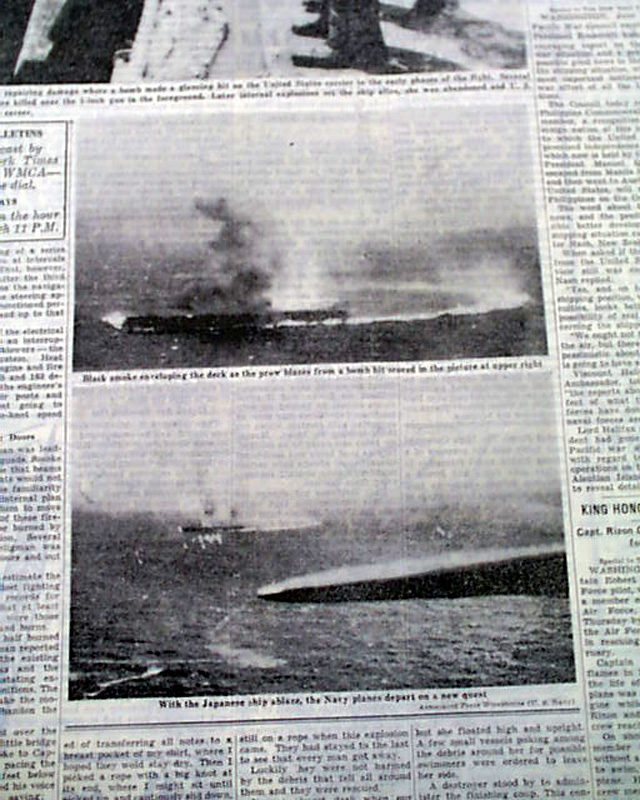
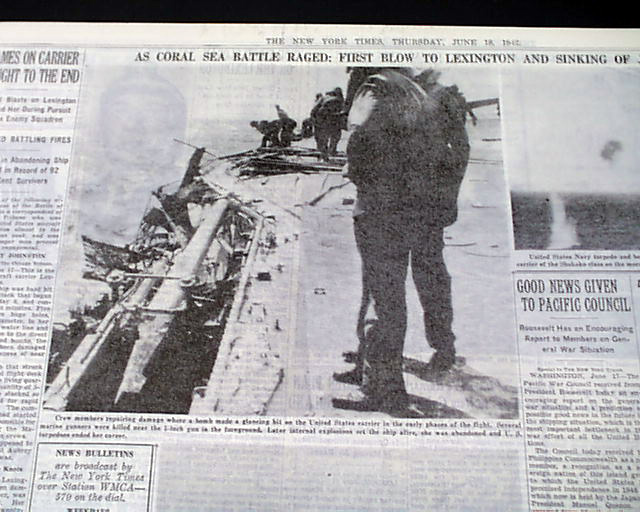
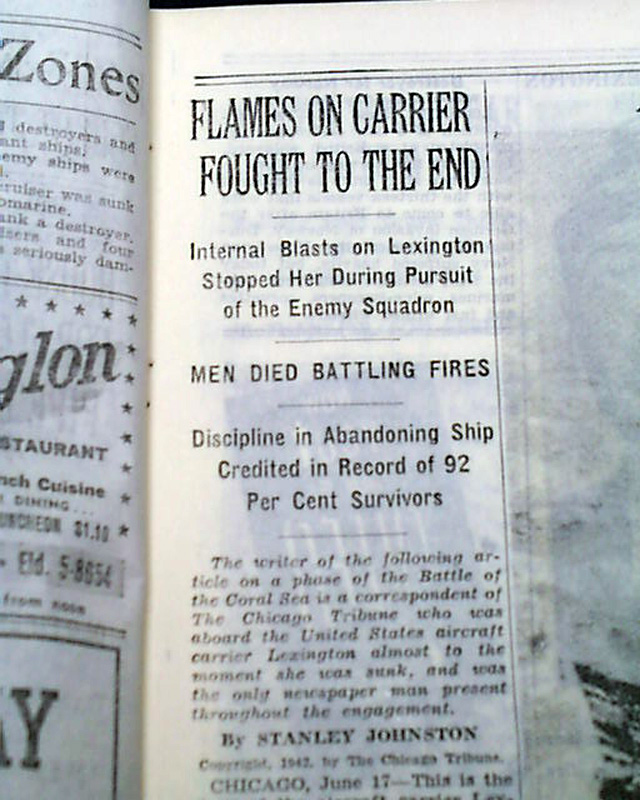
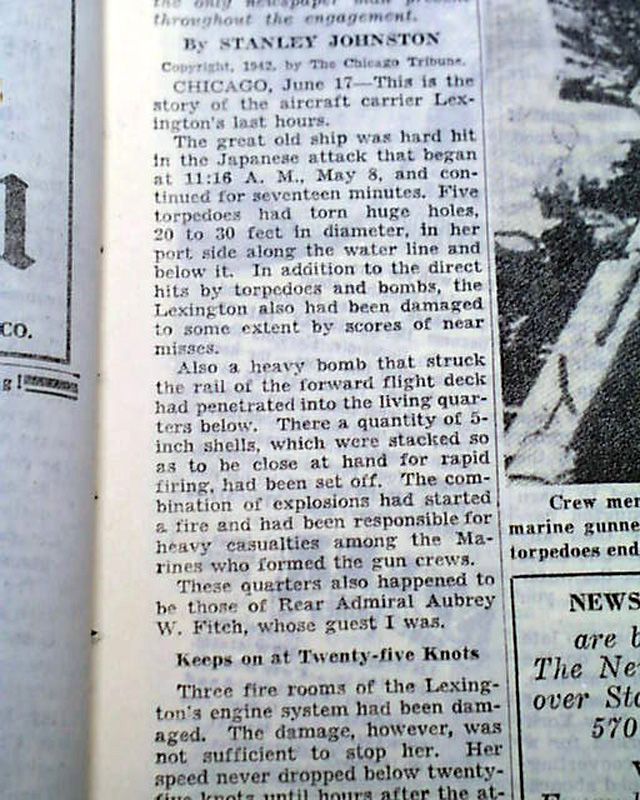
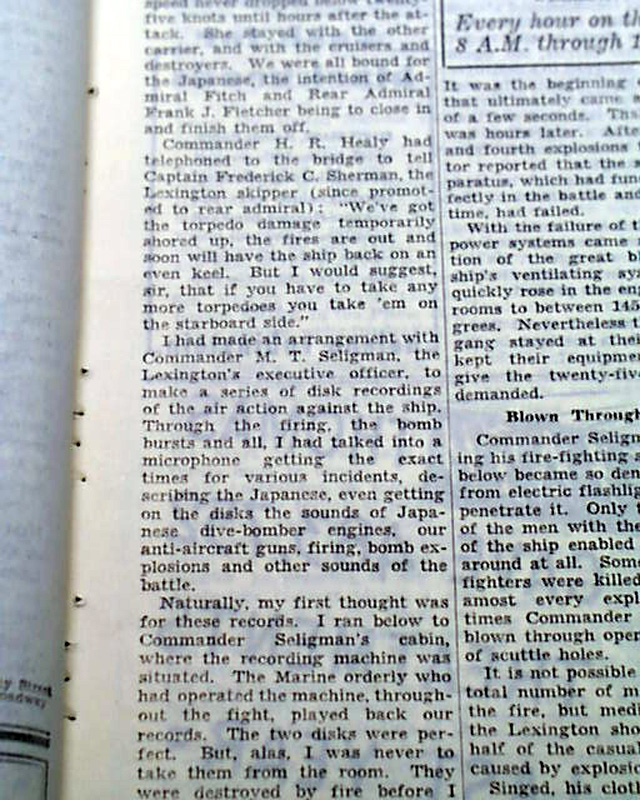
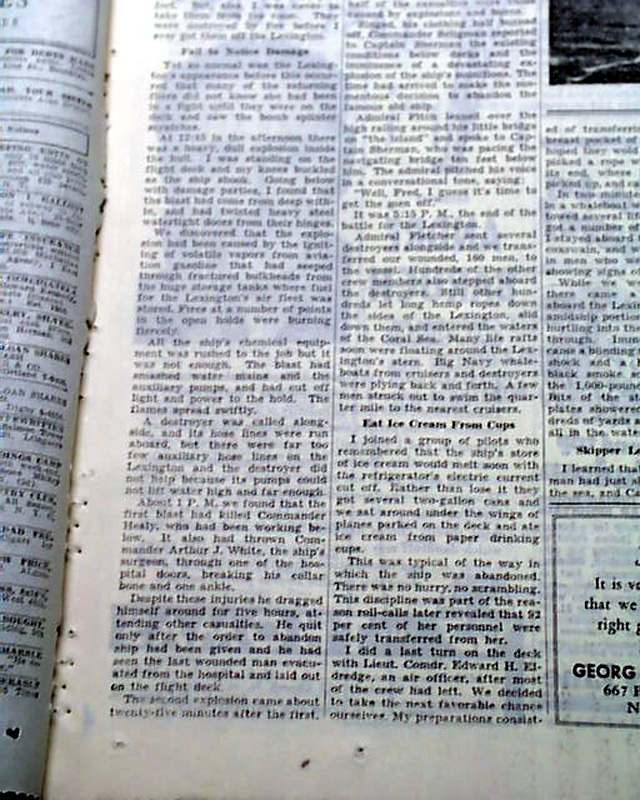
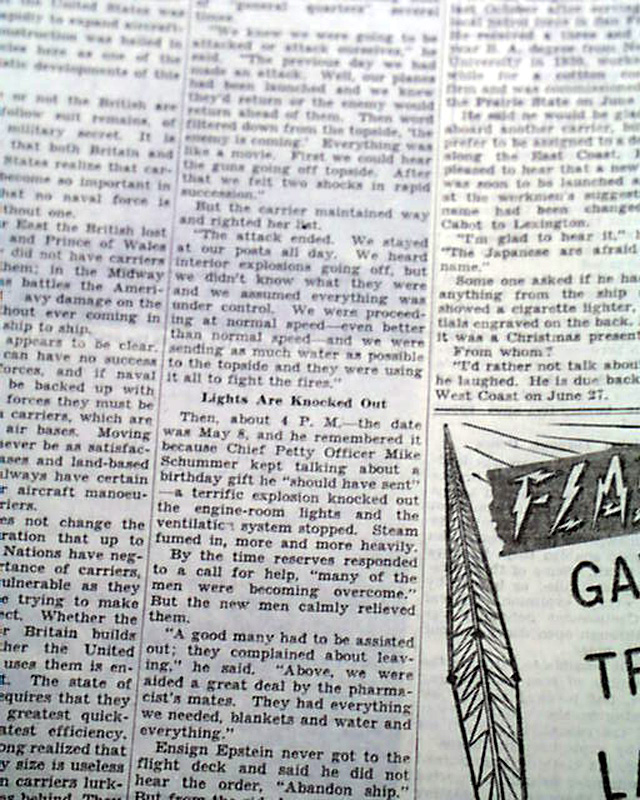
The top of page 3 has a one column heading: "FLAMES ON CARRIER FOUGHT TO THE END" with subheads. Also four photos with heading: "As Coral Sea Battle Raged; First Blow To Lexington And Sinking Of Japanese Carrier" (see images)
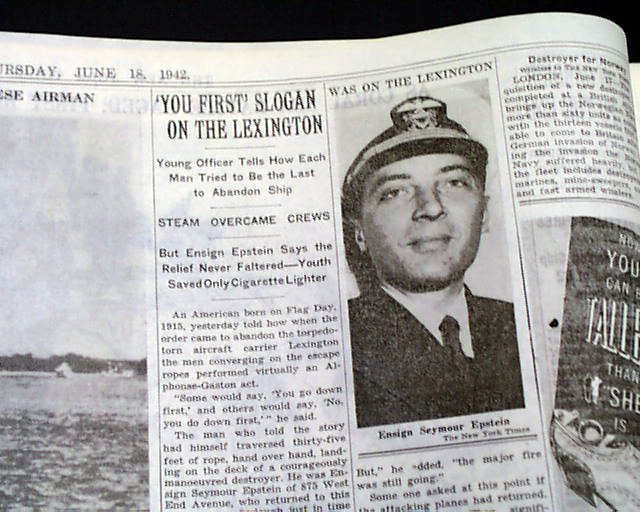
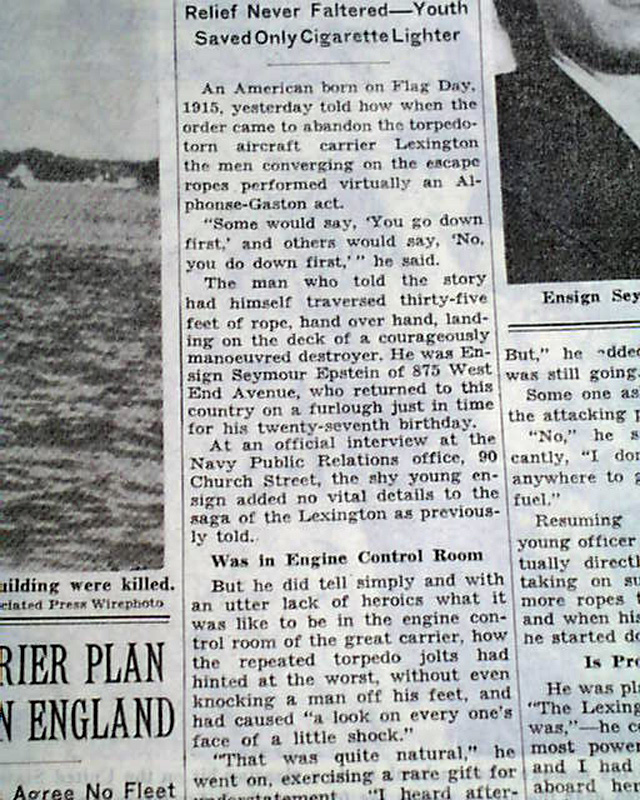
The top of page 4 has a one column heading: "'YOU FIRST' SLOGAN ON THE LEXINGTON" with subhead and photo.
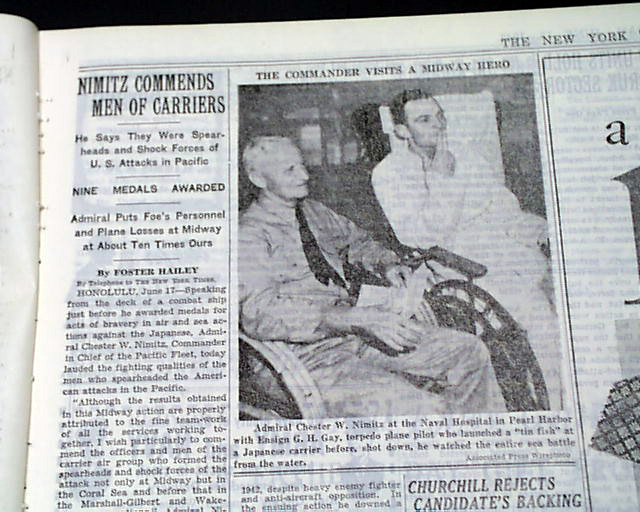
And the top of page 7 has a one column heading: "NIMITZ COMMENDS MEN OF CARRIERS" with subheads and photo showing Admiral Chester W. Nimitz with Ensign G.H. Gay.
Other World War II reporting throughout. Complete with all 42 pages, rag edition in great condition.
Background:In his action report for the sinking of USS Lexington (CV‑2) during the Battle of the Coral Sea on 8 May 1942, Frederick C. Sherman (then Captain) recounted that after the ship had already sustained multiple torpedo and bomb strikes, at approximately 1247 hours a violent internal explosion–triggered by accumulating gasoline vapors into a sealed compartment–ripped through the vessel below the armored deck and destroyed key damage‑control facilities. Despite vigorous efforts by the crew, including reinforcement of fire‑teams (though limited by the rapid exhaustion of available rescue‑breathers), the explosion and subsequent blast waves flooded and blacked out critical spaces, severed communications and extinguished propulsion. Sherman described the final sight of his ship as “a magnificent but sad sight. The ship and crew had performed gloriously and it seemed too bad that she had to perish in her hour of victory.” He noted that some 2,735 survivors were rescued, with no known drownings during abandonment—the loss of life (26 officers and 190 men) being attributable to the combat damage itself. In closing his report, Sherman emphasized the performance of his crew, declared the ship “was completely ready for the attack in every respect,” and pointed to the lessons learned in air defence, anti‑torpedo patrol, and damage control of vapour‑accumulation hazards for future carrier operations.
* USS Lexington & the Battle of the Coral Sea
* Chicago Tribune journalist Stanley Johnston
* Battle of Midway aircraft carriers - sailors
The top of page 3 has a one column heading: "FLAMES ON CARRIER FOUGHT TO THE END" with subheads. Also four photos with heading: "As Coral Sea Battle Raged; First Blow To Lexington And Sinking Of Japanese Carrier" (see images)
The top of page 4 has a one column heading: "'YOU FIRST' SLOGAN ON THE LEXINGTON" with subhead and photo.
And the top of page 7 has a one column heading: "NIMITZ COMMENDS MEN OF CARRIERS" with subheads and photo showing Admiral Chester W. Nimitz with Ensign G.H. Gay.
Other World War II reporting throughout. Complete with all 42 pages, rag edition in great condition.
Background:In his action report for the sinking of USS Lexington (CV‑2) during the Battle of the Coral Sea on 8 May 1942, Frederick C. Sherman (then Captain) recounted that after the ship had already sustained multiple torpedo and bomb strikes, at approximately 1247 hours a violent internal explosion–triggered by accumulating gasoline vapors into a sealed compartment–ripped through the vessel below the armored deck and destroyed key damage‑control facilities. Despite vigorous efforts by the crew, including reinforcement of fire‑teams (though limited by the rapid exhaustion of available rescue‑breathers), the explosion and subsequent blast waves flooded and blacked out critical spaces, severed communications and extinguished propulsion. Sherman described the final sight of his ship as “a magnificent but sad sight. The ship and crew had performed gloriously and it seemed too bad that she had to perish in her hour of victory.” He noted that some 2,735 survivors were rescued, with no known drownings during abandonment—the loss of life (26 officers and 190 men) being attributable to the combat damage itself. In closing his report, Sherman emphasized the performance of his crew, declared the ship “was completely ready for the attack in every respect,” and pointed to the lessons learned in air defence, anti‑torpedo patrol, and damage control of vapour‑accumulation hazards for future carrier operations.
Category: World War II


