Home >
Einstein-Rosen bridge (wormhole) theory...
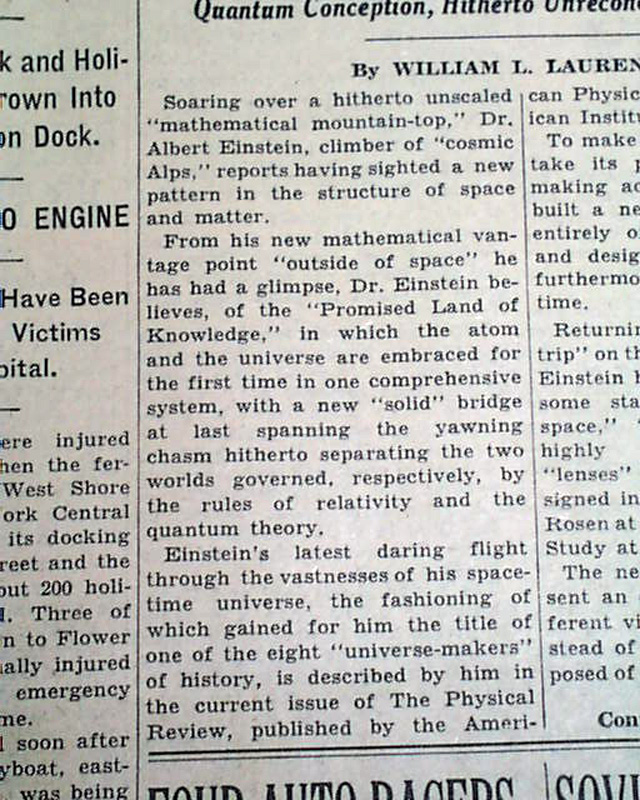
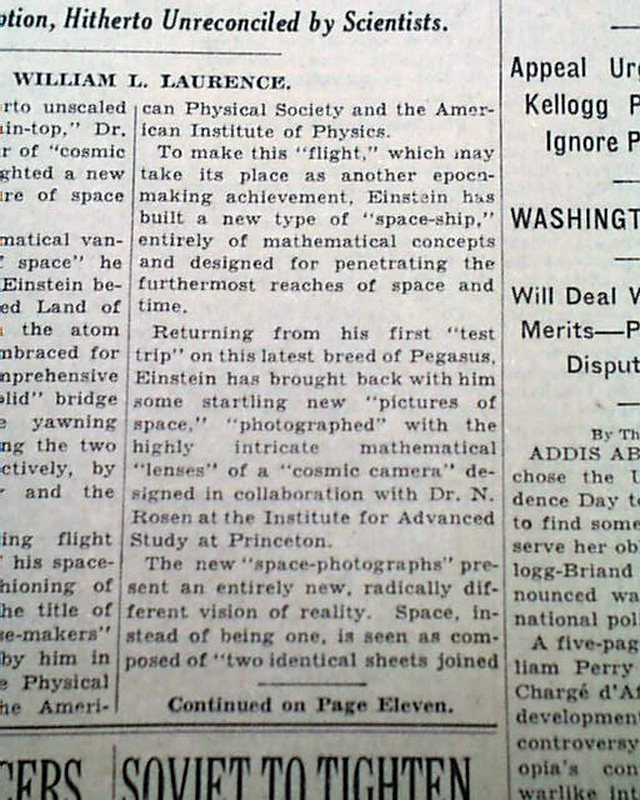
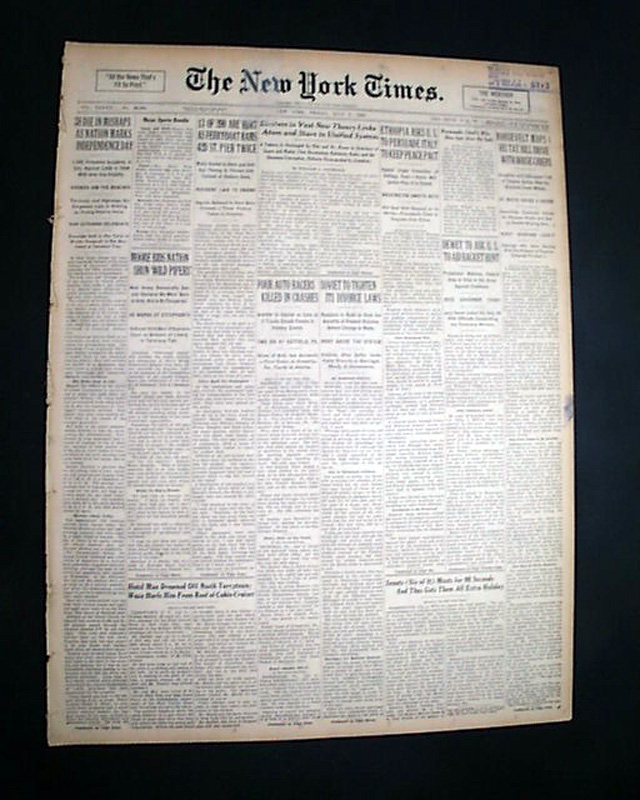
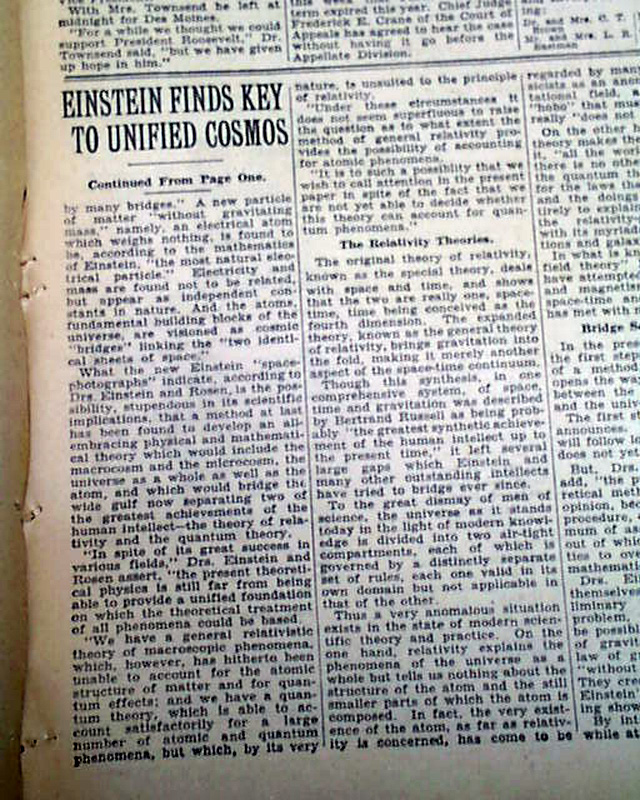
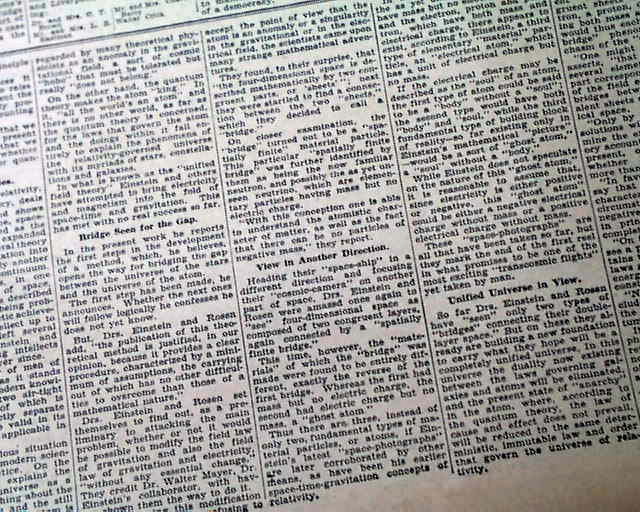
Einstein-Rosen bridge (wormhole) theory...
Item # 722288
July 05, 1935
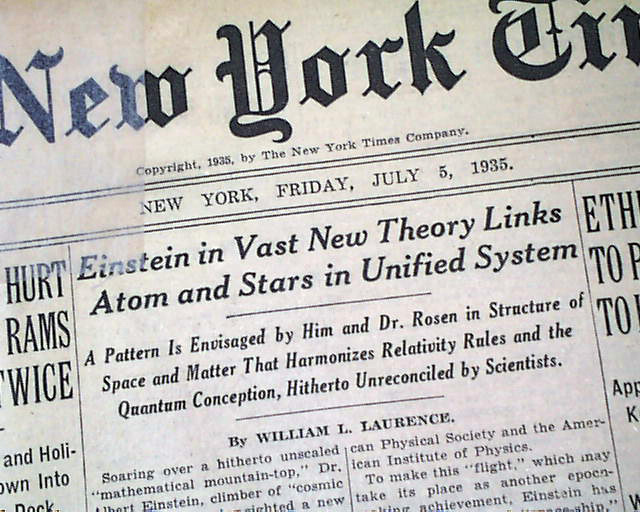
THE NEW YORK TIMES, July 5, 1935
* Albert Einstein & Nathan Rosen bridge
* Wormhole - spacetime - unified theory
The top of the front page has a two column heading: "Einstein in Vast New Theory Links Atom and Stars in Unified Theory" with subhead. (see) Lengthy text continues inside.
Other news, sports and advertisements of the day. Complete in 28 pages, light toning and a little wear at the margins, some small archival mends near the margins with one slightly affecting the Einstein heading, generally in good condition.
AI notes: In 1935, Albert Einstein, together with Nathan Rosen, proposed what became known as the Einstein–Rosen bridge, a theoretical concept in general relativity that described a “bridge” connecting two regions of space-time. Contemporary reports sensationalized this work as a “new theory linking atoms and stars,” reflecting Einstein’s broader ambition to unify atomic-scale phenomena with cosmic structure, though this interpretation was more speculative than established science. The idea was rooted in treating particles not as independent objects but as curvatures or localized structures within space-time itself, hinting at a possible connection between matter and the geometry of the universe. While Einstein described this as a potential step toward a general theory encompassing both nuclear processes and gravitation, the theory faced significant mathematical challenges and was never empirically verified. Historians note that although this work exemplified Einstein’s decades-long pursuit of a unified field theory, it remained a conceptual exploration rather than a fully accepted physical theory, influencing later ideas in theoretical physics, including the modern notion of wormholes.
Category: The 20th Century
Available Now
$52.00