Home >
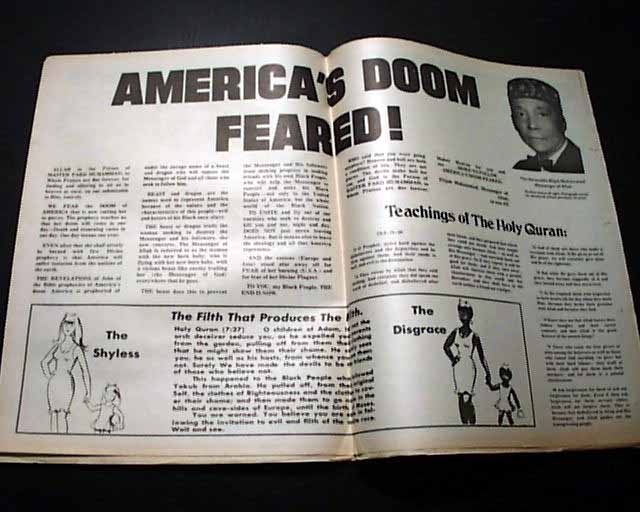
Voice of the Nation of Islam... America's Doom Feared...


Voice of the Nation of Islam... America's Doom Feared...
Item # 725357
June 18, 1971
MUHAMMAD SPEAKS, Chicago, Illinois, June 18, 1971
* Rare African American periodical
* Nation of Islam religious movement
* Elijah Muhammad - founder
This newspaper was one of the most widely-read ever produced by an African American organization. Nation of Islam leader Elijah Muhammad began the publication on May 1960 as a weekly publication. It was distributed nationwide by the Nation Of Islam and covered current events around the world as well as relevant news in African American communities, especially items concerning the Nation of Islam itself.
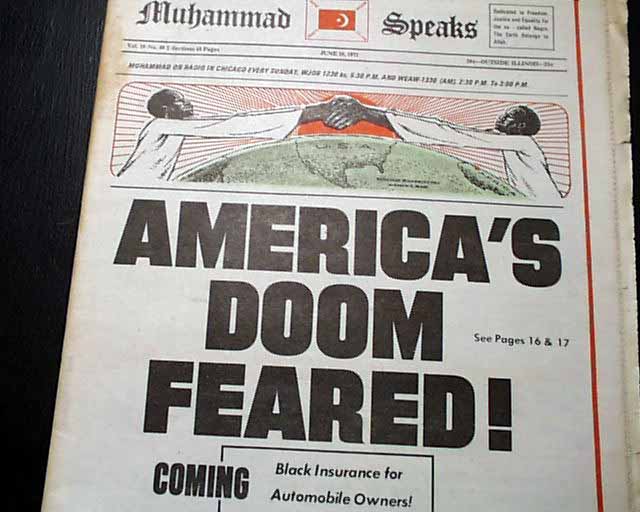
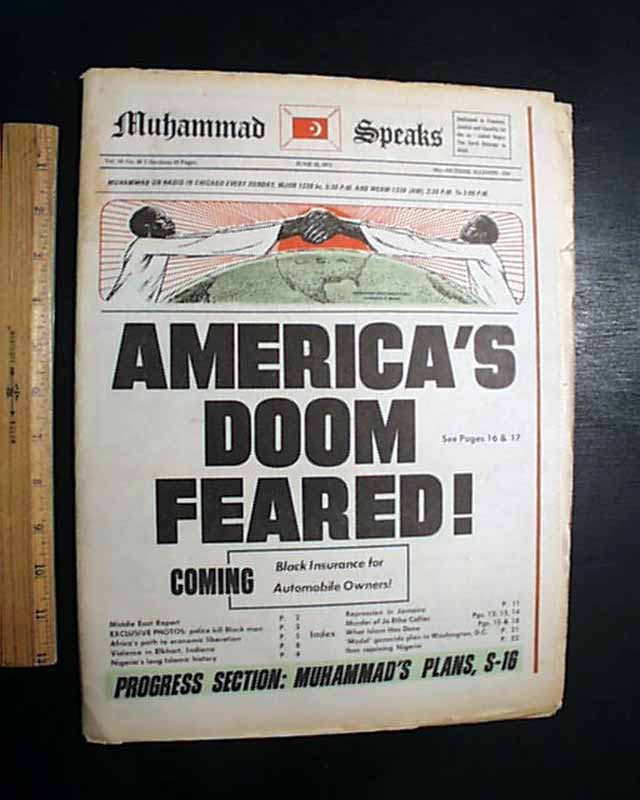
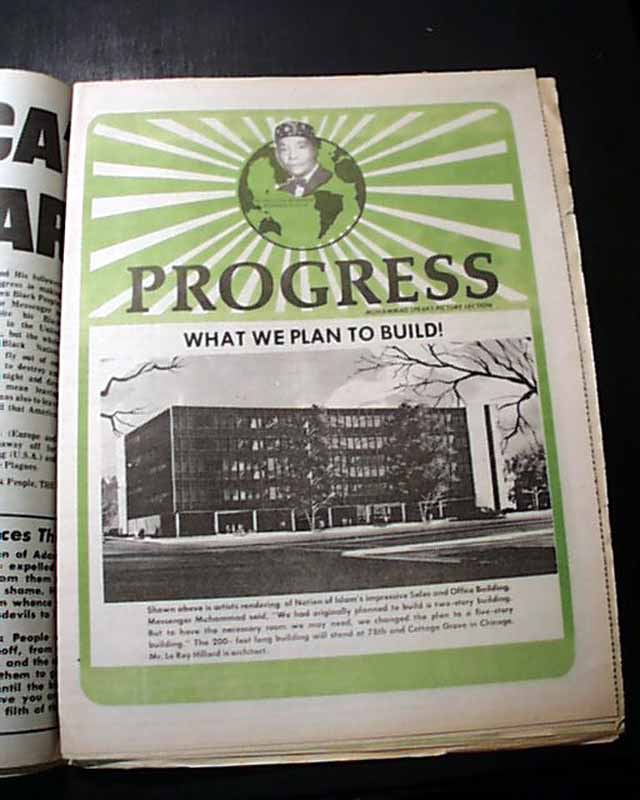
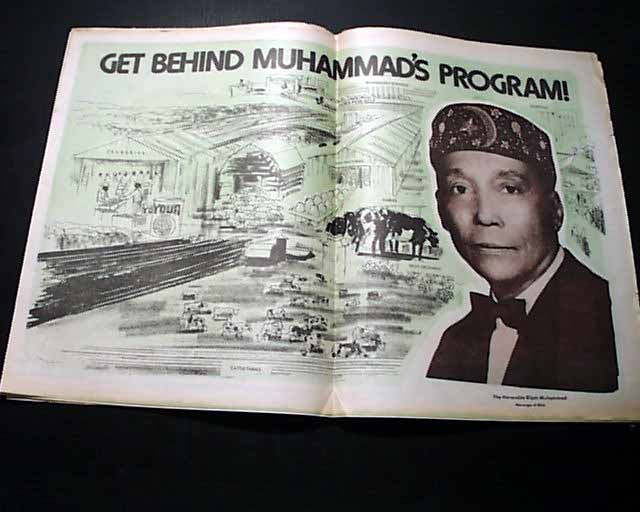
The bold banner headline reads: "AMERICA'S DOOM FEARED ! " and noting that within is a: "Progress Section: Muhammad's Plans" which has a photo of Elijah Muhammad. Other articles inside include: "Africa's Path to Economic Liberation" "Nigeria's Long Islamic History" "Repression in Jamaica" "Murder of Jo Etha Collier" "What Islam Has Done" and more.
A box within the masthead has: "Dedicated to Freedom, Justice and Equality for the so-called Negro. The Earth Belongs to Allah."
Complete in 32 pages, tabloid size, good condition.
background: The June 18, 1971, edition of Muhammad Speaks serves as a striking artifact of the Nation of Islam’s peak influence, characterized by its provocative front-page headline, "AMERICA’S DOOM FEARED!" Published from its Chicago headquarters, this 32-page issue exemplifies the newspaper's unique blend of religious doctrine, pan-Africanist international news, and aggressive reporting on domestic civil rights atrocities, such as the tragic murder of Jo Etha Collier in Mississippi. Under the editorial guidance of Elijah Muhammad, the paper functioned not just as a news outlet, but as a critical engine for the NOI’s "economic blueprint," featuring detailed updates on the group's acquisition of farmland and businesses intended to foster Black self-sufficiency. Its vivid graphic design—defined by bold, red-and-black typography and high-contrast photography—was specifically engineered to command attention on street corners where it was sold, making it a powerful visual symbol of the era's radical Black press.
Category: The 20th Century
Available Now
$40.00