Black Americana: Lewis H. Latimer's death report - member of the Edison Pioneers...
Item # 723372
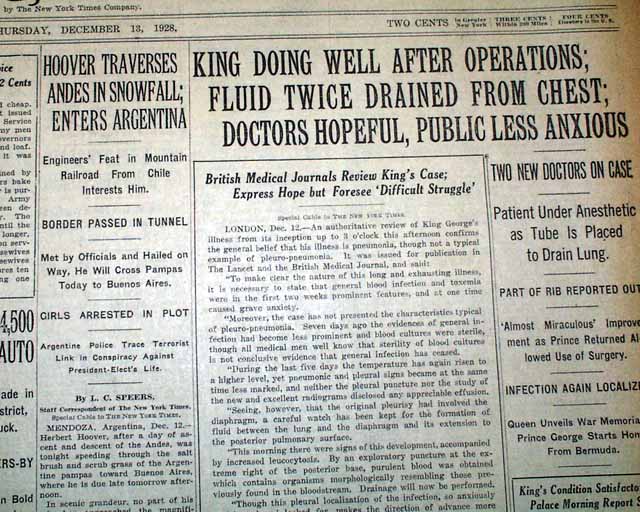
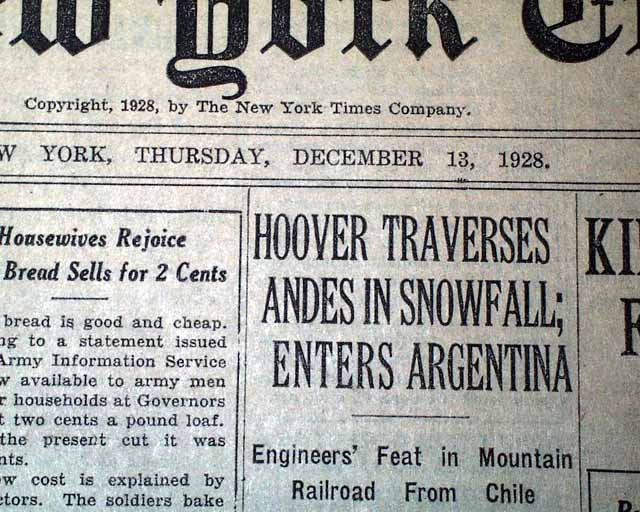
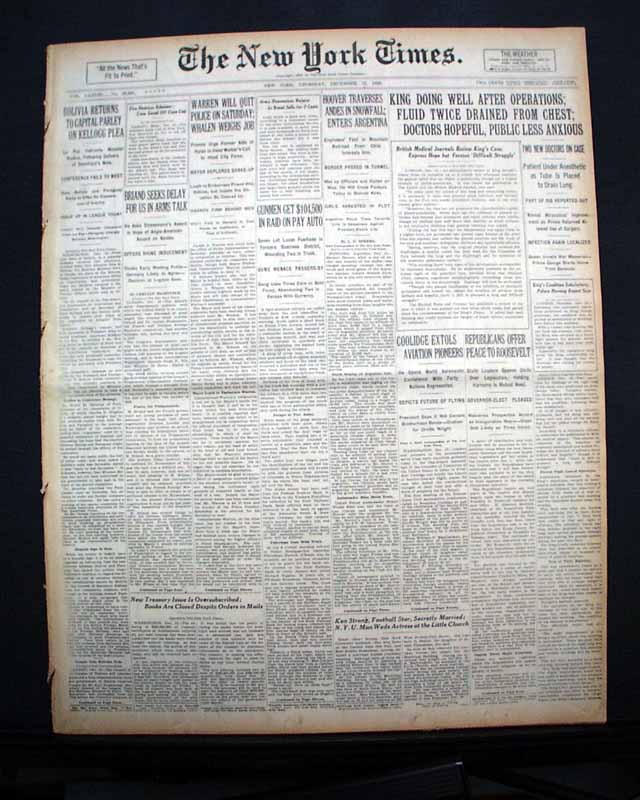
THE NEW YORK TIMES, Dec. 13, 1928 (new discovery - read backgrounds 1 and 2 below)
* Death report of Lewis H. Latimer
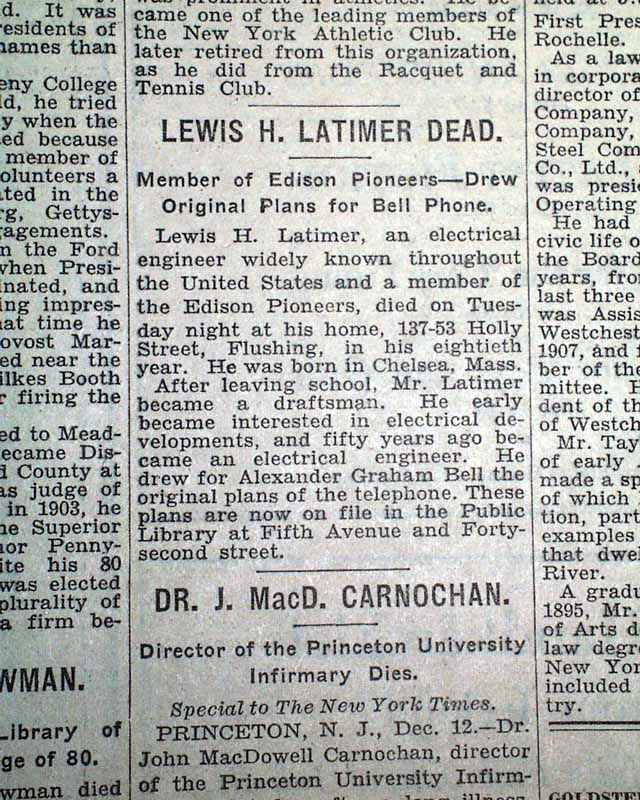
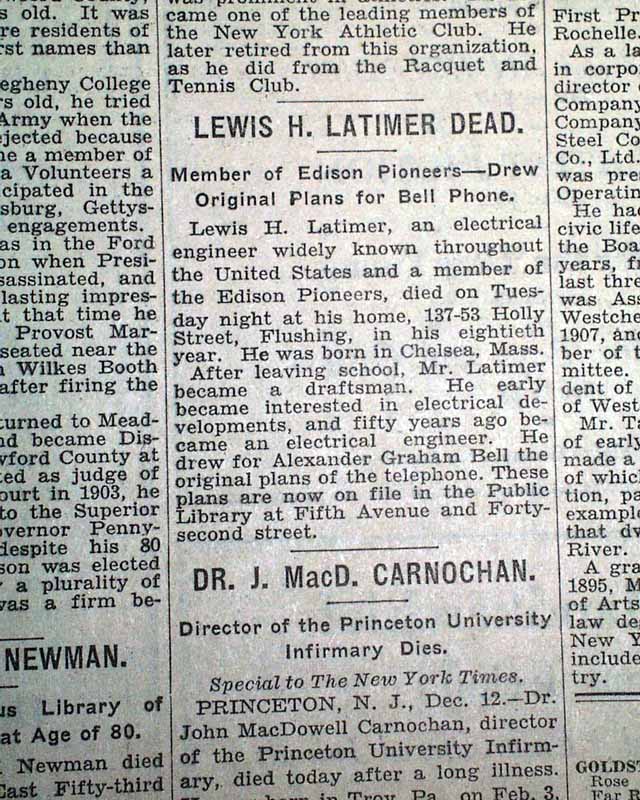
* Member of the Edison Pioneers
* Credited for drawing plans for Alexander Graham Bell's telephone
Page 29 has a 2-paragraph obituary headed: "LEWIS H. LATIMER DEAD", which tells of the death of Black-American Lewis Latimer, a member of the Edison Pioneers. See background details below.
Other news of the day is found throughout.
Complete in 60 pages, slightly irregular along the left spine, in very good condition.
Background (Lewis Latimer): Lewis Howard Latimer (1848–1928) was a groundbreaking African American inventor, engineer, and draftsman whose work significantly shaped modern technology. Born in Massachusetts to parents who had escaped slavery, Latimer faced racial barriers throughout his life but persevered through self-education and determination. After serving in the U.S. Navy during the Civil War, he taught himself mechanical drafting and was hired by a Boston patent law firm.
Latimer played a key role in drafting the patent drawings for Alexander Graham Bell’s telephone in 1876. He later worked with Hiram Maxim and Thomas Edison, where he improved the carbon filament for incandescent light bulbs, making them longer-lasting, more affordable, and suitable for widespread use. He also authored Incandescent Electric Lighting (1890), the first technical book on the subject.
Latimer was one of the few Black members of Edison’s engineering team and remains an important figure in American scientific and African American history.
Background (Edison Pioneers): The Edison Pioneers were an elite group of engineers, scientists, and technicians who worked closely with Thomas Edison during the early development of electric power, lighting, and sound recording in the late 19th century. Composed of individuals who helped transform Edison’s inventions into practical, commercial systems, the group included experts in electrical engineering, manufacturing, and infrastructure. In 1918, Edison formally organized the Edison Pioneers as an honorary society to recognize those who had contributed to his early work and to preserve the history of electrical innovation. Membership was limited to those who had worked with Edison before 1885. The Pioneers played a central role in ushering in the age of electricity and modern industrial technology.
Category: The 20th Century
Available Now