Home >
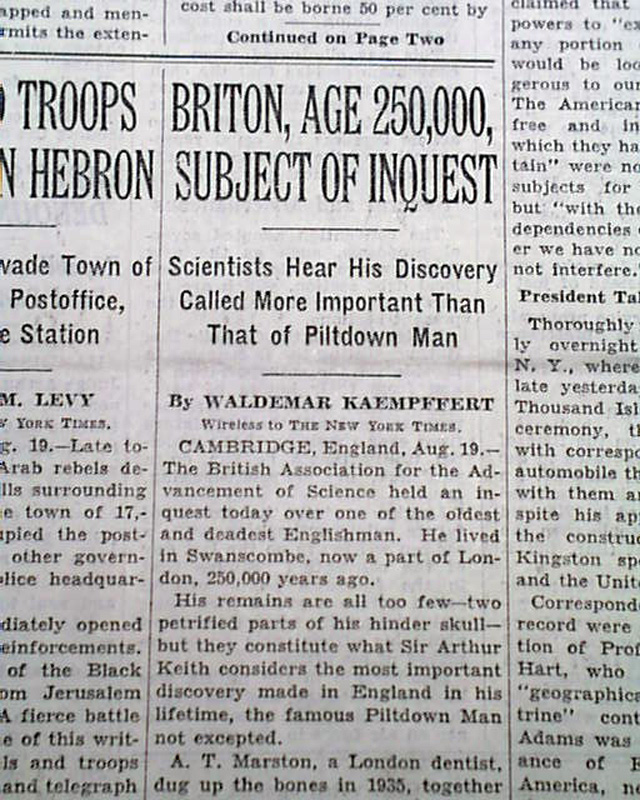
Discovery of the "Swanscombe Skull"...

Discovery of the "Swanscombe Skull"...
Item # 723022
August 20, 1938
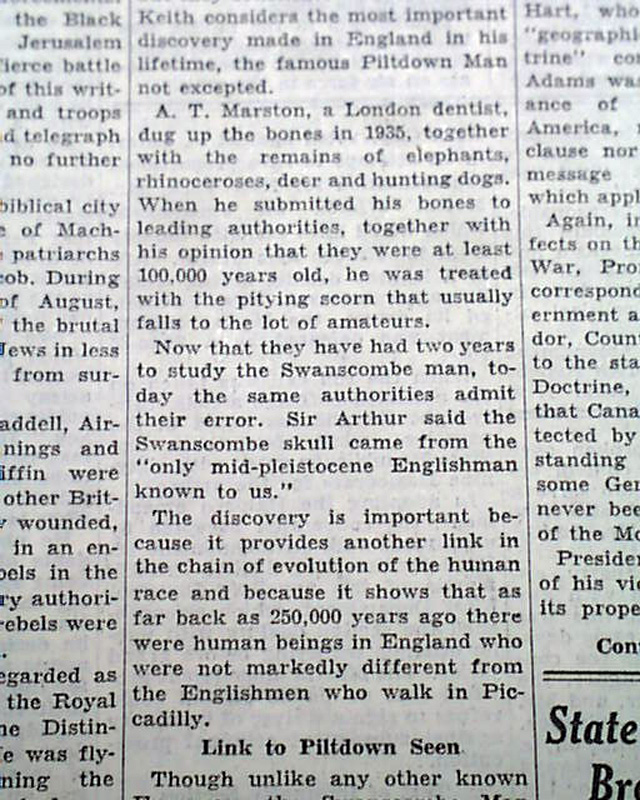
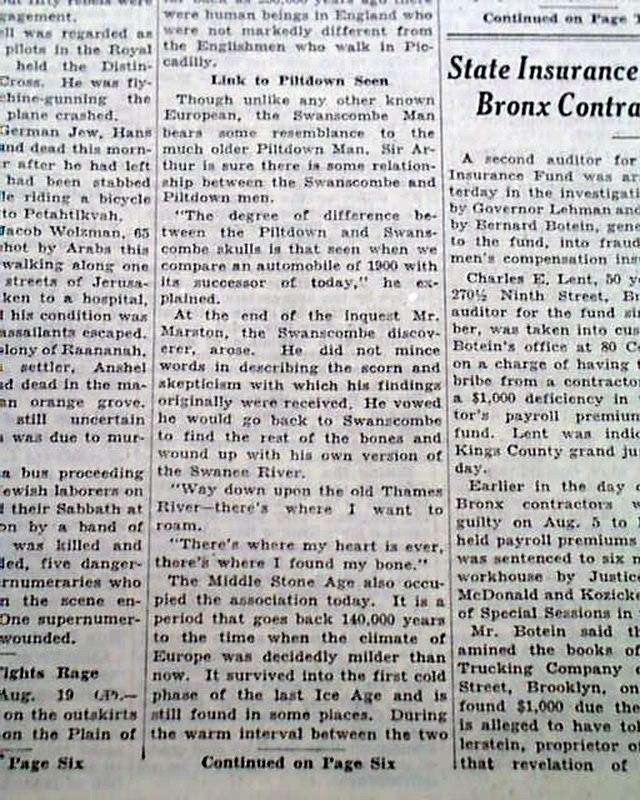
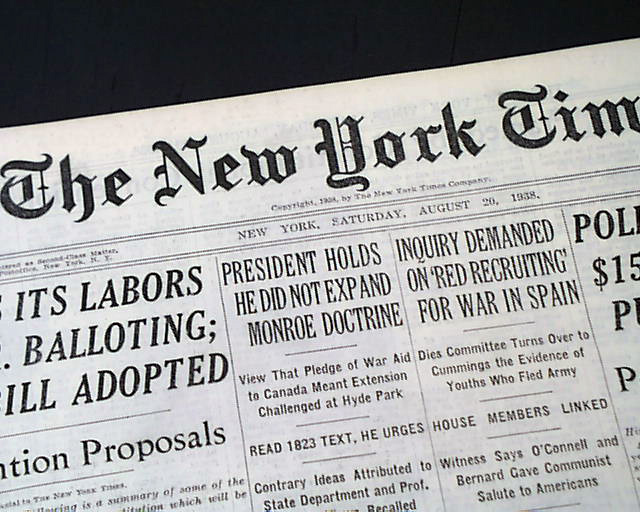
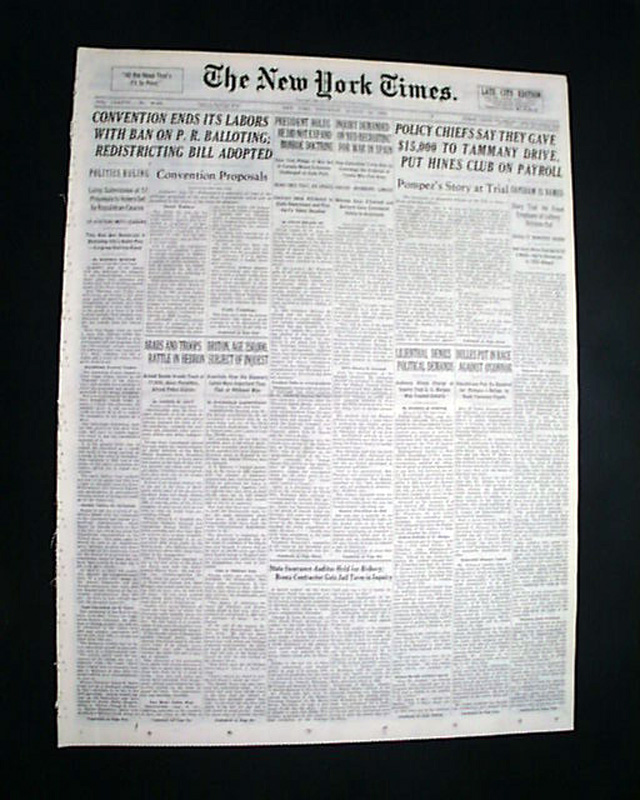
THE NEW YORK TIMES, Aug. 20, 1938
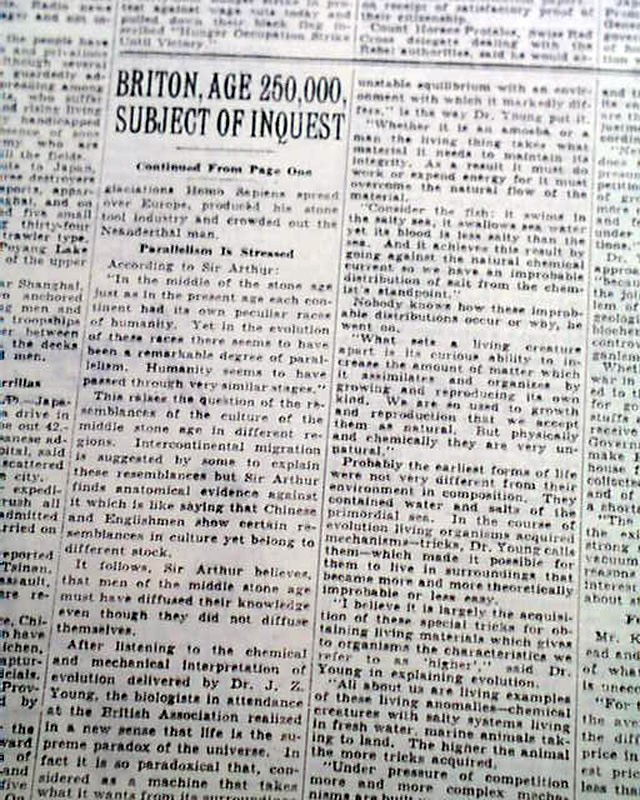
* Discovery of the "Swanscombe Skull" announced
* Found at Barnfield Pit, Swanscombe, Kent England
* Dentist and amateur archaeologist A.T. Marston
The front page has a one column heading: "BRITON, AGE 250,000, SUBJECT OF INQUEST" with subhead. (see images) This famous discovery was actually made a few years earlier but wasn't made public until the day prior of this issue being published.
Complete with 30 pages, rage edition in great condition.
AI notes: The Swanscombe Skull, discovered by A.T. Marston in 1935–1936 at the Barnfield Pit in Swanscombe, Kent, England, is one of Britain’s most important early human fossils. Marston, a dentist and amateur prehistorian, first found a fragment of the occipital bone on June 29, 1935, and later a matching left parietal fragment on March 15, 1936, which together formed part of a skull now dated to roughly 400,000 years ago, during the Middle Pleistocene. A third fragment, discovered in 1955, completed the fossil. The Swanscombe Skull exhibits a combination of archaic and proto-Neanderthal traits and is usually classified as Homo heidelbergensis, representing an early European human population. Marston’s careful excavation and anatomical expertise ensured the find’s scientific reliability, contrasting sharply with the earlier, fraudulent Piltdown Man, and his work contributed broadly to the understanding of human evolution in northern Europe, including early tool use and adaptations to colder climates.
Category: The 20th Century
Available Now
$52.00