Home >
Formalizing the boundary between the United States and the Republic of Texas...


Formalizing the boundary between the United States and the Republic of Texas...
Item # 708192
Currently Unavailable. Contact us if you would like to be placed on a want list or to be notified if a similar item is available.
May 20, 1839
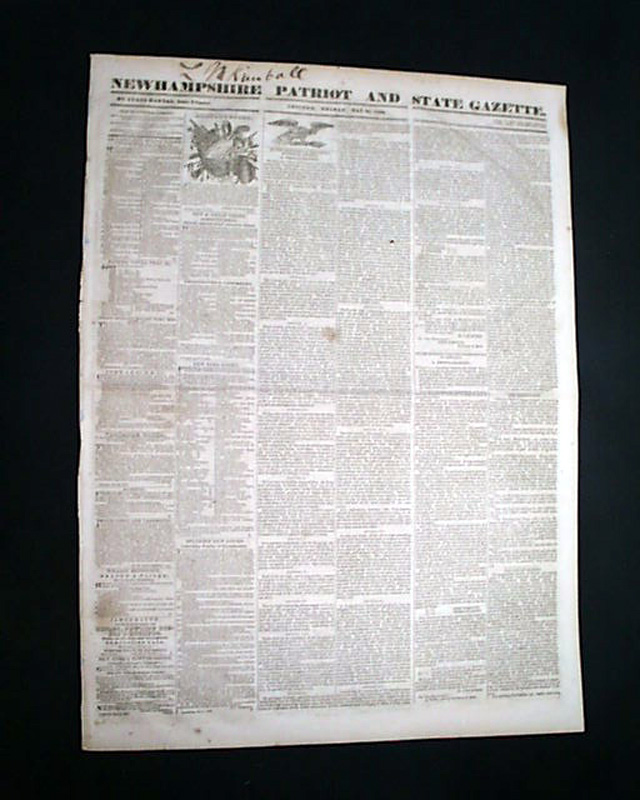
NEW HAMPSHIRE PATRIOT & STATE GAZETTE, Concord, May 20, 1839
* Formal Recognition of Sovereignty
* Van Buren’s "Good Faith" Warning
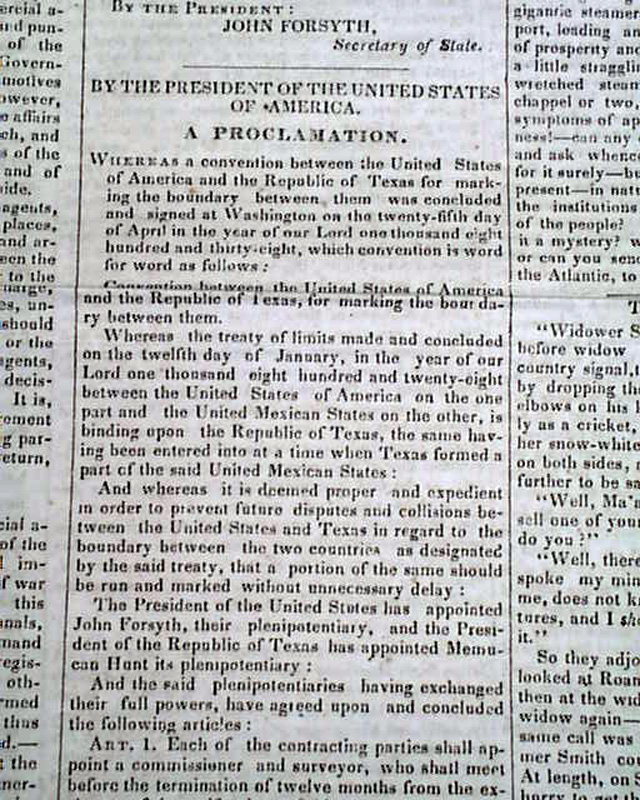
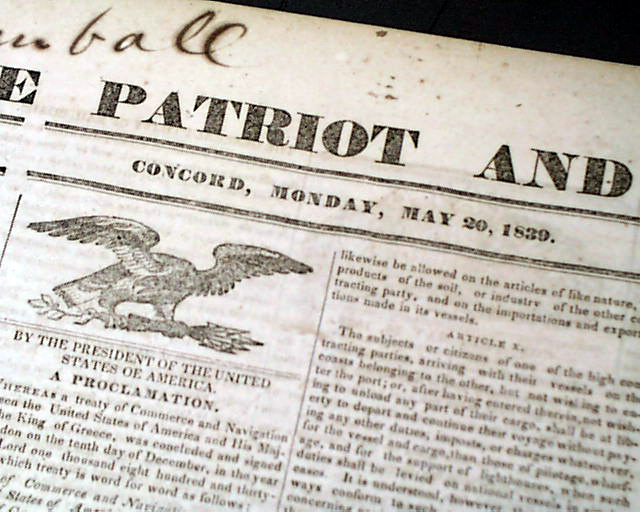
The front page has: "By the President of the United States of America - A PROCLAMATION" with ther preamble noting: "Whereas a convention between the United States of America and the Republic of Texas for marking the boundary between them was concluded & signed at Washington on the 25th day of April, 1838, which convention is word for word as follows:..." and what follows are the details of the boundary and the legal aspects of it with 3 Articles, followed by the text noting the President: "...have caused the said Convention to be made public...may be observed & fulfilled with good faith by the United States and the citizens thereof." It is signed by the President in type: M. Van Buren.
Keep in mind that Texas was an independent republic from 1836 thru 1846. Great to have this report not only on the front page, but in this newspaper which was the mouthpiece of the federal government.
Four pages, some archival strengthening at the blank spine, very nice condition.
background: This proclamation, issued during the pivotal administration of Martin Van Buren, represents a formal diplomatic milestone that solidified the Republic of Texas's status as a sovereign entity in the eyes of the United States. By codifying the 1838 Boundary Convention on the front page of a Democratic mouthpiece like the New Hampshire Patriot, the federal government was signaling its intent to treat Texas not as a rebellious province of Mexico, but as a legitimate neighbor requiring a surveyed and respected border. The focus on the Sabine River and the Red River within the three Articles was more than just a cartographic exercise; it was an attempt to mitigate the chaos of "filibustering" and westward encroachment by American settlers. For Van Buren, who was deeply wary of the sectional strife that the annexation of a new slave-holding territory would trigger, this public declaration was a way to maintain the international status quo—acknowledging Texas's existence while keeping it at arm's length as a foreign power rather than a prospective state.
Category: Pre-Civil War
No Longer Available