Home > Back to Search Results >
The battle for Charleston...
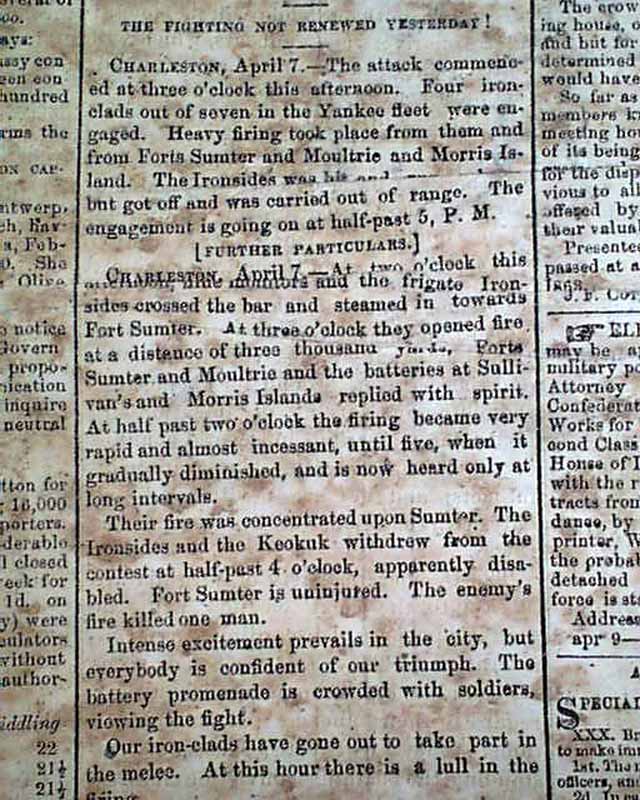
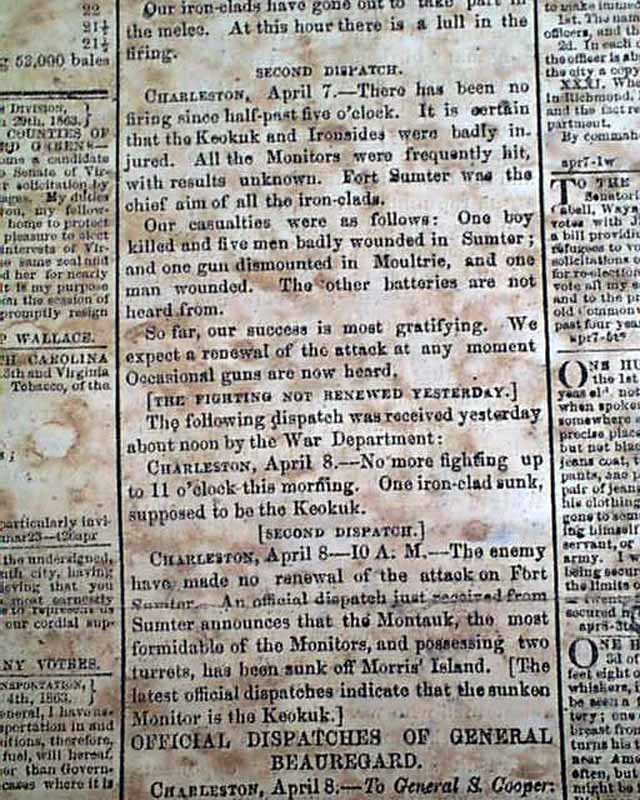
The battle for Charleston...
Item # 707365
April 09, 1863
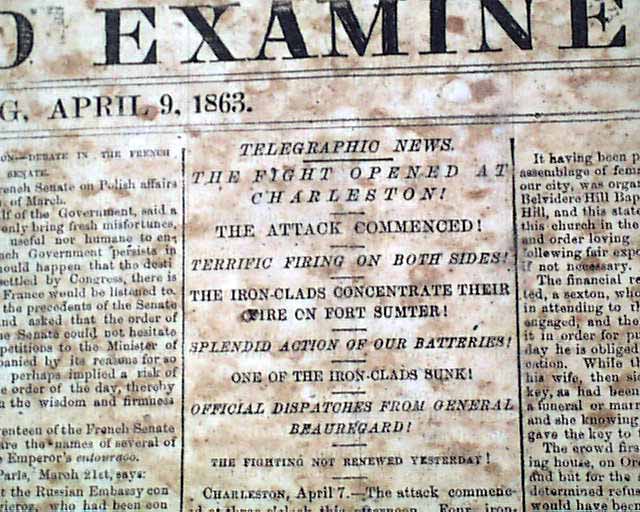
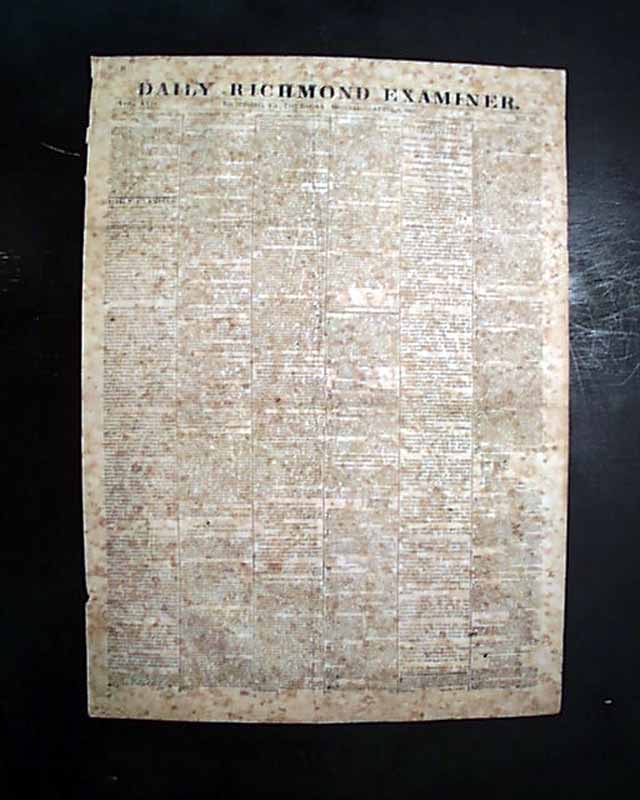
DAILY RICHMOND EXAMINER, Virginia, April 9, 1863
* Rebel General P.G.T. Beauregard defense
* Naval attack on Charleston, South Carolina
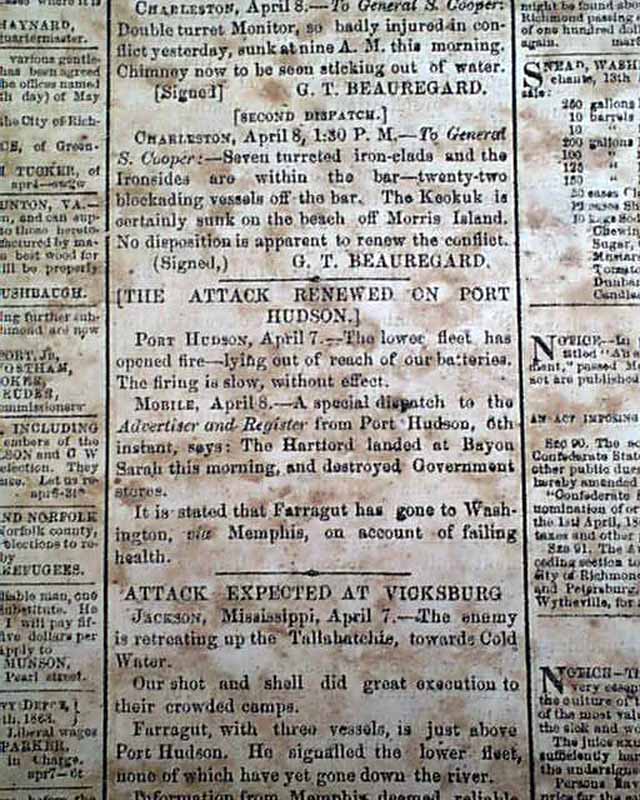
The front page includes: "The Situation In The West" "The Parole of Federal Prisoners" "Latest From the North" "The Fight Opened at Charleston!" "The Attack Commenced!" "Terrific Firing on Both Sides!" "Official Dispatches from General Beauregard!" with two of them, each signed in type: G. T. Beauregard.
The back page begins with a lengthy editorial concerning the beginning of the battle for Charleston. One bit notes: "...Certainly we have a right to believe that the long prepared attack o the famous city has proven a grand failure...". Also much from the "Confederate Congress".
A single sheet issue with a full banner masthead, spotted foxing throughout, good condition.
background: General P.G.T. Beauregard’s defense of Charleston in 1863 was a masterclass in asymmetric coastal engineering that neutralized the Union's superior naval technology through a strategy of defense-in-depth. Leveraging his background as a trained engineer, Beauregard transformed the harbor into a lethal "Circle of Fire" by coordinating masonry forts like Sumter and Moultrie with mobile inner batteries and innovative harbor obstructions. When Rear Admiral Samuel Du Pont’s fleet of "invincible" ironclads attacked on April 7, Beauregard’s pre-ranged artillery fire was so precise that it crippled the Union flagship and forced a full retreat within hours. Even as Union General Quincy Adams Gillmore's massive Parrott rifles reduced Fort Sumter to a pile of rubble later that year, Beauregard realized the debris provided better protection than the original brick, allowing his garrison to hold the ruins. By integrating early submarine warfare, naval mines (torpedoes), and the iron-willed defense of Battery Wagner on Morris Island, Beauregard ensured that Charleston remained a Confederate stronghold, proving that a technically savvy defender could hold a gateway to the South even when facing the world's most modern navy.
Category: Confederate
Available Now
$71.00