Home >
The Battle of Sugar Point...
The Battle of Sugar Point...
Item # 705882
October 06, 1898
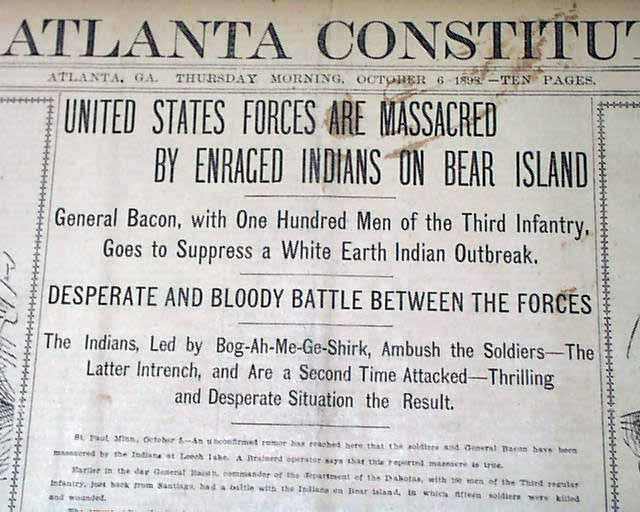
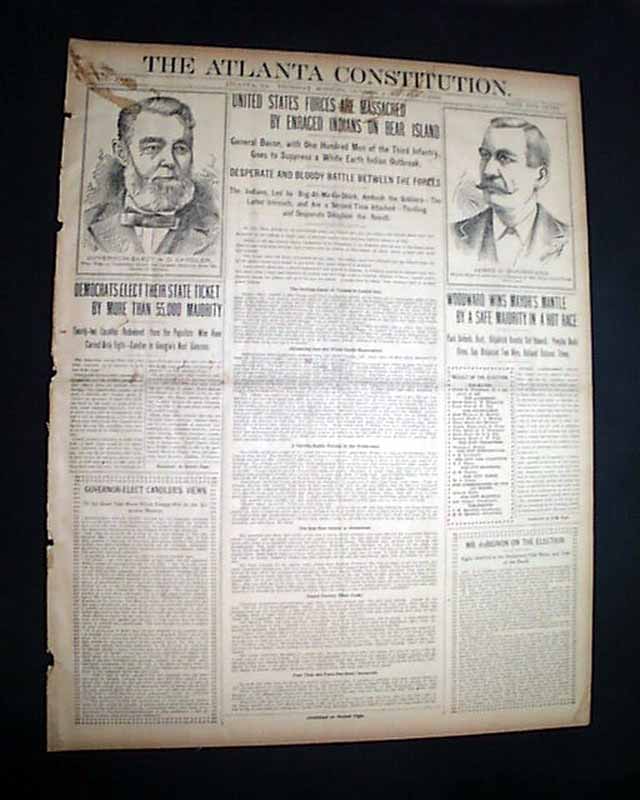
THE ATLANTA CONSTITUTION, Georgia, Oct. 6, 1898
* Battle of Sugar Point - Leech Lake - Minnesota
* Pillager Band of Chippewa Indians - Bugonaygeshig
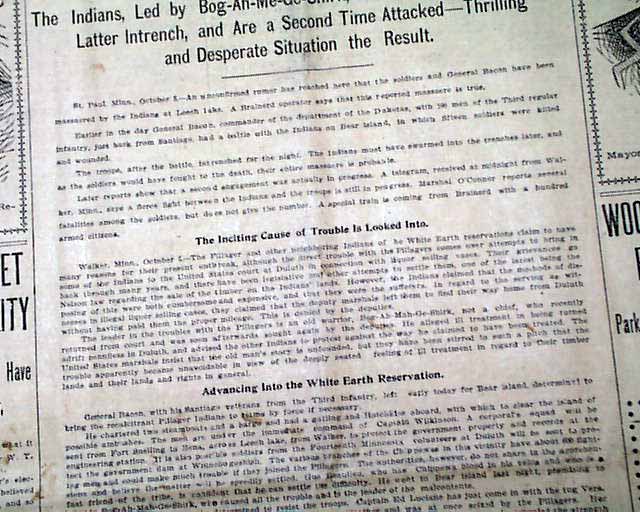
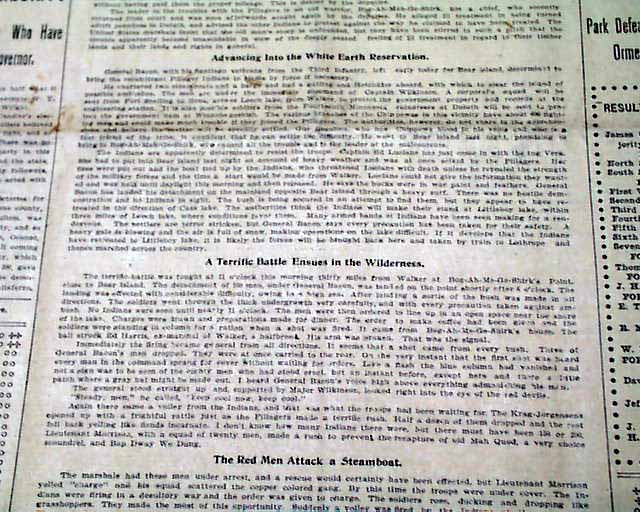
The front page is dominated by much reporting on the Battle of Sugar Point, with heads: "UNITED STATES FORCES ARE MASSACRED BY ENRAGED INDIANS ON BEAR ISLAND" "General Bacon, with 100 Men.l..Goes to Supress a White Earth Indian Outbreak" "Desperate & Bloody Battle Between the Forces" "The Indians...Ambush the Soldiers...Thrilling & Desperate Situation the Result".
This battle, also known as the Battle of Leech Lake, was fought on October 5, 1898 between the 3rd U.S. Infantry and members of the Pillager Band of Chippewa Indians in a failed attempt to apprehend Pillager Ojibwe Bugonaygeshig ("Old Bug" or "Hole-In-The-Day"), as the result of a dispute with Indian Service officials on the Leech Lake Reservation in Cass County, Minnesota.
Often referred to as "the last Indian Uprising in the United States", the engagement was also the first battle to be fought in the area of the United States known as the Old Northwest since the Black Hawk War in 1832.
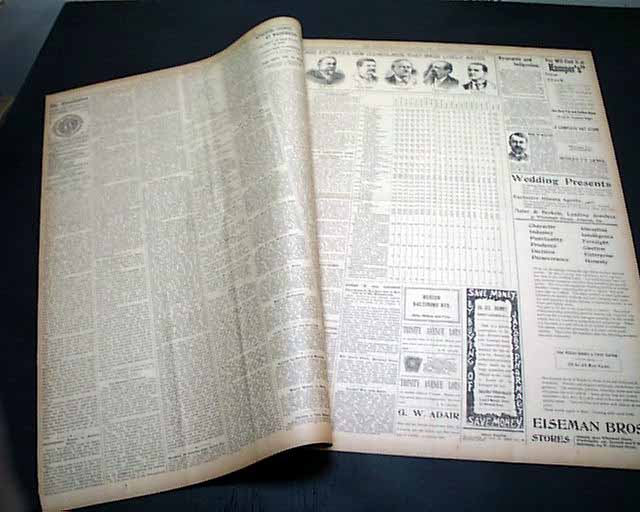
Complete in 10 pages, minor binding indents at the blank spine, partially loose at the spine, a few stains to the front page, good condition.
background: The Battle of Sugar Point, fought on October 5, 1898, near Leech Lake, Minnesota, was a brief but significant clash between the U.S. Army and members of the Ojibwe (Chippewa) tribe, often called the last Indian “battle” in the state. The conflict began when federal authorities attempted to arrest Bugonaygeshig, a respected Ojibwe leader, for alleged violations of federal law concerning firearms. As soldiers approached the village, they were ambushed by Ojibwe warriors using the dense forests and rugged lakeshore to their advantage, resulting in one soldier killed and several wounded, while Ojibwe casualties were minimal. The skirmish quickly escalated tension in the region, prompting reinforcements, but the confrontation ended without further bloodshed through negotiations, with the Ojibwe agreeing to release prisoners and comply with federal regulations. The battle highlighted resistance to U.S. authority, tensions over treaty rights, and the assertion of Ojibwe sovereignty, marking a symbolic close to armed Native American conflict in northern Minnesota.
background: The Battle of Sugar Point, fought on October 5, 1898, near Leech Lake, Minnesota, was a brief but significant clash between the U.S. Army and members of the Ojibwe (Chippewa) tribe, often called the last Indian “battle” in the state. The conflict began when federal authorities attempted to arrest Bugonaygeshig, a respected Ojibwe leader, for alleged violations of federal law concerning firearms. As soldiers approached the village, they were ambushed by Ojibwe warriors using the dense forests and rugged lakeshore to their advantage, resulting in one soldier killed and several wounded, while Ojibwe casualties were minimal. The skirmish quickly escalated tension in the region, prompting reinforcements, but the confrontation ended without further bloodshed through negotiations, with the Ojibwe agreeing to release prisoners and comply with federal regulations. The battle highlighted resistance to U.S. authority, tensions over treaty rights, and the assertion of Ojibwe sovereignty, marking a symbolic close to armed Native American conflict in northern Minnesota.
Category: Post-Civil War
Available Now
$48.00