



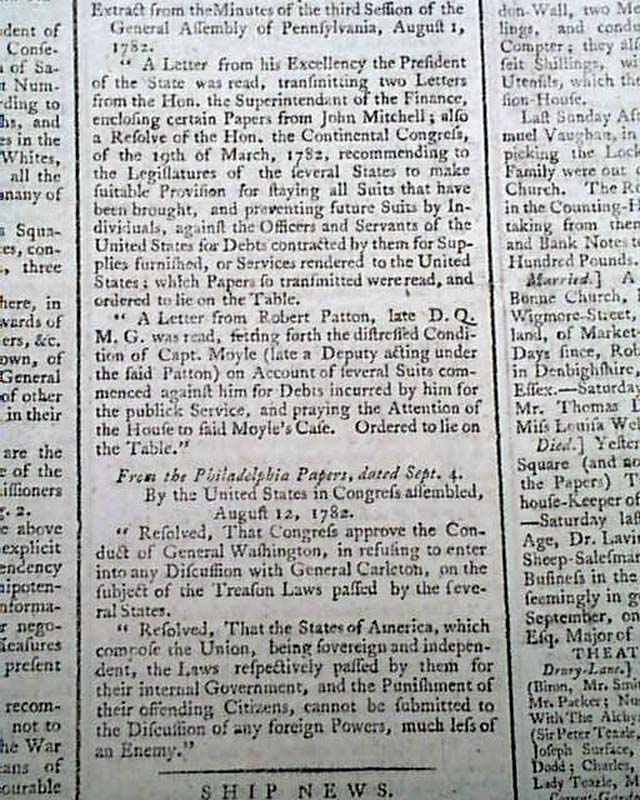


Congress approves the conduct of General Washington...
Item # 681285
October 22, 1782
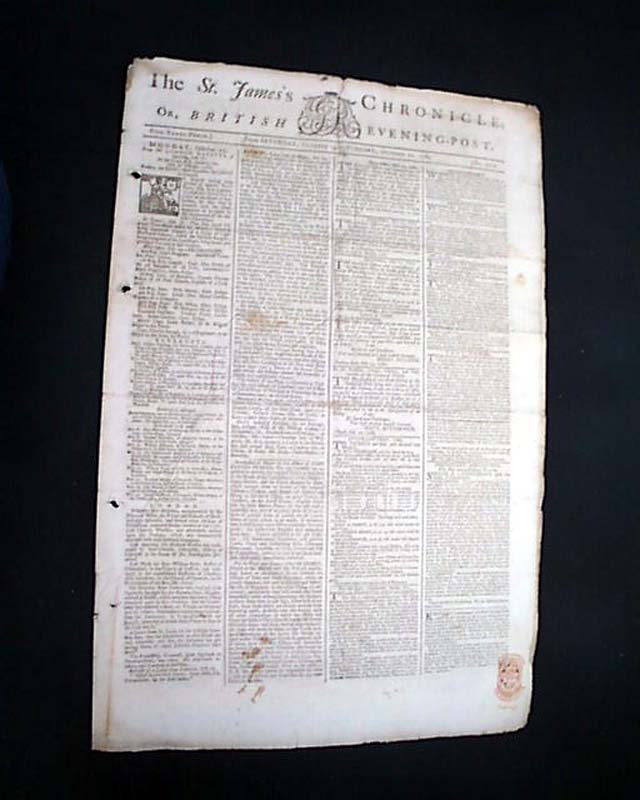
THE ST. JAMES'S CHRONICLE, London, Oct. 22, 1782
* American Revolutionary ending events
* George Washington & Sir Guy Carleton
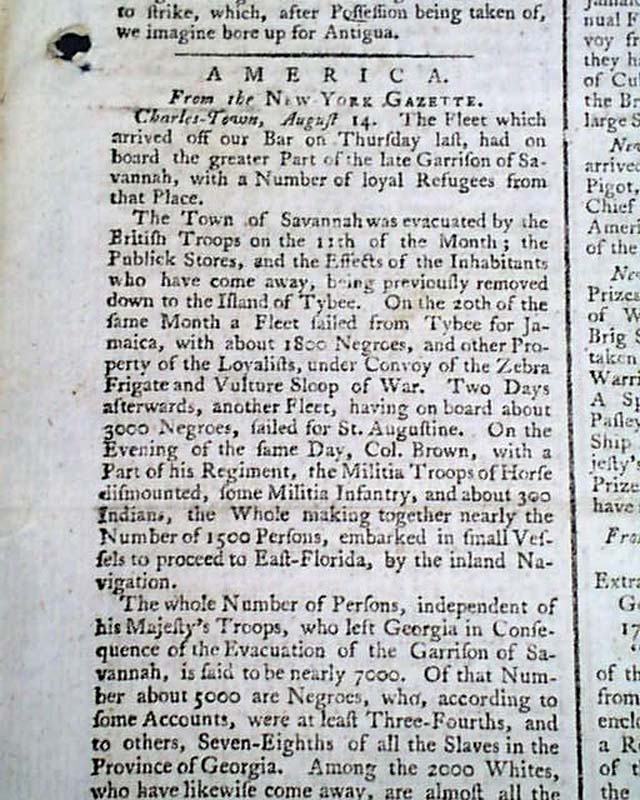
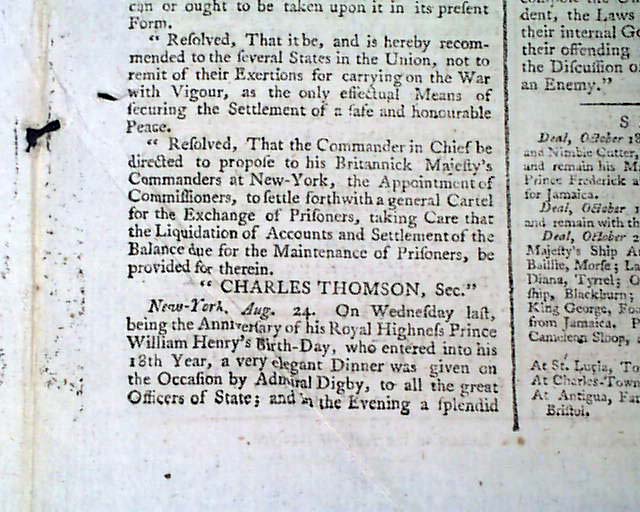
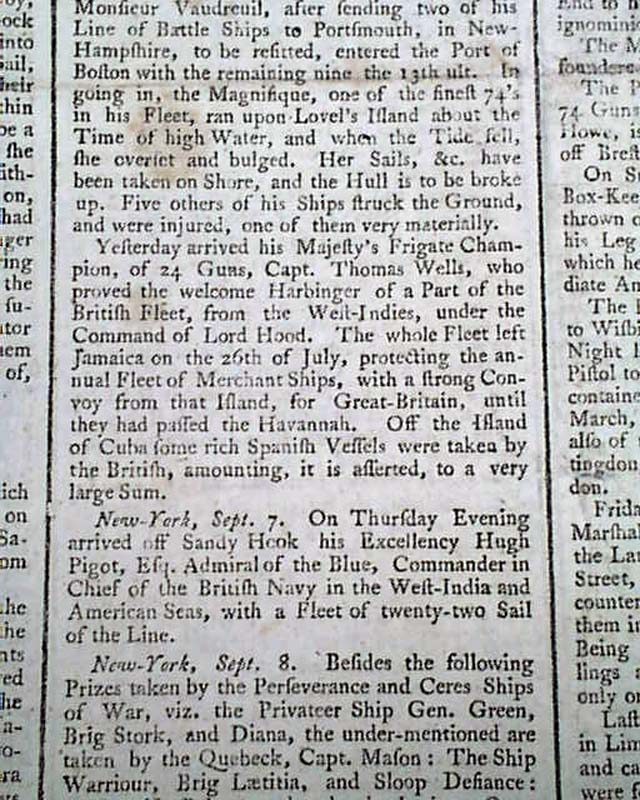
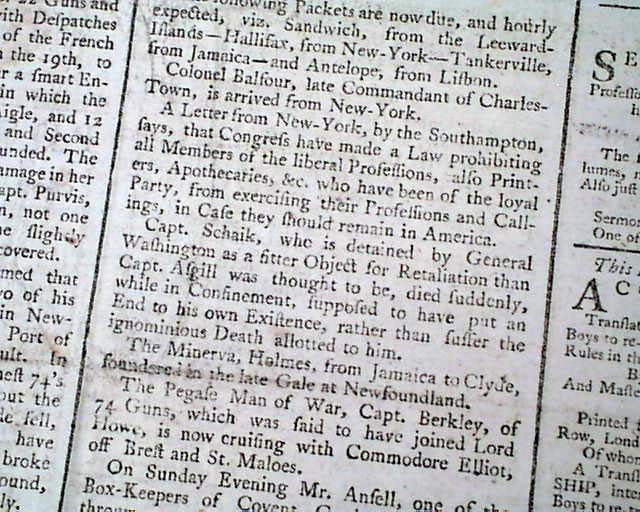
Page 3 has most of a column taken up with various reports from America, including four naval items datelined from New York. Also extracts from the Penna. Assembly, as well as a report from the U.S. Congress noting: "Resolved, that Congress approve the conduct of General Washington in refusing to enter into any discussion with General Carleton on the subject of the treason laws passed by the several states..." with more.
Also a brief note that: "Capt. Schaik, who is detained by General Washington as a fitter object for retaliation than Capt. Asgill was thought to be, died suddenly while in confinement, supposed to have put an end to his own existence rather than suffer the ignominious death allotted to him."
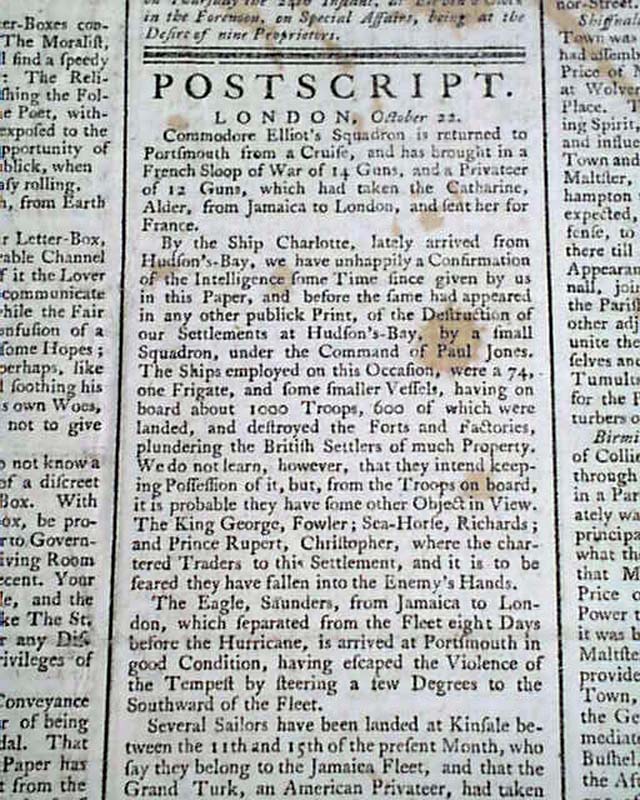
The back page has a brief mention of John Paul Jones: "...unhappily a confirmation of the intelligence...of the destruction of our settlements at Hudson's Bay by a small squadron, under the command of Paul Jones...".
Four pages, never bound nor trimmed, red tax stamp on the front page, some foxing, good condition.
AI notes: In late 1778 and early 1779, Congress repeatedly reviewed and ultimately approved George Washington’s conduct in handling British accusations of American “treason” and the related controversy involving Sir Guy Carleton (then Governor of Quebec and a senior British commander). The issue grew out of British claims—circulated through Carleton and other officials—that Americans who had once been under British rule but joined the patriot cause were technically traitors to the Crown and could be executed if captured. Washington forcefully rejected this doctrine, insisting that American soldiers and supporters were lawful combatants of an independent nation and must be treated as prisoners of war. When Carleton’s correspondence and British proclamations threatened harsh treatment of captured Americans, Washington responded with firm, measured letters stressing reciprocity and warning that any execution of Americans as “traitors” would be met in kind. Congress reviewed this exchange and, in resolutions in 1779, fully endorsed Washington’s stance—commending the “propriety and spirit” of his letters, affirming that no American would be surrendered or recognized as a British subject, and authorizing Washington to maintain a strict policy of retaliation if the British attempted punitive executions. This approval strengthened Washington’s hand and helped ensure that British commanders—including Carleton—did not proceed with treason-based executions of American prisoners.
* American Revolutionary ending events
* George Washington & Sir Guy Carleton
Page 3 has most of a column taken up with various reports from America, including four naval items datelined from New York. Also extracts from the Penna. Assembly, as well as a report from the U.S. Congress noting: "Resolved, that Congress approve the conduct of General Washington in refusing to enter into any discussion with General Carleton on the subject of the treason laws passed by the several states..." with more.
Also a brief note that: "Capt. Schaik, who is detained by General Washington as a fitter object for retaliation than Capt. Asgill was thought to be, died suddenly while in confinement, supposed to have put an end to his own existence rather than suffer the ignominious death allotted to him."
The back page has a brief mention of John Paul Jones: "...unhappily a confirmation of the intelligence...of the destruction of our settlements at Hudson's Bay by a small squadron, under the command of Paul Jones...".
Four pages, never bound nor trimmed, red tax stamp on the front page, some foxing, good condition.
AI notes: In late 1778 and early 1779, Congress repeatedly reviewed and ultimately approved George Washington’s conduct in handling British accusations of American “treason” and the related controversy involving Sir Guy Carleton (then Governor of Quebec and a senior British commander). The issue grew out of British claims—circulated through Carleton and other officials—that Americans who had once been under British rule but joined the patriot cause were technically traitors to the Crown and could be executed if captured. Washington forcefully rejected this doctrine, insisting that American soldiers and supporters were lawful combatants of an independent nation and must be treated as prisoners of war. When Carleton’s correspondence and British proclamations threatened harsh treatment of captured Americans, Washington responded with firm, measured letters stressing reciprocity and warning that any execution of Americans as “traitors” would be met in kind. Congress reviewed this exchange and, in resolutions in 1779, fully endorsed Washington’s stance—commending the “propriety and spirit” of his letters, affirming that no American would be surrendered or recognized as a British subject, and authorizing Washington to maintain a strict policy of retaliation if the British attempted punitive executions. This approval strengthened Washington’s hand and helped ensure that British commanders—including Carleton—did not proceed with treason-based executions of American prisoners.
Category: Revolutionary War


