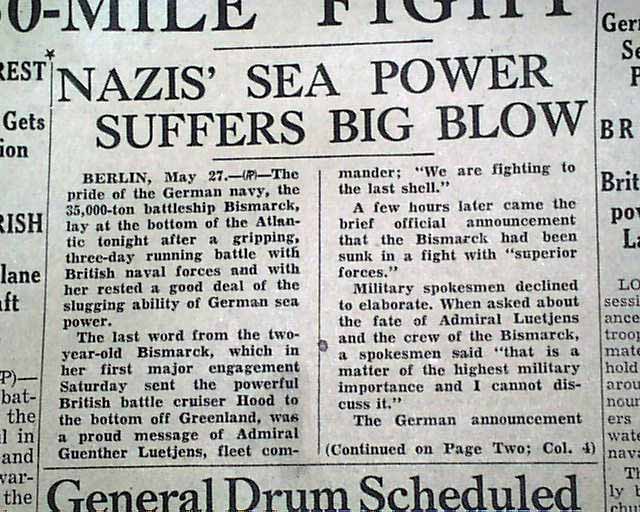
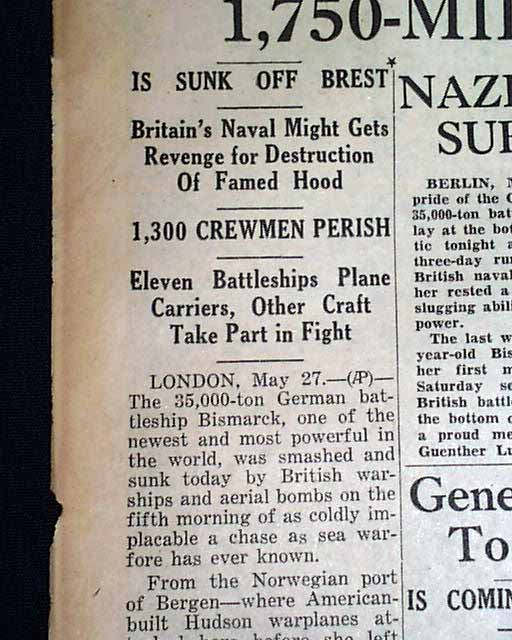
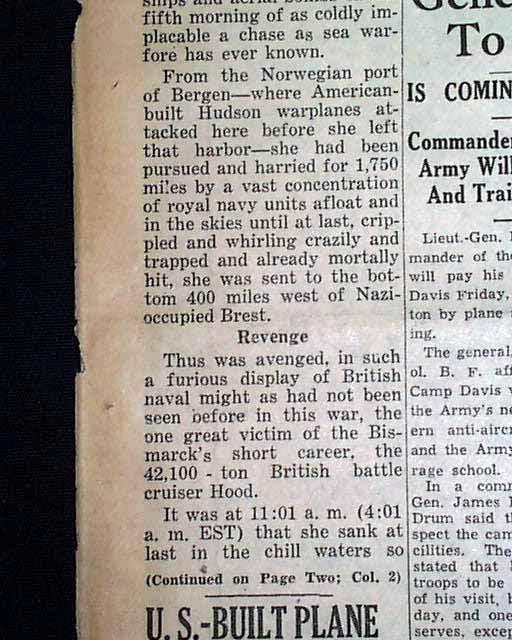
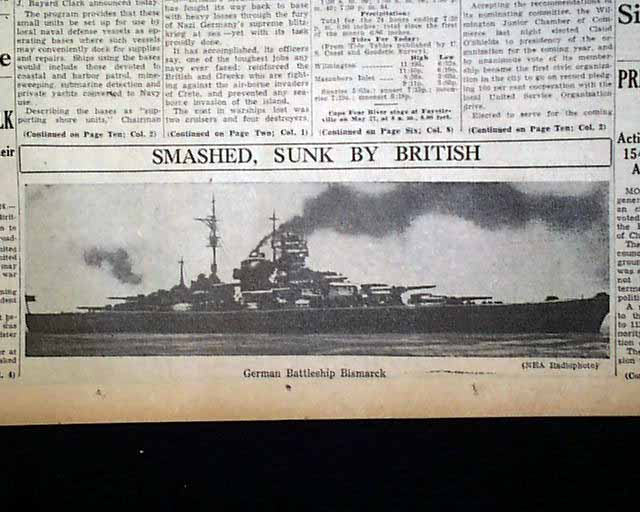
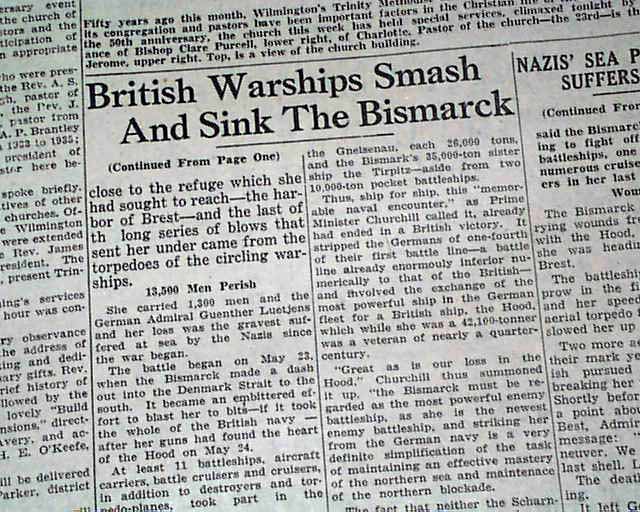

German Battleship Bismarck sunk.....
Item # 539109
Currently Unavailable. Contact us if you would like to be placed on a want list or to be notified if a similar item is available.
* German Battleship Bismarck sunk
* 1st report
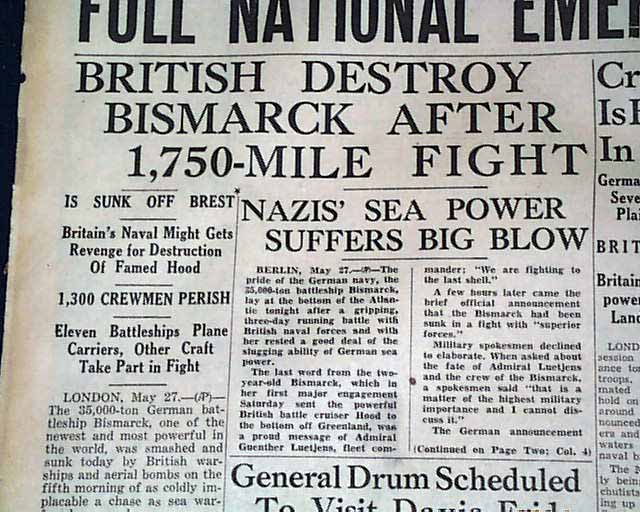
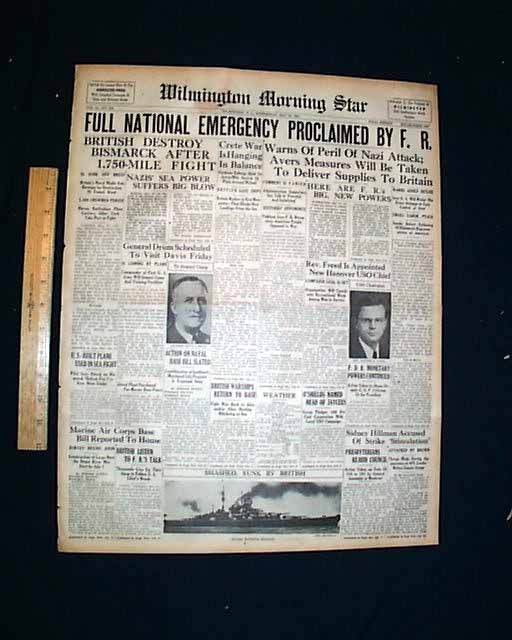
This 10 page newspaper has a three line, three column headline on the front page: "BRITISH DESTROY BISMARCK AFTER 1,750-MILE FIGHT" with subheads that include: "Is Sunk Off Brest" "1,300 Crewmen Perish" and more..
Other news of the day including much on the war. Light browning at the margins with minor wear, otherwise in good condition.
source: wikipedia: Determined to avenge the sinking of Hood, the British committed every possible unit to hunting down Bismarck. During the early evening of 24 May an attack was made by a small group of Swordfish biplane torpedo planes from No. 825 Naval Air Squadron of the aircraft carrierVictorious. One hit was scored resulting in a single fatality (Bismarck's first); however, the blast caused only superficial damage to Bismarcks armoured belt.
For some time Bismarck remained under long-distance observation by the British. At about 03.00 on 25 May, the ship took advantage of her opponents' zig-zagging and performed an almost three-quarter clockwise turn behind her pursuers to escape towards the east and then south-east. Contact was lost for four hours; however, perhaps in awe of British radar capabilities, it appears that the Germans did not realize their good fortune. For reasons still unclear, Ltjens transmitted a half-hour radio message to HQ, which was intercepted thereby giving the British time to work out roughly where he was heading. However, a plotting error made onboard King George V, now in pursuit of the Germans, incorrectly calculated Bismarcks position and caused the chase to veer too far north. Bismarck was therefore able to make good time on 25 May/26 May in her unhindered passage towards France and protective air cover and destroyer escort. By now, though, fuel was becoming a major concern to both sides.
The British had a stroke of luck on 26 May. In mid-morning a Royal Air ForceCoastal CommandCatalina reconnaissance aircraft from 209 Squadron, which had flown over the Atlantic from its base on Lough Erne in Northern Ireland across Donegal through a small corridor secretly provided by the ire government [2], spotted Bismarck (via her oil-slick) and reported her position to the Admiralty. From then on, the German ship's position was known to the British, although the enemy would have to be slowed significantly if heavy units hoped to engage it out of range of German aircraft protection. All British hopes were now pinned on Force H, whose main units were the aircraft-carrier Ark Royal, the old battlecruiser Renown and the cruiser Sheffield. This battle-group, commanded by Admiral James Somerville, had been diverted north from Gibraltar.
At dusk that evening, and in atrocious weather conditions, Swordfish from Ark Royal launched an attack. The first wave mistakenly targeted the Sheffield that was by now shadowing the quarry. Although precious time was lost by this incident, it proved beneficial to the British in that the magnetic detonators on the torpedoes used against Sheffield were seen to be defective and for the following attack on Bismarck were replaced by those designed to explode on contact. In a final attack, almost in darkness at around 21.00, a "miracle" hit by a single torpedo (launched by pilot John Moffat's plane) jammed Bismarck's rudder and steering gear. This rendered her virtually unmanoeuvrable, able only to steam in a large circle in the general direction of King George V and Rodney, two frontline battleships that had been pursuing Bismarck from the west. The largest and most powerful warship yet commissioned had now been rendered a sitting-duck by a single aircraft. After extensive efforts to free the jammed rudders, the fleet command finally acknowledged their by-now impossible position in several messages to naval headquarters. Ltjens promised that the ship would fight until its last shell was spent.
Throughout that night, Bismarck was the target of incessant torpedo attacks by the Tribal-class destroyersCossack, Sikh, Maori and Zulu, with the Polish Piorun. Neither side scored a hit but the constant worrying tactics of the British helped wear down the morale of the Germans and deepened the fatigue of an already exhausted crew.
edit]
[ Sinking
On the morning of Tuesday 27 May1941Rodney and King George V drew closer to Bismarck, with their enemy well illuminated by the morning sun in the background. Rodney steered to the north so that her gunfire would work the length of Bismarck, while King George V took the side. They opened fire just before 0900. Bismarck returned fire, but her inability to steer and her list to port severely affected her shooting capacity. Her low speed of seven knots also made her an easy target and she was soon hit several times, with heavy cruisers Norfolk and Dorsetshire adding their firepower. One salvo destroyed the forward control post, killing most of the senior officers. Within half an hour, Bismarck's guns were all but silent and she was even lower in the water. Rodney now closed to point blank range (approx 3 km) to strike the superstructure while King George V fired from further out.
Bismarck continued to fly its ensign. With no sign of surrender, despite the unequal struggle, the British were loath to leave the Bismarck. Their fuel and shell supplies were low - a demonstration of how difficult it was for a battleship to sink a similar unit in even an unbalanced engagement. However, when it became obvious that their enemy could not reach port, Rodney, King George V and the destroyers were sent home. Norfolk had used its last torpedoes, therefore Dorsetshire launched 3 21 in (533 mm) torpedoes which may have hit the Bismarck at comparatively short range. Although the battleship's upper works were almost completely destroyed, her engines were still functioning and the hull appeared to be relatively sound; therefore rather than risk her being captured, surviors have said the order to scuttle and then abandon ship was given. Many of the crew went into the water, but few sailors from the lower engine spaces got out alive. As Captain Lindemann was presumed killed with all officers after the bridge was hit by a 16 inch shell, it is unclear whether he could have given the order to scuttle. Some of the survivors, though, strongly believe they saw him going down alive with his ship.

Bismarck went under the waves at 10.39 hours that morning. Unaware of the fate of the ship, Group West, the German command base, continued to issue signals to Bismarck for some hours, until Reuters reported news from Britain that the ship had been sunk. In Britain, the House of Commons was informed of the sinking early that afternoon.
Dorsetshire and Maori stopped to rescue survivors but a U-boat alarm caused them to leave the scene after rescuing only 110 Bismarck sailors, abandoning the surviving crew in the water. The next morning U-74, dispatched to try to rescue Bismarck's log-book (and which had heard sinking noises from a distance), and the German weather ship Sachsenwald, picked up 5 survivors. In all, almost 2,100 German sailors had lost their lives.
After the sinking John Tovey said: "The Bismarck had put up a most gallant fight against impossible odds worthy of the old days of the Imperial German Navy, and she went down with her colours flying."
Category: The 20th Century
No Longer Available