

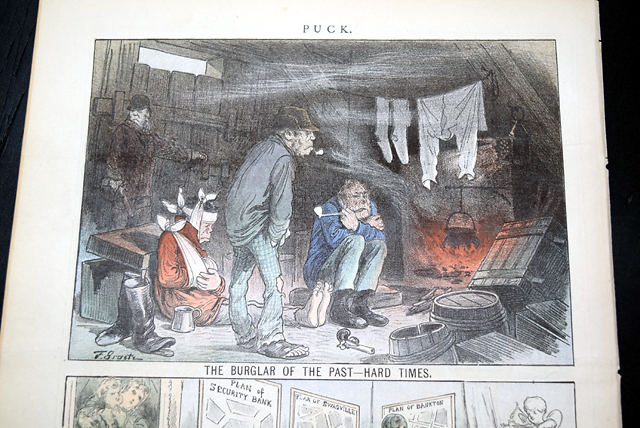
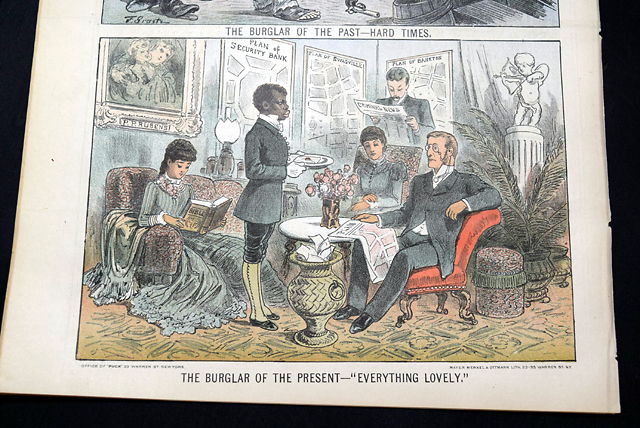
Wealth and greed portrayed...
Item # 727127
January 24, 1883
PUCK, New York, Jan. 24, 1883
* Color political prints
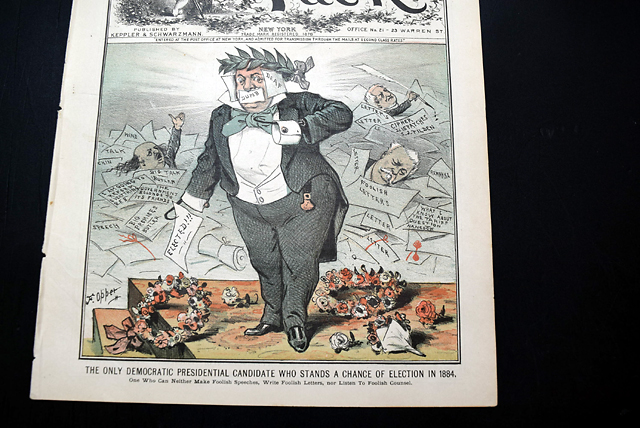
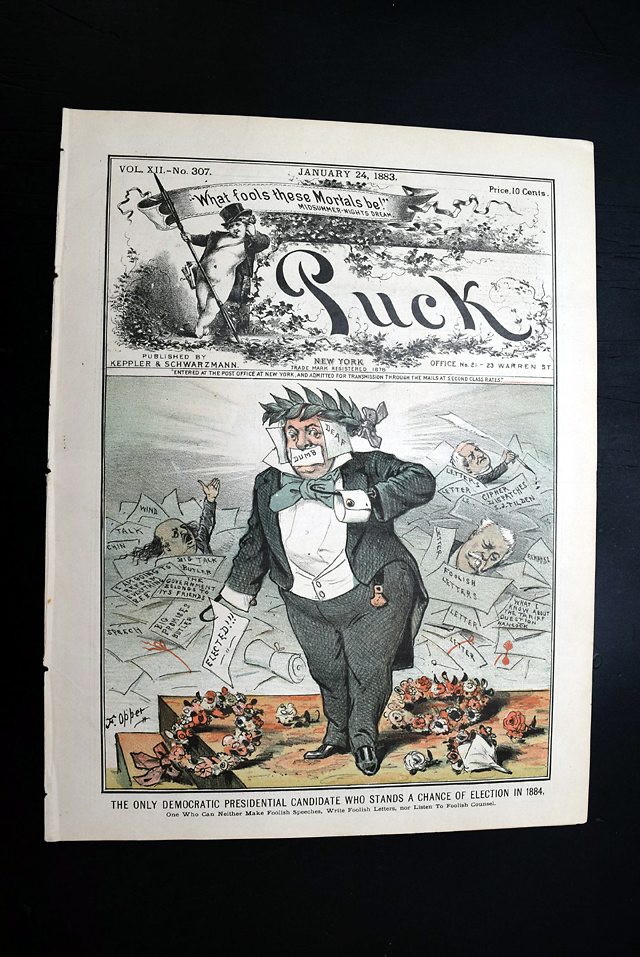
Puck was a highly influential illustrated satirical magazine, famous for pioneering colorful political cartoons and sharp commentary on American politics, religion, and society. Founded by Joseph Keppler, the magazine used humor and elaborate chromolithographs to criticize corruption, political machines, monopolies, and cultural controversies.
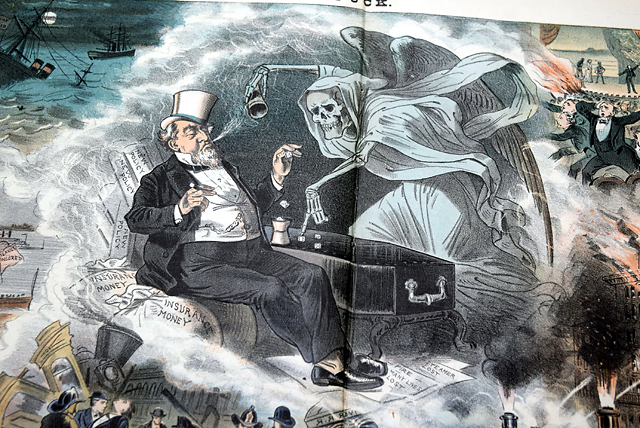
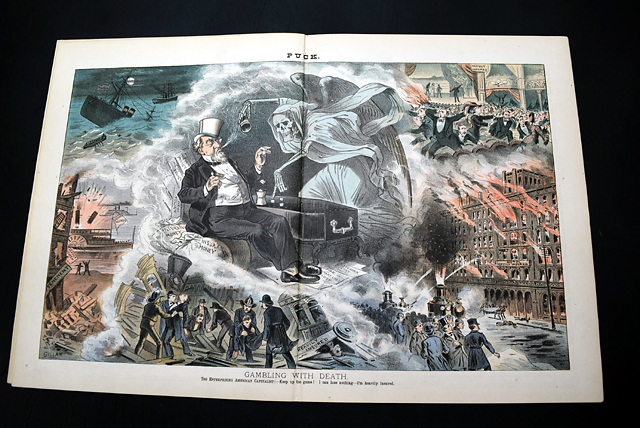
The key priunt is the doublepage centerfold cartoon “Gambling with Death,” which depicted a wealthy capitalist playing cards with Death while insured ships, railroads, factories, and buildings met with disaster around him. The image satirized the idea that excessive reliance on insurance could encourage reckless business practices by shielding owners from financial loss, reflecting broader Gilded Age concerns about corporate responsibility, industrial accidents, and speculative capitalism.
Sixteen pages, 10 by 13 1/2 inches with a color front page, back page, and doublepage centerfold. Very nice condition.
Background: This January 24, 1883 issue of Puck represents a pinnacle of Gilded Age political satire and 19th-century print media history, making it exceptionally rare and culturally significant due to both its contents and its pristine, uncut condition. Published during an era of rapid, unregulated industrial expansion, its famous double-page centerfold cartoon, "Gambling with Death," serves as a scathing historical critique of speculative capitalism and moral hazard; it vividly captures the societal outrage over wealthy tycoons who weaponized corporate insurance to shield themselves from financial loss while treating industrial disasters and worker lives as disposable assets. The publication itself is a landmark of American media, pioneering the use of vibrant, multi-color chromolithography to democratize political art. Because 19th-century magazines were printed on fragile newsprint and routinely dismantled by dealers who cut out the centerfolds for individual framing, finding a complete, 16-page issue with its front, back, and centerfold intact and in "very nice condition" is an extraordinary rarity for historians and paper ephemera collectors alike.
* Color political prints
Puck was a highly influential illustrated satirical magazine, famous for pioneering colorful political cartoons and sharp commentary on American politics, religion, and society. Founded by Joseph Keppler, the magazine used humor and elaborate chromolithographs to criticize corruption, political machines, monopolies, and cultural controversies.
The key priunt is the doublepage centerfold cartoon “Gambling with Death,” which depicted a wealthy capitalist playing cards with Death while insured ships, railroads, factories, and buildings met with disaster around him. The image satirized the idea that excessive reliance on insurance could encourage reckless business practices by shielding owners from financial loss, reflecting broader Gilded Age concerns about corporate responsibility, industrial accidents, and speculative capitalism.
Sixteen pages, 10 by 13 1/2 inches with a color front page, back page, and doublepage centerfold. Very nice condition.
Background: This January 24, 1883 issue of Puck represents a pinnacle of Gilded Age political satire and 19th-century print media history, making it exceptionally rare and culturally significant due to both its contents and its pristine, uncut condition. Published during an era of rapid, unregulated industrial expansion, its famous double-page centerfold cartoon, "Gambling with Death," serves as a scathing historical critique of speculative capitalism and moral hazard; it vividly captures the societal outrage over wealthy tycoons who weaponized corporate insurance to shield themselves from financial loss while treating industrial disasters and worker lives as disposable assets. The publication itself is a landmark of American media, pioneering the use of vibrant, multi-color chromolithography to democratize political art. Because 19th-century magazines were printed on fragile newsprint and routinely dismantled by dealers who cut out the centerfolds for individual framing, finding a complete, 16-page issue with its front, back, and centerfold intact and in "very nice condition" is an extraordinary rarity for historians and paper ephemera collectors alike.
Category: Post-Civil War


