Edgar Allan Poe Parents Theatre Ad In 1808...
Item # 726480
·
Sorry, but this item is no longer available. Please be in touch at info@rarenewspapers.com if you would like to be placed on a want list or are interested in a potential alternate issue.
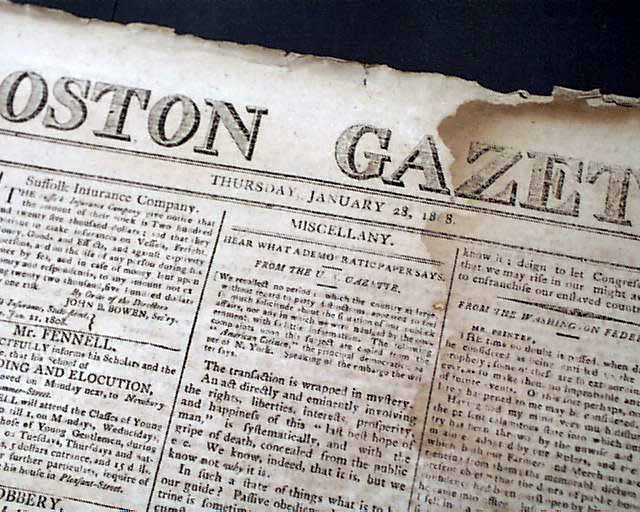
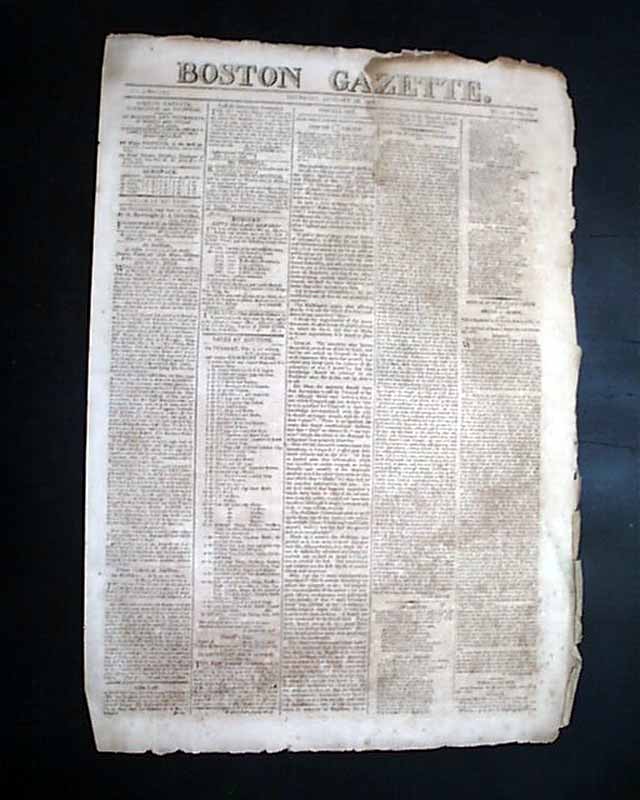
BOSTON GAZETTE, Jan. 28, 1808
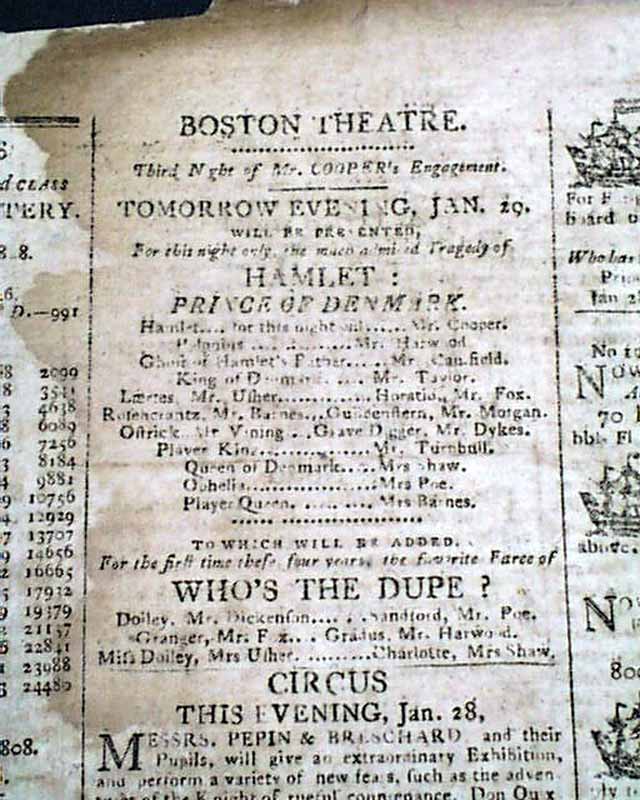
* Edgar Allan Poe's father & mother theater ad
* Advertisement for the showing of "Hamlet"
* Also one for "Who's The Dope ?"
* Eliza Arnold Hopkins Poe & David Poe Jr.
1808 On page 3 under "Boston Theatre" is a listing for a performance of "Hamlet" with Mrs. Poe as "Ophelia", plus one for a "Farce" called "Who's The Dupe?", with Mr. Poe as "Sandford". The parents of Edgar Allan Poe. (see image) Notice that the advertisement is lightly inked and somewhat hard to see.
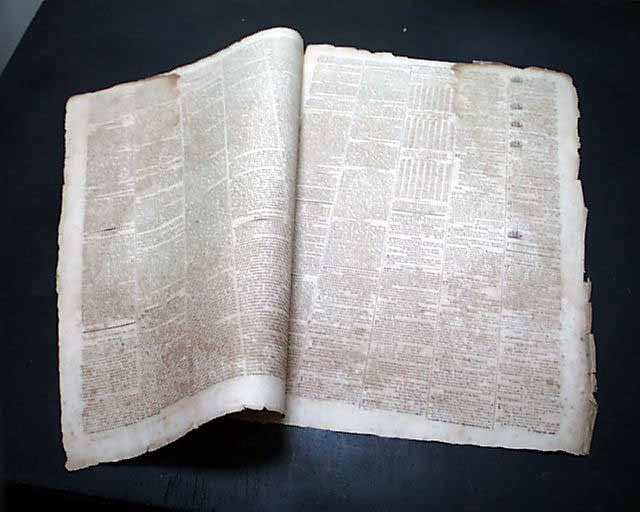
Complete with 4 pages, some light damp staining, generally good.
background: The performance on January 29, 1808, at Boston’s Federal Street Theatre serves as a profound historical prelude to the life of Edgar Allan Poe, capturing his parents at the height of their professional partnership just one year before his birth. The evening's playbill required an exhausting display of range from David Poe Jr. and Elizabeth Arnold Poe, who transitioned from the grim mortality of Shakespeare’s "Hamlet"—with Elizabeth as the tragic Ophelia and David as Laertes—to the spirited antics of Hannah Cowley’s farce, "Who’s the Dupe?", where David portrayed the clever Sandford. This event is historically significant not only for documenting the grueling "double-bill" nature of the early 19th-century American stage but also for highlighting the stark contrast in the couple's reputations: Elizabeth was the lauded star whose "sweetness" defined her roles, while David's performance as Sandford reflected his reliance on supporting "gentleman" roles to mask his struggles with leading tragic parts. Ultimately, this night crystallizes the atmosphere into which Edgar was born; he was the child of a wandering, "stage-struck" couple who inhabited a world of scripted ghosts and masquerades, a legacy of performance and precariousness that would deeply inform the haunting, theatrical nature of his own literary masterpieces.
* Edgar Allan Poe's father & mother theater ad
* Advertisement for the showing of "Hamlet"
* Also one for "Who's The Dope ?"
* Eliza Arnold Hopkins Poe & David Poe Jr.
1808 On page 3 under "Boston Theatre" is a listing for a performance of "Hamlet" with Mrs. Poe as "Ophelia", plus one for a "Farce" called "Who's The Dupe?", with Mr. Poe as "Sandford". The parents of Edgar Allan Poe. (see image) Notice that the advertisement is lightly inked and somewhat hard to see.
Complete with 4 pages, some light damp staining, generally good.
background: The performance on January 29, 1808, at Boston’s Federal Street Theatre serves as a profound historical prelude to the life of Edgar Allan Poe, capturing his parents at the height of their professional partnership just one year before his birth. The evening's playbill required an exhausting display of range from David Poe Jr. and Elizabeth Arnold Poe, who transitioned from the grim mortality of Shakespeare’s "Hamlet"—with Elizabeth as the tragic Ophelia and David as Laertes—to the spirited antics of Hannah Cowley’s farce, "Who’s the Dupe?", where David portrayed the clever Sandford. This event is historically significant not only for documenting the grueling "double-bill" nature of the early 19th-century American stage but also for highlighting the stark contrast in the couple's reputations: Elizabeth was the lauded star whose "sweetness" defined her roles, while David's performance as Sandford reflected his reliance on supporting "gentleman" roles to mask his struggles with leading tragic parts. Ultimately, this night crystallizes the atmosphere into which Edgar was born; he was the child of a wandering, "stage-struck" couple who inhabited a world of scripted ghosts and masquerades, a legacy of performance and precariousness that would deeply inform the haunting, theatrical nature of his own literary masterpieces.
Category: Pre-Civil War
No Longer Available
100% Authentic: Original printing, never a reproduction.
Other issues you may like
§ related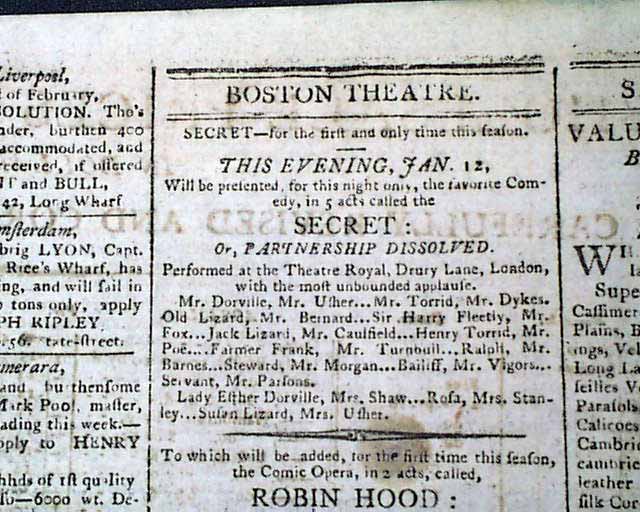
Edgar Allan Poe Parents Theatre Ad In 1806...
BOSTON GAZETTE, Jan. 12, 1807
* Edgar Allan Poe's father & mother theater ads
* "The Secret" and "Robin Hood" comedy plays
* Eliza Arnold Hopkins Poe & David...
* Edgar Allan Poe's father & mother theater ads
* "The Secret" and "Robin Hood" comedy plays
* Eliza Arnold Hopkins Poe & David...
Jan 1807
$52
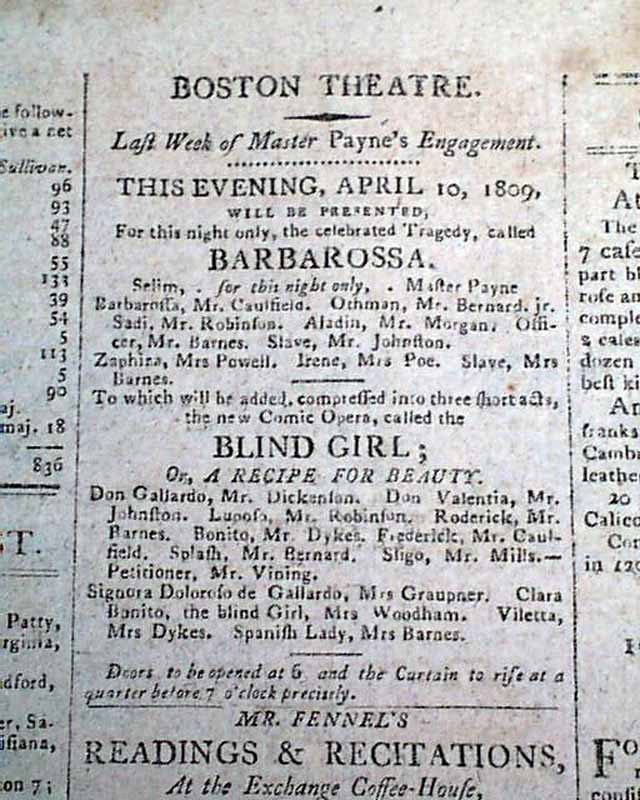
Theatrical ad includes Edgar Allan Poe's father...
BOSTON GAZETTE, April 10, 1809
* Edgar Allan Poe's mother theater ad (Eliza Arnold Hopkins Poe)
A curious literary item here as the top of page 3 has an...
* Edgar Allan Poe's mother theater ad (Eliza Arnold Hopkins Poe)
A curious literary item here as the top of page 3 has an...
Apr 1809
$34
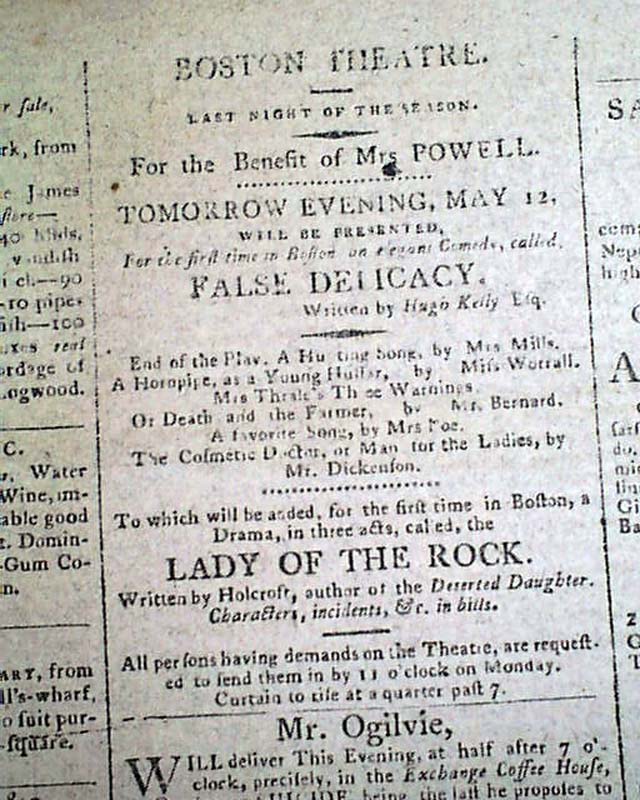
Theatrical ad includes Edgar Allan Poe's mother...
BOSTON GAZETTE, May 11, 1809
* Edgar Allan Poe's mother theater ad
A curious literary item here as the top of page 3 has an advertisement for the...
* Edgar Allan Poe's mother theater ad
A curious literary item here as the top of page 3 has an advertisement for the...
May 1809
$34
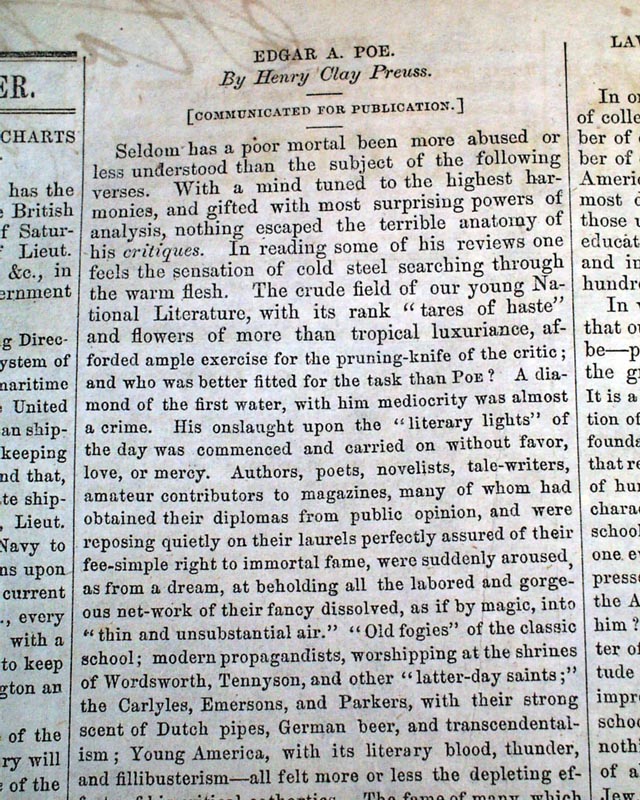
Defending Edgar Allan Poe... Significant Poe issue...
DAILY NATIONAL INTELLIGENCER, Washington, D.C., May 19, 1853 Page 2 has almost an entire column taken up with a very notable article headed: "Edgar A. Poe,...
May 1853
$525