

Bob Dylan transitions from acoustic to electric: his Forest Hills concert...
Item # 726272
September 02, 1965
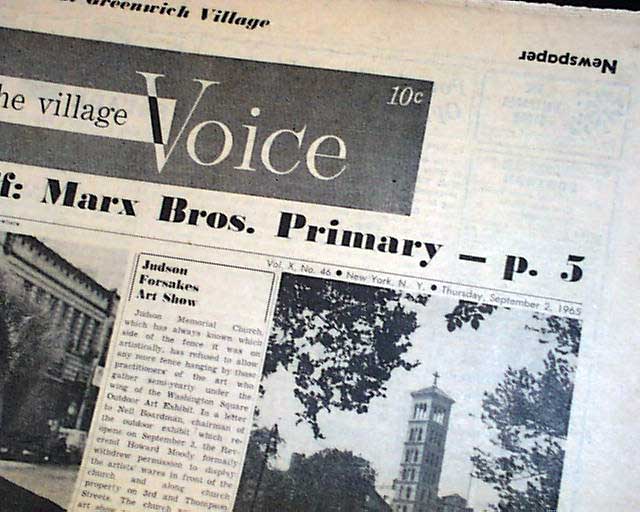
THE VILLAGE VOICE, New York, Sept. 2, 1965
* Bob Dylan & his electric guitar
* His famous Forest Hills concert
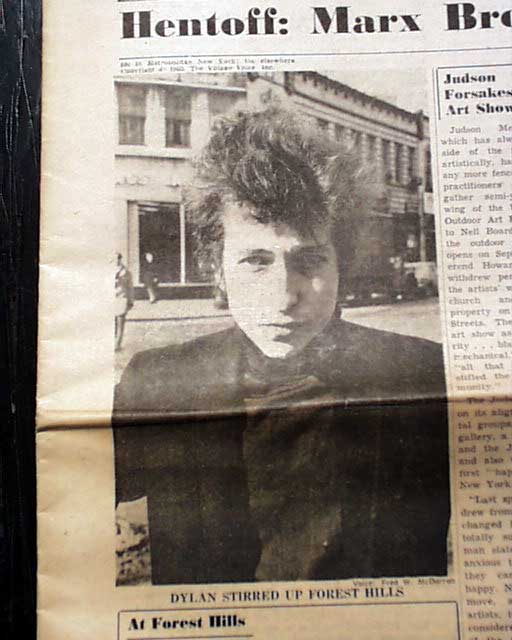
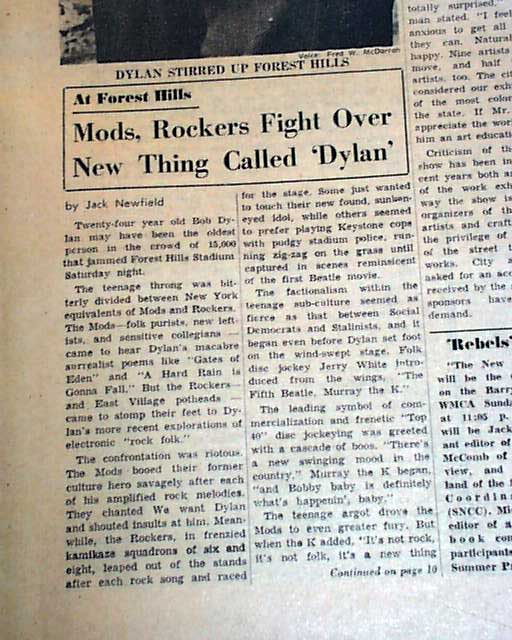
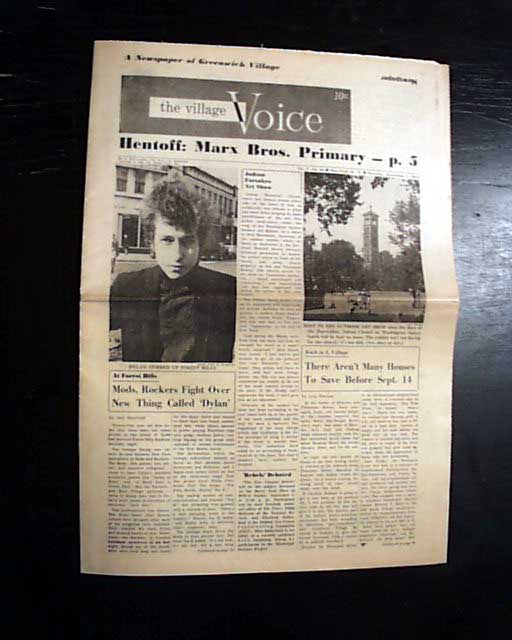
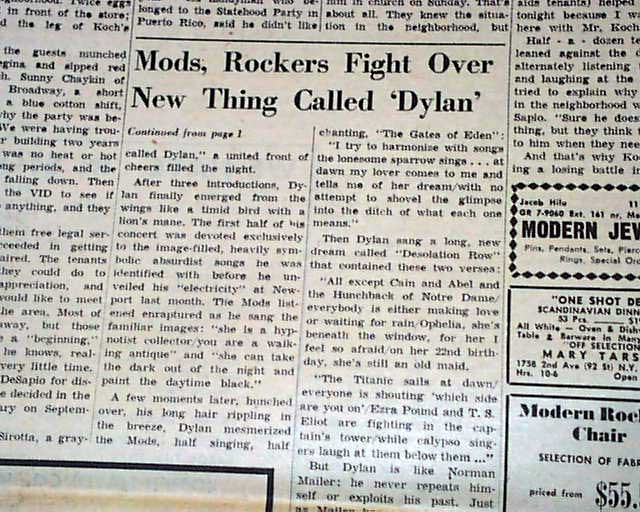
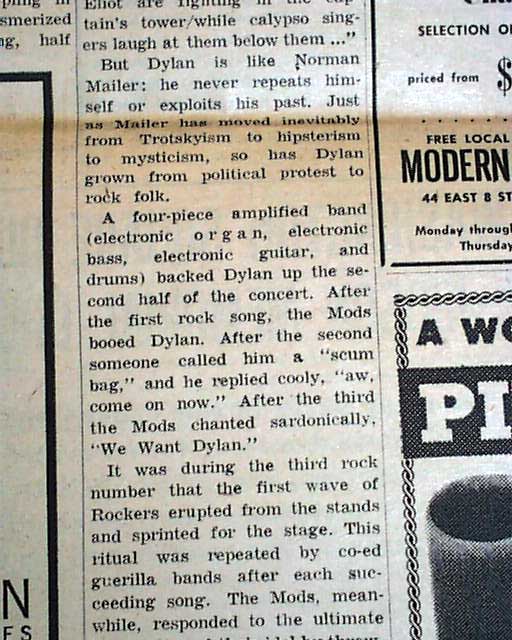
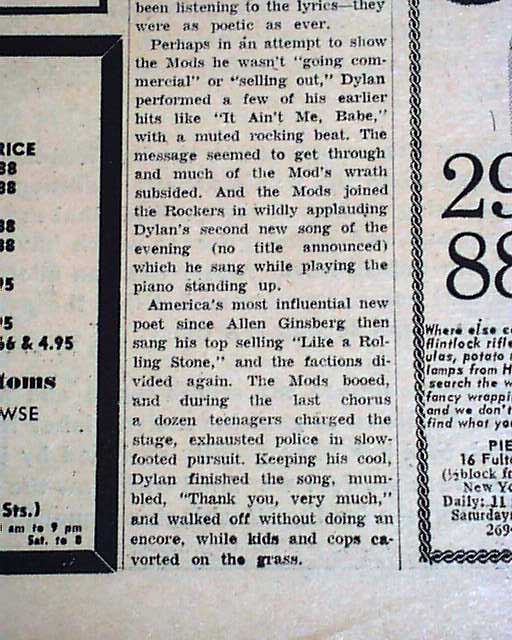
The front page features a photo of Bob Dylan captioned: "Dylan Stirred Up Forrest Hills". Also on the ftpg, & concluding inside, is a detailed account of the Dylan's very notable & controversial performance at Forest Hills of just 5 days earlier. Portions include: "...teenage throng was bitterly divided between New York equivalents of Mods and Rockers. The Mods--folk purists, new leftists, and sensitive collegians--But the Rockers--an East Village potheads--came to stomp their feet to Dylan's more recent explorations of electronic 'rock folk'...The Confrontation was riotous. The Mods booed their former culture hero savagely ...and shouted insults at him..." and so much more.
This was a pivotal concert, at a time when Dylan was exploring more rock styles with an electric guitar (first introduced at the Newport Folk Festival in July) & band, much to the dismay of his folk music fans and those who wanted only more of his acoustic guitar sound.
Background: The 1965 Forest Hills Stadium concert stands as the definitive transition point where Bob Dylan forced the folk world to accept his electric evolution, turning a tennis stadium into a battleground of cultural upheaval. Occurring on a freakishly cold August night, the performance was a masterclass in provocation: it began with a reverent acoustic set that debuted the surreal masterpiece "Desolation Row," only to pivot into a high-decibel second half backed by the musicians who would eventually become The Band. Introduced by Top 40 DJ Murray the K—a move that felt like a deliberate insult to folk purists—the electric set was met with a "slow-motion riot" where fans hurdled barricades and security guards tackled protestors on the grass while Dylan sneered the lyrics of "Ballad of a Thin Man" at his detractors. The atmosphere was a bizarre paradox where the audience booed the very idea of the electric instruments while simultaneously singing along to "Like a Rolling Stone," creating a chaotic, carnival-like tension that Dylan embraced as a victory. Ultimately, the evening solidified Dylan’s departure from his role as the "voice of a generation" folk singer, signaling a permanent shift toward the rock-and-roll iconoclasm that would redefine the 1960s.
I suspect this to be an extremely rare item because there was really no reason to save it at the time.
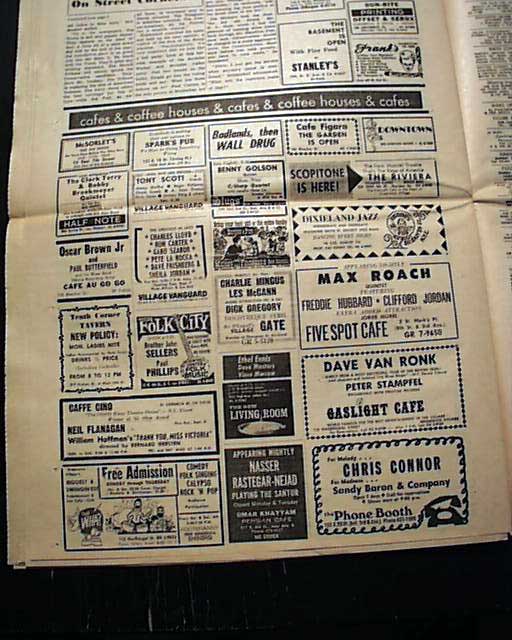
The Village Voice was an American counterculture newspaper known for being the country's first alternative newsweekly. It introduced free-form, high-spirited, and passionate journalism into the public discourse - a tradition it maintained throughout its 60+ year history. It is quite common to find great political cartoons, satirical cartoons and articles, thought-provoking editorials, and ads and reviews for both concerts and theater productions - both on and off Broadway. Many iconic writers and musicians credit their appearance in The Village Voice for at least a portion of their success.
Complete in 24 pages, tabloid-size, very nice condition.
Provenance note: This issue comes from The Village Voice's own archives, part of their in-house collection used to create their digital archive.
Alert: Many issues of The Village Voice contain articles and/or photos that some consider offensive, and are certainly inappropriate for children. Please purchase with discretion.
* Bob Dylan & his electric guitar
* His famous Forest Hills concert
The front page features a photo of Bob Dylan captioned: "Dylan Stirred Up Forrest Hills". Also on the ftpg, & concluding inside, is a detailed account of the Dylan's very notable & controversial performance at Forest Hills of just 5 days earlier. Portions include: "...teenage throng was bitterly divided between New York equivalents of Mods and Rockers. The Mods--folk purists, new leftists, and sensitive collegians--But the Rockers--an East Village potheads--came to stomp their feet to Dylan's more recent explorations of electronic 'rock folk'...The Confrontation was riotous. The Mods booed their former culture hero savagely ...and shouted insults at him..." and so much more.
This was a pivotal concert, at a time when Dylan was exploring more rock styles with an electric guitar (first introduced at the Newport Folk Festival in July) & band, much to the dismay of his folk music fans and those who wanted only more of his acoustic guitar sound.
Background: The 1965 Forest Hills Stadium concert stands as the definitive transition point where Bob Dylan forced the folk world to accept his electric evolution, turning a tennis stadium into a battleground of cultural upheaval. Occurring on a freakishly cold August night, the performance was a masterclass in provocation: it began with a reverent acoustic set that debuted the surreal masterpiece "Desolation Row," only to pivot into a high-decibel second half backed by the musicians who would eventually become The Band. Introduced by Top 40 DJ Murray the K—a move that felt like a deliberate insult to folk purists—the electric set was met with a "slow-motion riot" where fans hurdled barricades and security guards tackled protestors on the grass while Dylan sneered the lyrics of "Ballad of a Thin Man" at his detractors. The atmosphere was a bizarre paradox where the audience booed the very idea of the electric instruments while simultaneously singing along to "Like a Rolling Stone," creating a chaotic, carnival-like tension that Dylan embraced as a victory. Ultimately, the evening solidified Dylan’s departure from his role as the "voice of a generation" folk singer, signaling a permanent shift toward the rock-and-roll iconoclasm that would redefine the 1960s.
I suspect this to be an extremely rare item because there was really no reason to save it at the time.
The Village Voice was an American counterculture newspaper known for being the country's first alternative newsweekly. It introduced free-form, high-spirited, and passionate journalism into the public discourse - a tradition it maintained throughout its 60+ year history. It is quite common to find great political cartoons, satirical cartoons and articles, thought-provoking editorials, and ads and reviews for both concerts and theater productions - both on and off Broadway. Many iconic writers and musicians credit their appearance in The Village Voice for at least a portion of their success.
Complete in 24 pages, tabloid-size, very nice condition.
Provenance note: This issue comes from The Village Voice's own archives, part of their in-house collection used to create their digital archive.
Alert: Many issues of The Village Voice contain articles and/or photos that some consider offensive, and are certainly inappropriate for children. Please purchase with discretion.
Category: The 20th Century


