

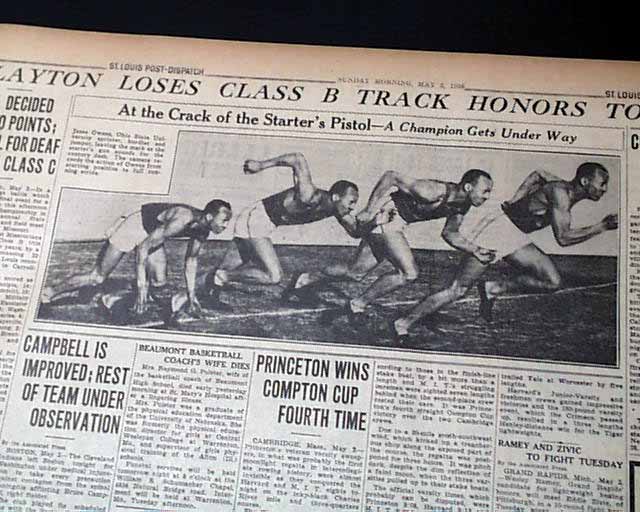
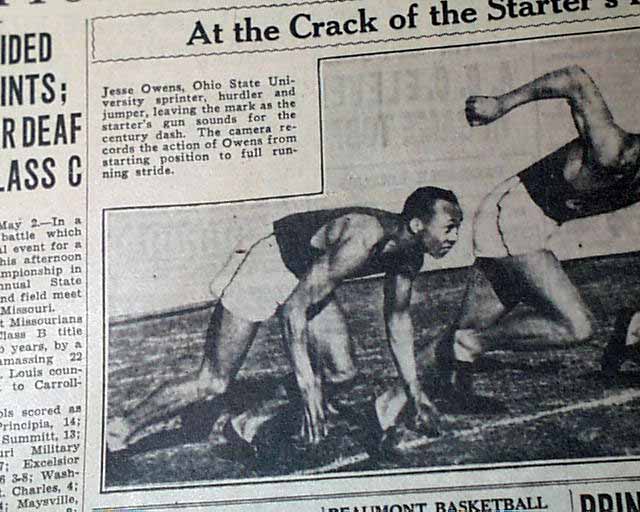
Jesse Owens.. Ohio State track star...
Item # 726142
May 03, 1936
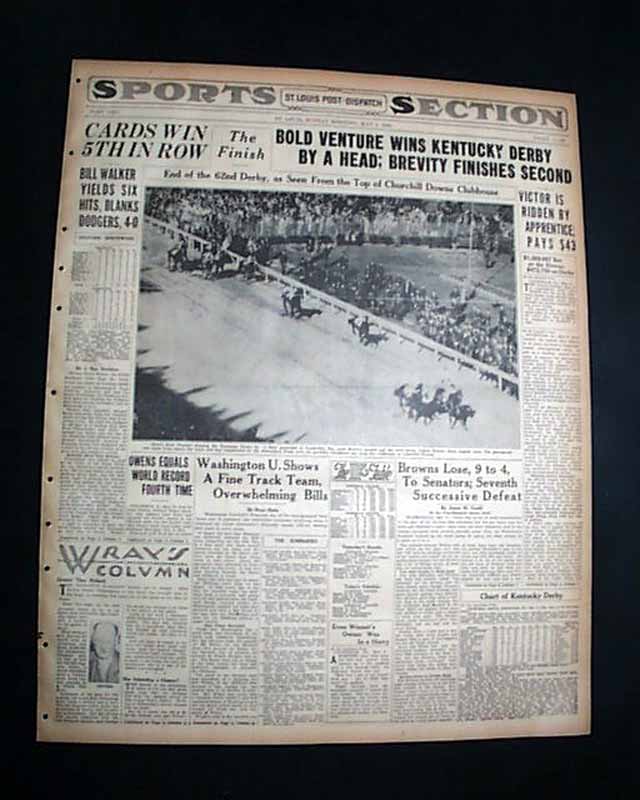
SPORTS SECTION only of the St. Louis Post-Dispatch, May 3, 1936
* African American Jesse Owens
* Ohio State Buckeyes track & field
* Pre Summer Olympics in Nazi Germany
Page 5 of this section has a time-lapse pictorial showing Jesse Owens going from the starting position to a full running stride. (see images)
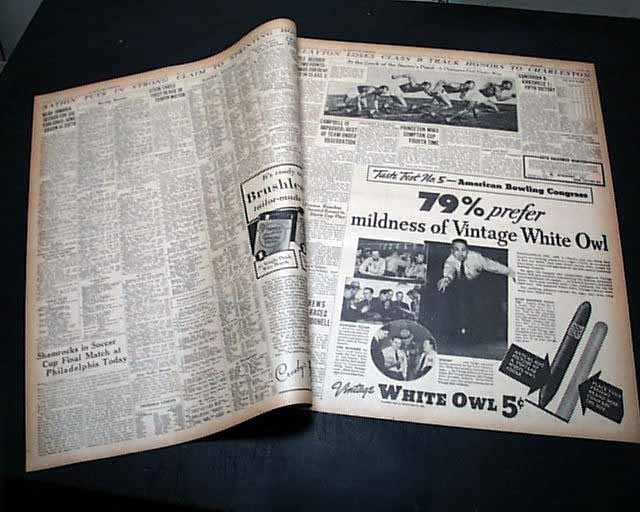
Complete sports section only with 8 pages, light toning at the margins, some small binding holes along the spine, nice condition.
Background: In May 1936, Jesse Owens capped off his legendary collegiate career at Ohio State by dominating the Big Ten Championships, serving notice to the world that he was the undisputed favorite for the upcoming Berlin Olympics. Competing in front of a home-state crowd in Columbus, Owens defended his titles in the 100-yard dash, 220-yard dash, 220-yard low hurdles, and the long jump, accounting for the vast majority of the Buckeyes' team points. This period was a masterclass in athletic efficiency under the guidance of coach Larry Snyder; Owens utilized a smooth, upright running style and a "hitch-kick" long jump technique that prioritized fluid momentum over raw power. Despite his status as a national hero and his record-shattering performances on the track that month, Owens continued to face the systemic sting of racial segregation, often forced to stay in "Blacks-only" boarding houses and eat in separate facilities while traveling with his white teammates. His performance in May 1936 was more than just a victory lap for his senior year; it was a defiant display of grace and excellence that set the stage for him to dismantle Nazi ideologies of Aryan supremacy just three months later.
* African American Jesse Owens
* Ohio State Buckeyes track & field
* Pre Summer Olympics in Nazi Germany
Page 5 of this section has a time-lapse pictorial showing Jesse Owens going from the starting position to a full running stride. (see images)
Complete sports section only with 8 pages, light toning at the margins, some small binding holes along the spine, nice condition.
Background: In May 1936, Jesse Owens capped off his legendary collegiate career at Ohio State by dominating the Big Ten Championships, serving notice to the world that he was the undisputed favorite for the upcoming Berlin Olympics. Competing in front of a home-state crowd in Columbus, Owens defended his titles in the 100-yard dash, 220-yard dash, 220-yard low hurdles, and the long jump, accounting for the vast majority of the Buckeyes' team points. This period was a masterclass in athletic efficiency under the guidance of coach Larry Snyder; Owens utilized a smooth, upright running style and a "hitch-kick" long jump technique that prioritized fluid momentum over raw power. Despite his status as a national hero and his record-shattering performances on the track that month, Owens continued to face the systemic sting of racial segregation, often forced to stay in "Blacks-only" boarding houses and eat in separate facilities while traveling with his white teammates. His performance in May 1936 was more than just a victory lap for his senior year; it was a defiant display of grace and excellence that set the stage for him to dismantle Nazi ideologies of Aryan supremacy just three months later.
Category: The 20th Century


