

John Adams, Thomas Jefferson - the XYZ Affair... Battle of the Nile...
Item # 725313
October 24, 1798
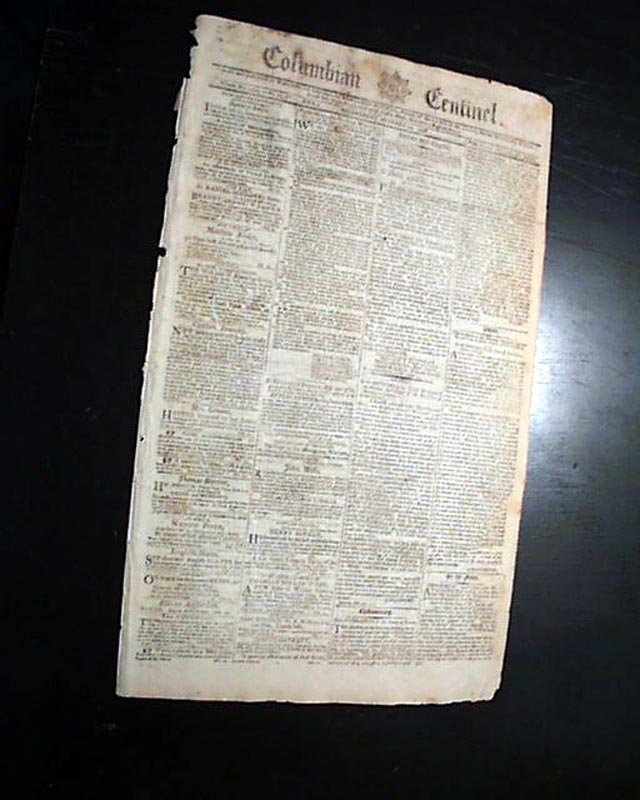
COLUMBIAN CENTINEL, Boston, Oct. 24, 1798
* The XYZ Affair - France relations
* John Adams & Thomas Jefferson
* Battle if the Nile (Napoleon/Nelson)
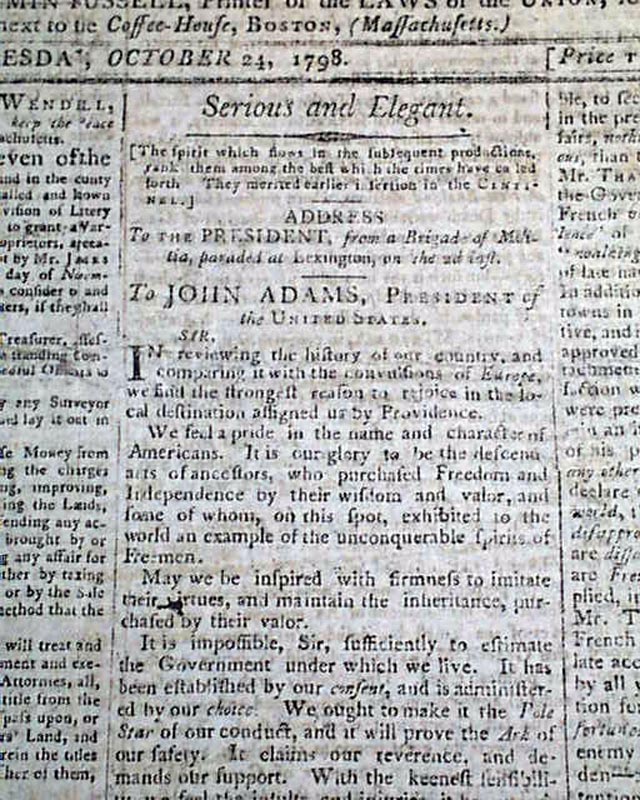
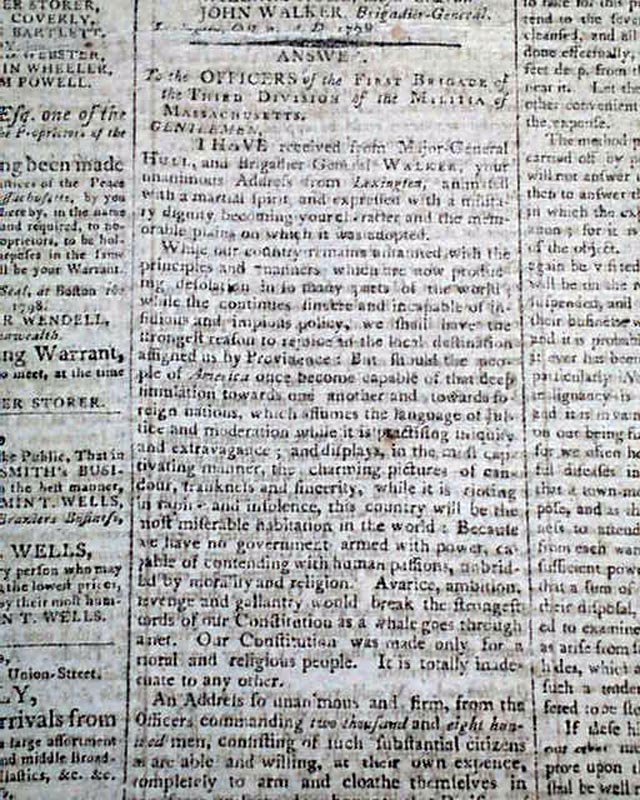
The front page has an address: "To John Adams, President of the United States" from a military unit at Lexington, followed by his response signed in type: John Adams.
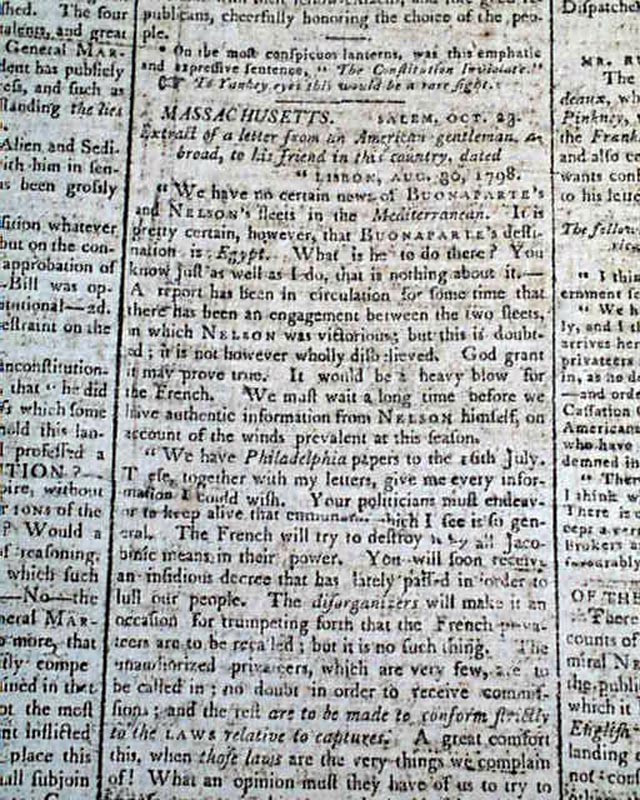
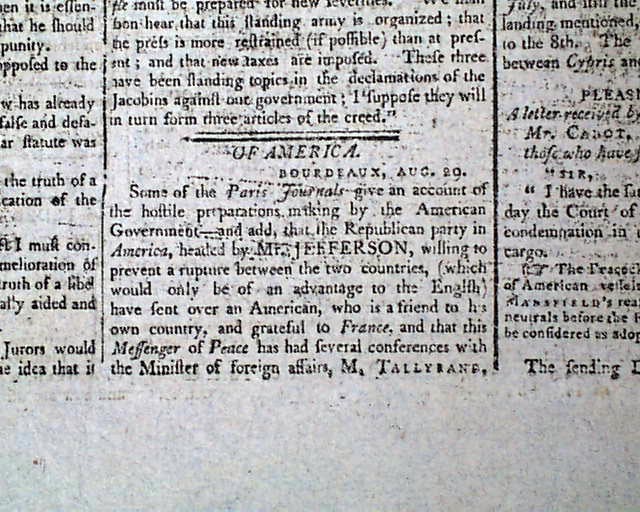
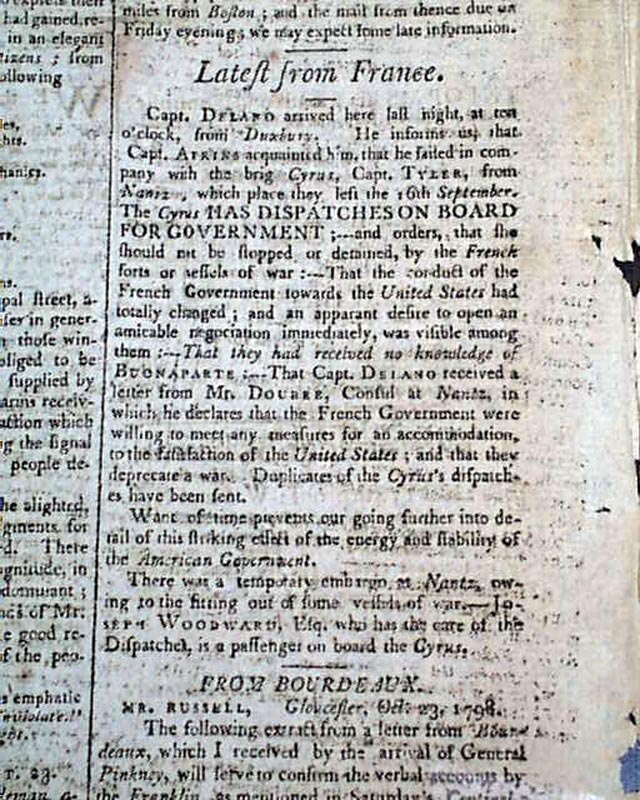
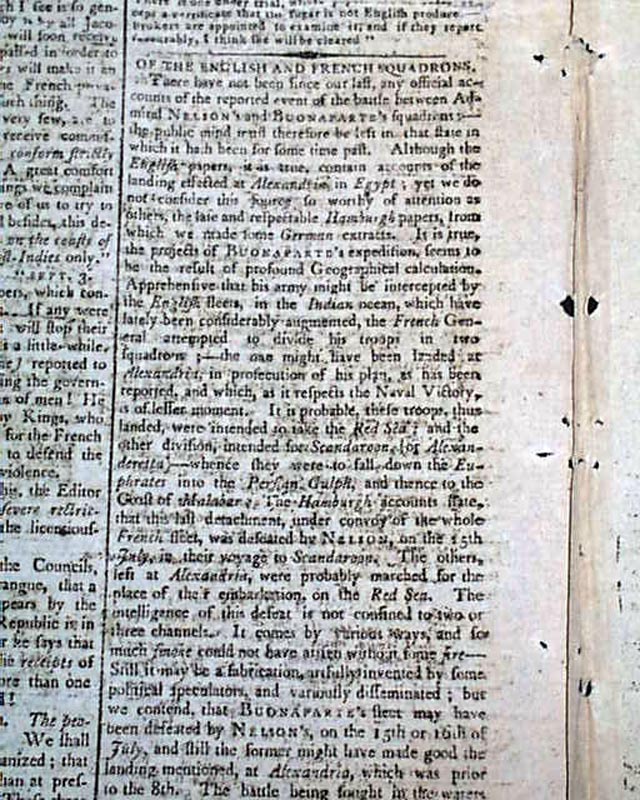
A page 2 bit concerning America making preparations for action against France during the XYZ Affair, with Thomas Jefferson intervening. Other reports concerning the troubling relationship with France. There are two reports concerning Napoleon Buonaparte's army in Egypt, with mention of Admiral Nelson, who would defeat him in the Battle of the Nile.
Four pages, a bit irregular at the blank spine, some minor archival mends and minor margin tears.
Background: The convergence of these events in late 1798 represents a critical turning point where domestic American factionalism collided with global geopolitics, ultimately shaping the trajectory of the early American republic. Locally, the Lexington address and the military preparations against France highlight the peak of the Quasi-War crisis, a period of intense patriotic fervor that the ruling Federalist Party leveraged to expand the federal government, build the modern U.S. Navy, and pass the controversial Alien and Sedition Acts. Politically, Thomas Jefferson’s intervention underscores the deepening, bitter ideological schism between his pro-French Democratic-Republicans and John Adams’s pro-British Federalists—a polarization that laid the groundwork for the foundational election of 1800. Globally, the reports of Napoleon’s Egyptian campaign and Admiral Nelson’s victory at the Battle of the Nile were not just distant news, but the geopolitical catalyst that saved the young United States from a full-scale war. By crippling France’s naval power and trapping Napoleon in the Middle East, Nelson’s victory severely weakened America's adversary, cooling French aggression in the Atlantic and allowing President Adams to successfully pursue a peaceful diplomatic resolution to the XYZ Affair, thereby preserving American neutrality and preventing a catastrophic foreign entanglement.
* The XYZ Affair - France relations
* John Adams & Thomas Jefferson
* Battle if the Nile (Napoleon/Nelson)
The front page has an address: "To John Adams, President of the United States" from a military unit at Lexington, followed by his response signed in type: John Adams.
A page 2 bit concerning America making preparations for action against France during the XYZ Affair, with Thomas Jefferson intervening. Other reports concerning the troubling relationship with France. There are two reports concerning Napoleon Buonaparte's army in Egypt, with mention of Admiral Nelson, who would defeat him in the Battle of the Nile.
Four pages, a bit irregular at the blank spine, some minor archival mends and minor margin tears.
Background: The convergence of these events in late 1798 represents a critical turning point where domestic American factionalism collided with global geopolitics, ultimately shaping the trajectory of the early American republic. Locally, the Lexington address and the military preparations against France highlight the peak of the Quasi-War crisis, a period of intense patriotic fervor that the ruling Federalist Party leveraged to expand the federal government, build the modern U.S. Navy, and pass the controversial Alien and Sedition Acts. Politically, Thomas Jefferson’s intervention underscores the deepening, bitter ideological schism between his pro-French Democratic-Republicans and John Adams’s pro-British Federalists—a polarization that laid the groundwork for the foundational election of 1800. Globally, the reports of Napoleon’s Egyptian campaign and Admiral Nelson’s victory at the Battle of the Nile were not just distant news, but the geopolitical catalyst that saved the young United States from a full-scale war. By crippling France’s naval power and trapping Napoleon in the Middle East, Nelson’s victory severely weakened America's adversary, cooling French aggression in the Atlantic and allowing President Adams to successfully pursue a peaceful diplomatic resolution to the XYZ Affair, thereby preserving American neutrality and preventing a catastrophic foreign entanglement.
Category: The 1600's and 1700's


