

South Carolina formally secedes from the Union...
Item # 714033
December 21, 1860
NEW YORK SEMI-WEEKLY TRIBUNE, Dec. 21, 1860
* South Carolina Ordinance of Secession
* Abraham Lincoln as president-elect
* Pre American Civil War Southern tensions
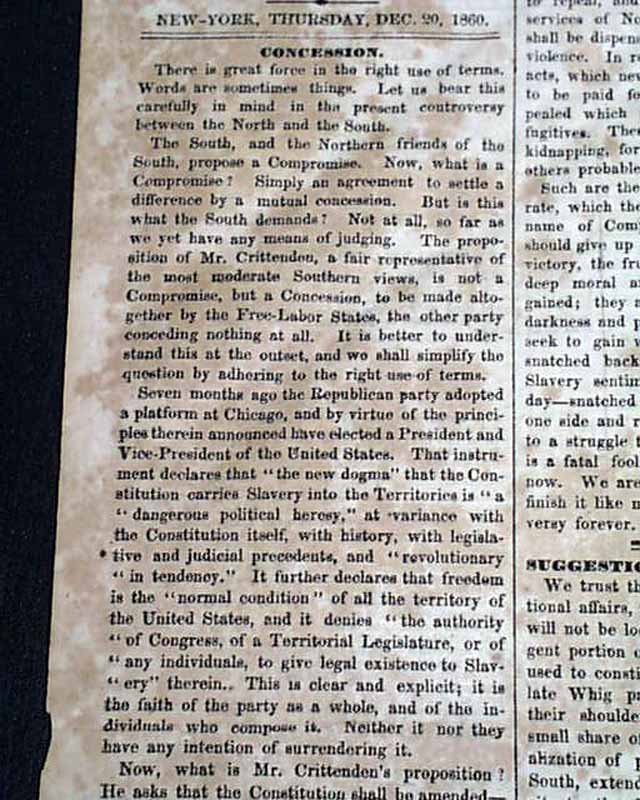
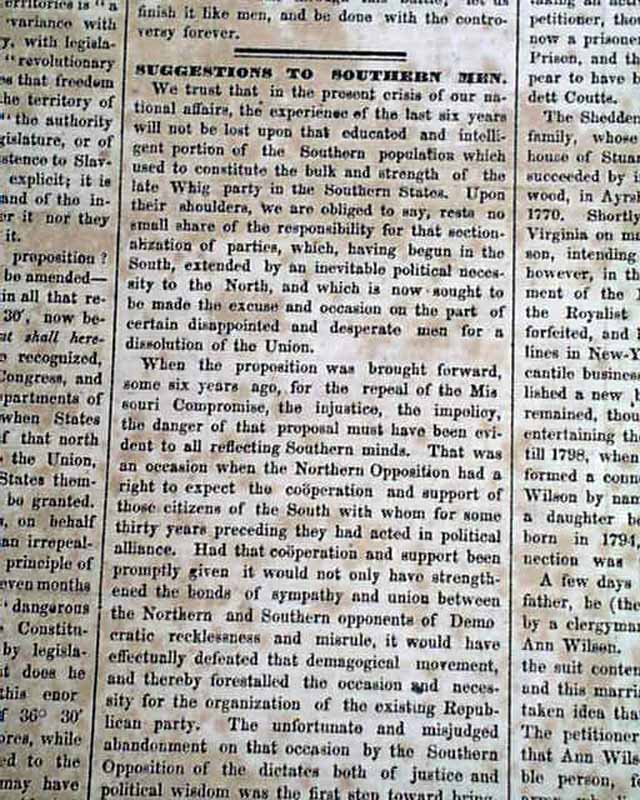
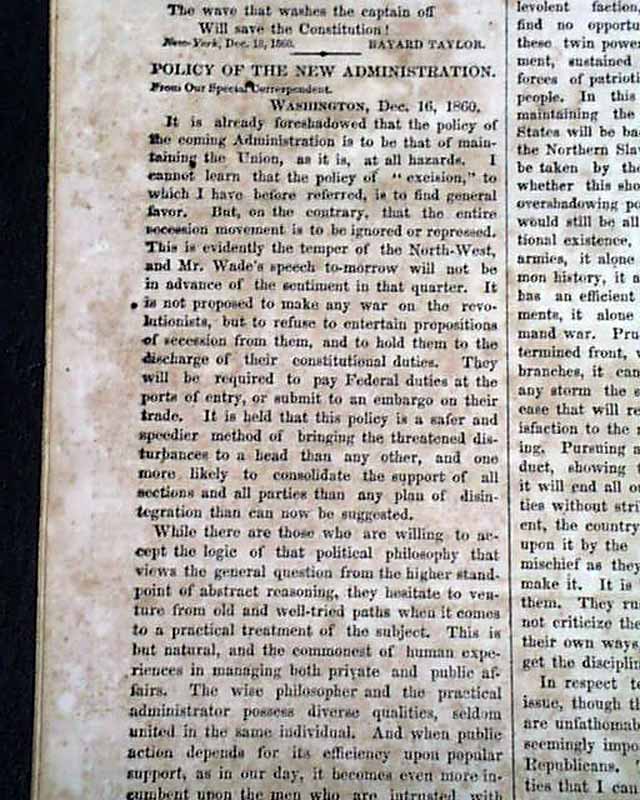
With Lincoln's election determined, much national focus is on the slavery issue and the secession of Southern states.
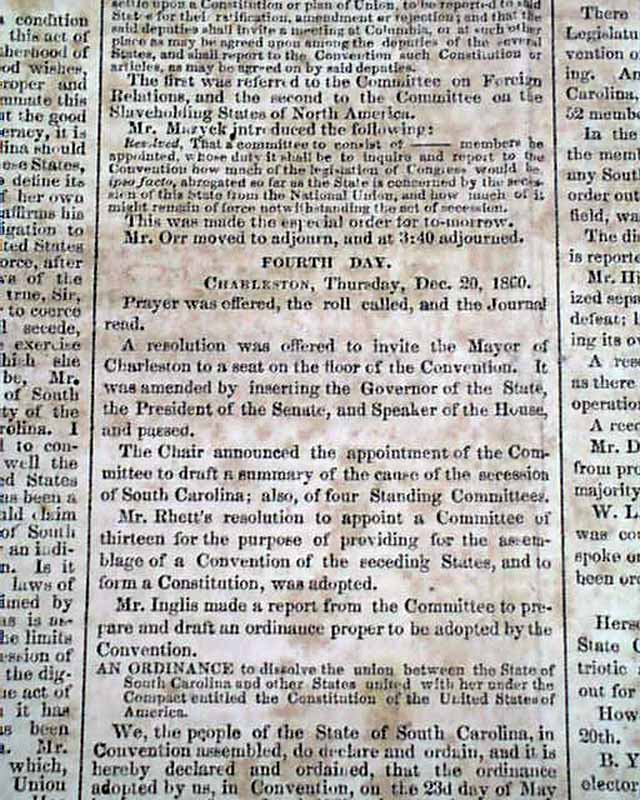
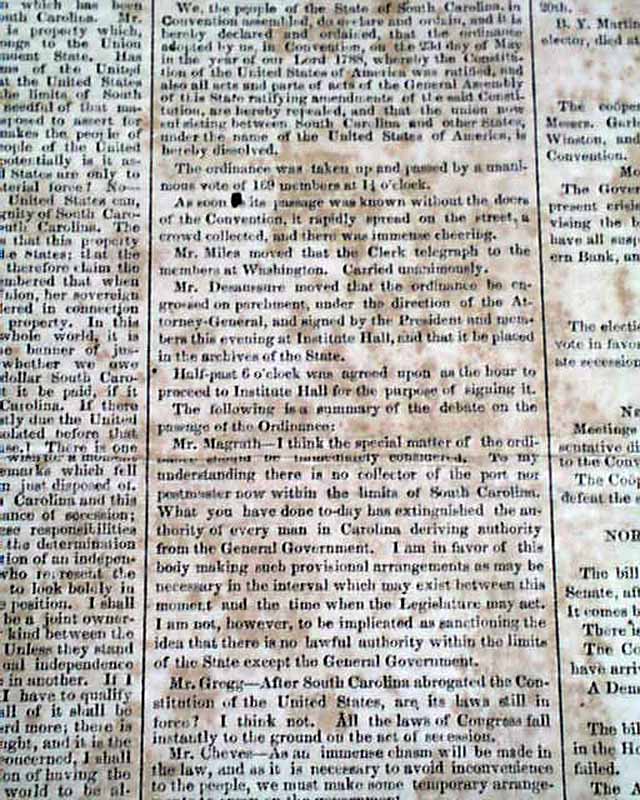
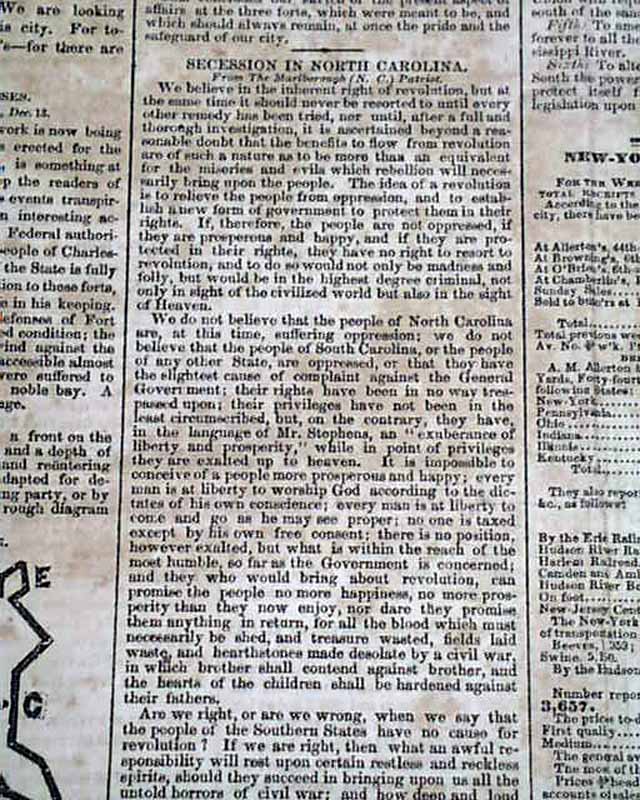
Certainly the most notable content is the detailed report from the South Carolina convention on seceding from the Union, ultimately approved on December 20.
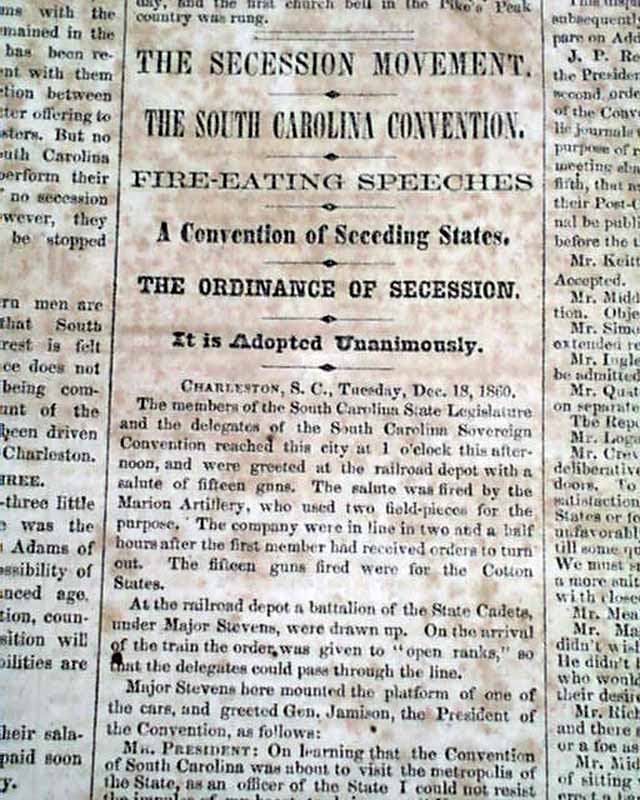
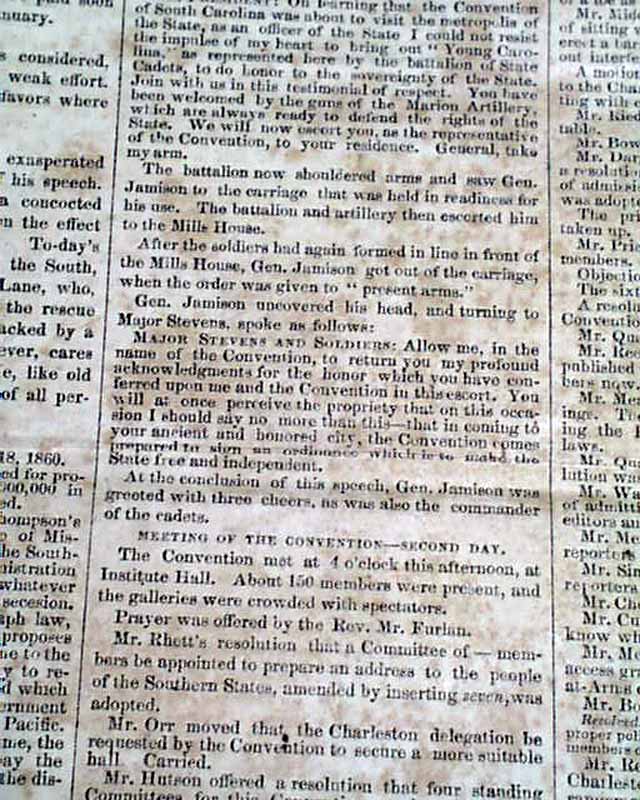
The page 4 and 5 reporting is headed: "THE SECESSION MOVEMENT" "The South Carolina Convention" "Fire-Eating Speeches" "A Convention of Seceding States" "The Ordinance of Secession" "It is Adopted Unanimously". The report headed: "Fourth Day" from Charleston includes: "...An Ordinance to dissolve the union between the state of South Carolina and other states united with her under the Compact entitled the Constitution of the United States of America. We, the people of the state of South Carolina...do declare & ordain......are hereby repealed & that the union now subsisting between South Carolina and other States, under the name of the United States of America, is hereby dissolved. The ordinance was taken up and passed by a unanimous vote of 169 members...As soon as its passage was known without the doors of the Convention, it rapidly spread on the streets, a crowd collected, and there was immense cheering..." with more.
With South Carolina's decision, other states are close to seceding as well, as reported in this issue.
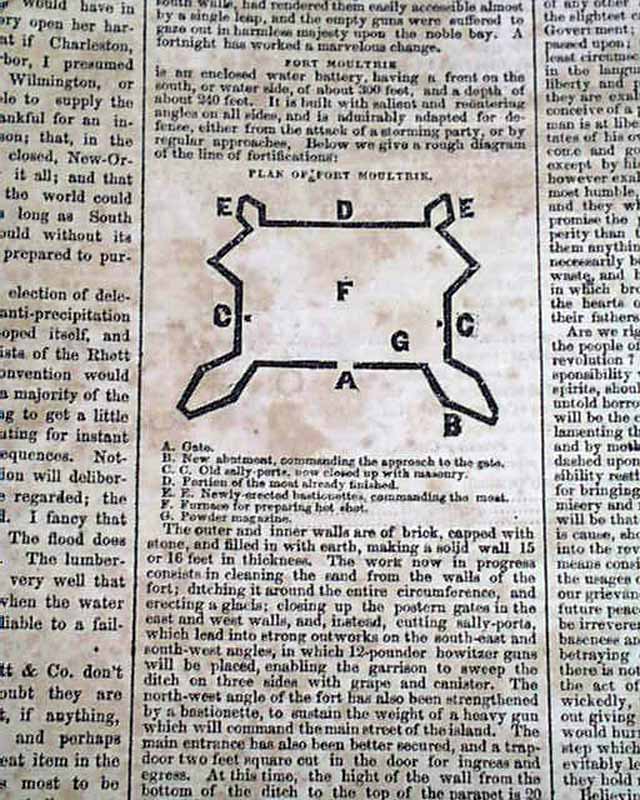
Page 7 has a small diagram of Fort Moultrie in Charleston harbor.
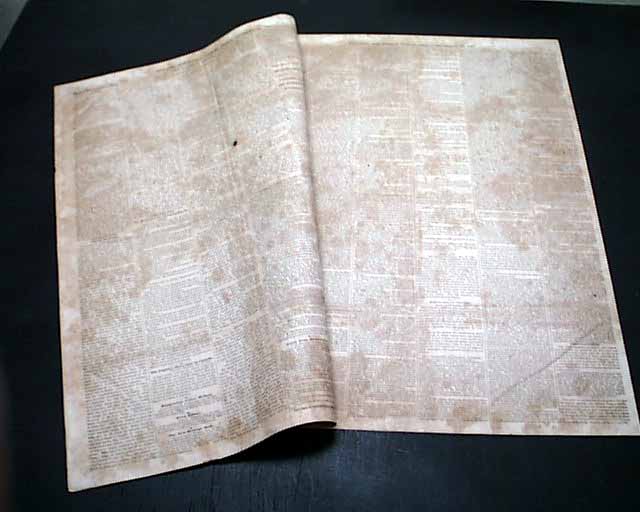
Eight pages, foxing throughout, irregular at the spine margin, good condition.
Background: The South Carolina Ordinance of Secession, adopted unanimously on December 20, 1860, represents the definitive breaking point of the American Union and the immediate catalyst for the American Civil War. Triggered by the election of Abraham Lincoln, whom white Southerners viewed as an existential threat to the institution of slavery, the ordinance fundamentally challenged the permanence of the nation by framing the U.S. Constitution as a revocable "compact" rather than an unbreakable bond. By declaring its independence, South Carolina established a dangerous precedent that rapidly prompted six other Deep South states to secede within two months, leading to the formation of the Confederate States of America. The frantic contemporary media coverage, exemplified by the New York Tribune, underscored the nation's profound polarization, while the local military standoff at Charleston Harbor—foreshadowed by the garrison at Fort Moultrie—escalated rapidly until Major Robert Anderson’s strategic retreat to Fort Sumter set the stage for the first shots of the war in April 1861, transforming a constitutional crisis into the deadliest conflict in American history.
* South Carolina Ordinance of Secession
* Abraham Lincoln as president-elect
* Pre American Civil War Southern tensions
With Lincoln's election determined, much national focus is on the slavery issue and the secession of Southern states.
Certainly the most notable content is the detailed report from the South Carolina convention on seceding from the Union, ultimately approved on December 20.
The page 4 and 5 reporting is headed: "THE SECESSION MOVEMENT" "The South Carolina Convention" "Fire-Eating Speeches" "A Convention of Seceding States" "The Ordinance of Secession" "It is Adopted Unanimously". The report headed: "Fourth Day" from Charleston includes: "...An Ordinance to dissolve the union between the state of South Carolina and other states united with her under the Compact entitled the Constitution of the United States of America. We, the people of the state of South Carolina...do declare & ordain......are hereby repealed & that the union now subsisting between South Carolina and other States, under the name of the United States of America, is hereby dissolved. The ordinance was taken up and passed by a unanimous vote of 169 members...As soon as its passage was known without the doors of the Convention, it rapidly spread on the streets, a crowd collected, and there was immense cheering..." with more.
With South Carolina's decision, other states are close to seceding as well, as reported in this issue.
Page 7 has a small diagram of Fort Moultrie in Charleston harbor.
Eight pages, foxing throughout, irregular at the spine margin, good condition.
Background: The South Carolina Ordinance of Secession, adopted unanimously on December 20, 1860, represents the definitive breaking point of the American Union and the immediate catalyst for the American Civil War. Triggered by the election of Abraham Lincoln, whom white Southerners viewed as an existential threat to the institution of slavery, the ordinance fundamentally challenged the permanence of the nation by framing the U.S. Constitution as a revocable "compact" rather than an unbreakable bond. By declaring its independence, South Carolina established a dangerous precedent that rapidly prompted six other Deep South states to secede within two months, leading to the formation of the Confederate States of America. The frantic contemporary media coverage, exemplified by the New York Tribune, underscored the nation's profound polarization, while the local military standoff at Charleston Harbor—foreshadowed by the garrison at Fort Moultrie—escalated rapidly until Major Robert Anderson’s strategic retreat to Fort Sumter set the stage for the first shots of the war in April 1861, transforming a constitutional crisis into the deadliest conflict in American history.
Category: Pre-Civil War


