


On the Prince Regent taking over for his father, King George III...
Item # 713639
April 27, 1811
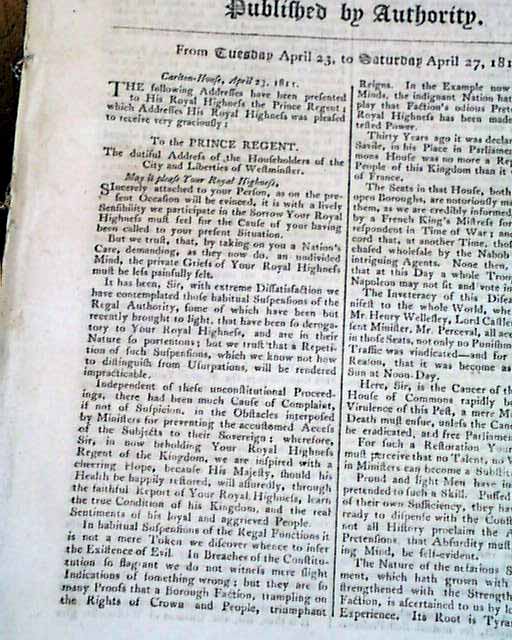
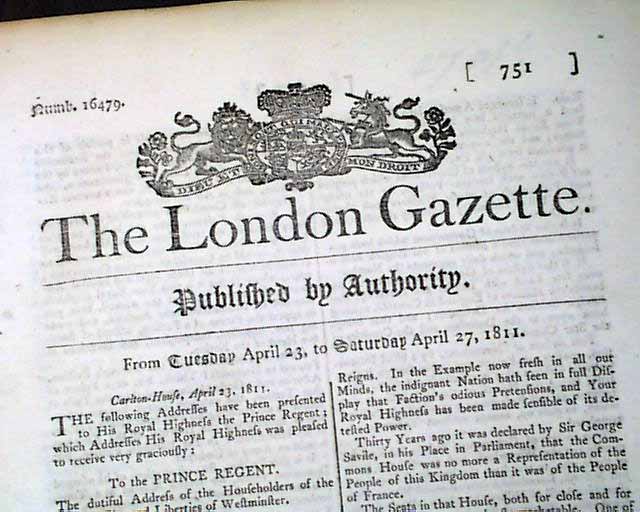
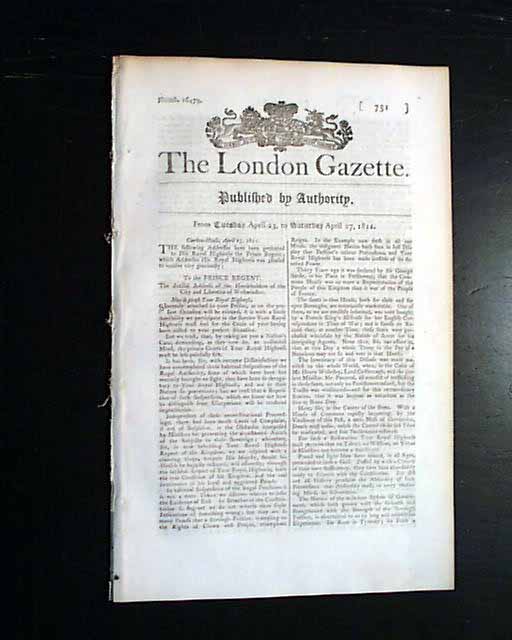
THE LONDON GAZETTE, England, April 27, 1811 During the latter years of his reign, King George III was declared mentally incapable of carrying on his duties. Thus, the "Care of the King During his Illness Act" of 1811 came into play, giving his son, the Prince Regent and the future King George IV, the authority to act in his father's behalf.
All of pages 1-6 are taken up with various letters "To the Prince Regent" from legislative bodies & other groups offering their acknowledgement of his taking over the Royal authority for his incapacitated father.
Complete in 28 pages, 7 1/2 by 11 3/4 inches, very nice condition.
Background: The April 27, 1811, issue of The London Gazette captures a profound constitutional and cultural turning point in British history: the formal establishment of the Regency Era following the permanent mental incapacitation of King George III. Driven into a final, incurable lapse of illness—historically attributed to porphyria or severe bipolar mania—the King was deemed unfit to rule, prompting Parliament to pass the Care of the King During his Illness Act of 1811 (the Regency Act). This legislation effectively stripped the monarch of his executive duties and transferred royal authority to his eldest son, George, Prince of Wales, who assumed power as the Prince Regent. The six pages of formal addresses and letters from legislative bodies contained within this specific Gazette represent the official, public pivot of the British Empire's political apparatus aligning itself with a new, proxy ruler. This transition fundamentally reshaped the nation's leadership during the height of the Napoleonic Wars and ushered in an era defined by distinct architectural, social, and political shifts, marking the end of the traditional Georgian period and the dawn of a decade ruled by the flamboyant future King George IV.
All of pages 1-6 are taken up with various letters "To the Prince Regent" from legislative bodies & other groups offering their acknowledgement of his taking over the Royal authority for his incapacitated father.
Complete in 28 pages, 7 1/2 by 11 3/4 inches, very nice condition.
Background: The April 27, 1811, issue of The London Gazette captures a profound constitutional and cultural turning point in British history: the formal establishment of the Regency Era following the permanent mental incapacitation of King George III. Driven into a final, incurable lapse of illness—historically attributed to porphyria or severe bipolar mania—the King was deemed unfit to rule, prompting Parliament to pass the Care of the King During his Illness Act of 1811 (the Regency Act). This legislation effectively stripped the monarch of his executive duties and transferred royal authority to his eldest son, George, Prince of Wales, who assumed power as the Prince Regent. The six pages of formal addresses and letters from legislative bodies contained within this specific Gazette represent the official, public pivot of the British Empire's political apparatus aligning itself with a new, proxy ruler. This transition fundamentally reshaped the nation's leadership during the height of the Napoleonic Wars and ushered in an era defined by distinct architectural, social, and political shifts, marking the end of the traditional Georgian period and the dawn of a decade ruled by the flamboyant future King George IV.
Category: Pre-Civil War


