


Progress report on the Erie Canal...
Item # 713625
July 12, 1820
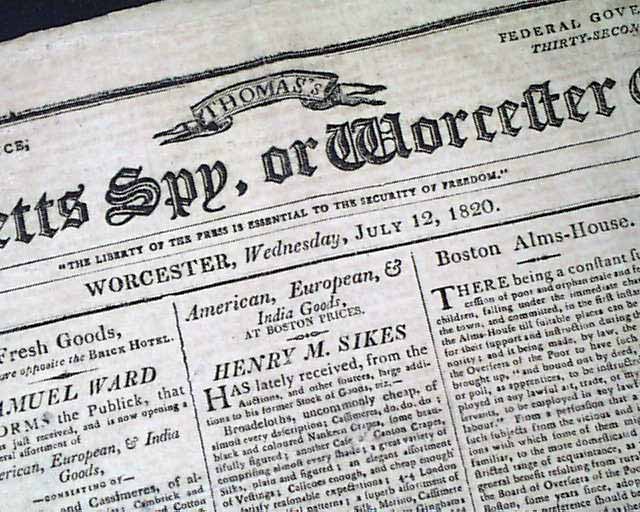
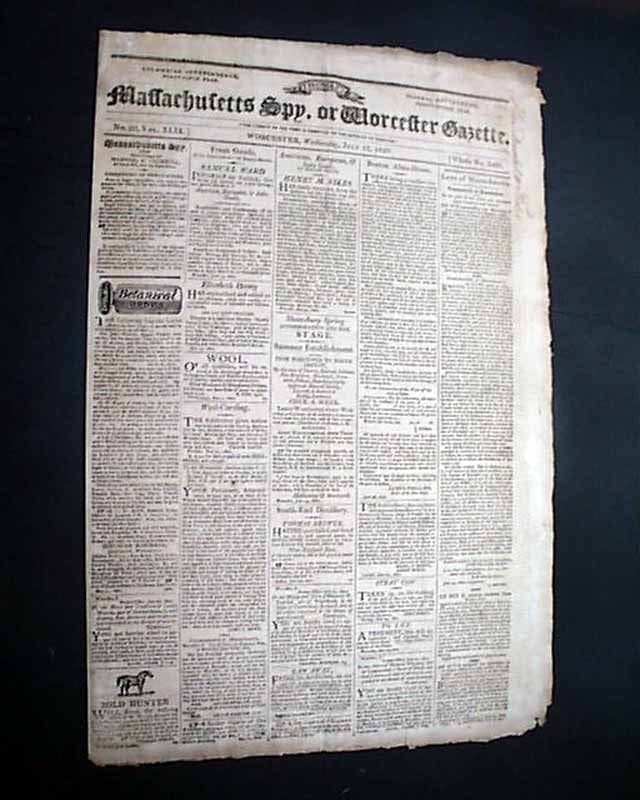
MASSACHUSETTS SPY, OR WORCESTER GAZETTE, July 12, 1820
* Construction of the Erie Canal
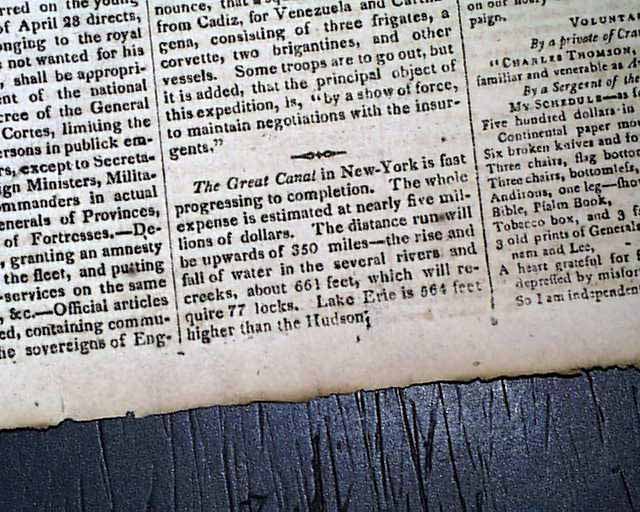
A page 2 report notes: "The Great Canal in New-York is fast progressing...The whole expense is estimated at nearly five million dollars. The distance will be upwards of 350 miles--the rise and fall of water in the...rivers and creeks, about 661 feet...will require 77 locks. Lake Erie is 564 feet higher than the Hudson."
Completed in 1825, the canal was the first navigable waterway connecting the Atlantic Ocean to the Great Lakes, vastly reducing the costs of transporting people and goods across the Appalachians. The Erie Canal accelerated the settlement of the Great Lakes region, the westward expansion of the United States, and the economic ascendancy of New York state. It has been called "The Nation's First Superhighway".
Four pages, never-trimmed margins, good condition.
Background: The report in the July 12, 1820, edition of the Massachusetts Spy captures the United States on the brink of an economic and geographical revolution, documenting the mid-construction statistics of the Erie Canal—an engineering marvel widely celebrated as "The Nation's First Superhighway." At the time of publication, critics still derided the project as "Clinton's Ditch," doubting that human labor could conquer the Appalachian wilderness to connect the Atlantic Ocean to the Great Lakes. However, upon its completion in 1825, the canal achieved the monumental feat of overcoming a 661-foot elevation change through a pioneering system of 77 locks, stretching over 350 miles from Albany to Buffalo. Its historical significance cannot be overstated: by dropping shipping costs by over 90% (from nearly $100 a ton to less than $10) and slashing travel times from weeks to days, the canal dissolved the natural barrier of the Appalachian Mountains. This massive infrastructure achievement bypassed the economic dominance of rival ports like Philadelphia and Baltimore, single-handedly securing the financial ascendancy of New York City, while simultaneously triggering a massive wave of westward migration that accelerated the settlement of the Great Lakes region and permanently altered the geopolitical landscape of the expanding United States.
* Construction of the Erie Canal
A page 2 report notes: "The Great Canal in New-York is fast progressing...The whole expense is estimated at nearly five million dollars. The distance will be upwards of 350 miles--the rise and fall of water in the...rivers and creeks, about 661 feet...will require 77 locks. Lake Erie is 564 feet higher than the Hudson."
Completed in 1825, the canal was the first navigable waterway connecting the Atlantic Ocean to the Great Lakes, vastly reducing the costs of transporting people and goods across the Appalachians. The Erie Canal accelerated the settlement of the Great Lakes region, the westward expansion of the United States, and the economic ascendancy of New York state. It has been called "The Nation's First Superhighway".
Four pages, never-trimmed margins, good condition.
Background: The report in the July 12, 1820, edition of the Massachusetts Spy captures the United States on the brink of an economic and geographical revolution, documenting the mid-construction statistics of the Erie Canal—an engineering marvel widely celebrated as "The Nation's First Superhighway." At the time of publication, critics still derided the project as "Clinton's Ditch," doubting that human labor could conquer the Appalachian wilderness to connect the Atlantic Ocean to the Great Lakes. However, upon its completion in 1825, the canal achieved the monumental feat of overcoming a 661-foot elevation change through a pioneering system of 77 locks, stretching over 350 miles from Albany to Buffalo. Its historical significance cannot be overstated: by dropping shipping costs by over 90% (from nearly $100 a ton to less than $10) and slashing travel times from weeks to days, the canal dissolved the natural barrier of the Appalachian Mountains. This massive infrastructure achievement bypassed the economic dominance of rival ports like Philadelphia and Baltimore, single-handedly securing the financial ascendancy of New York City, while simultaneously triggering a massive wave of westward migration that accelerated the settlement of the Great Lakes region and permanently altered the geopolitical landscape of the expanding United States.
Category: Pre-Civil War


