


Once Tuleburg, then Fat City, then Mudville, but now Stockton...
Item # 712889This item is currently up for auction on eBay (item #110588487331). You’re welcome to bid there, or email us at info@rarenewspapers.com if you’d prefer to buy directly at the web-price. If it remains unsold, we’ll be in touch.
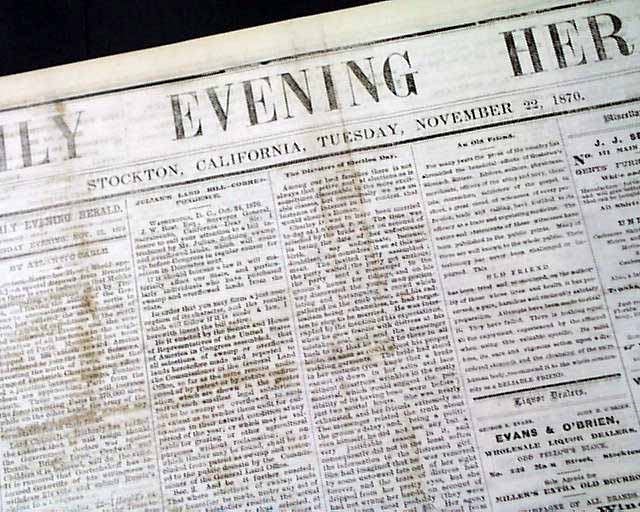
November 22, 1870
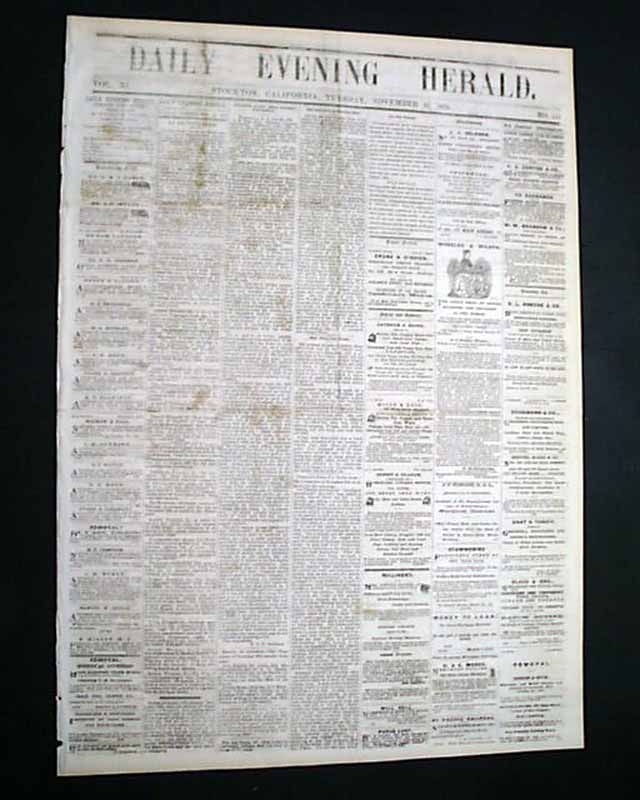
DAILY EVENING HERALD, Stockton, California, Nov. 22, 1870
* Wild Old West
* Rare publication
The city, founded in 1849, is named after Robert F. Stockton and it was the first community in California to have a name not of Spanish or Native American origin. During its early years, Stockton was known by several names including "Tuleburg" "Fat City" and "Mudville".
Built during the California Gold Rush, Stockton's seaport serves as a gateway to the Central Valley and beyond.
Four pages, nice condition.
Background: Founded in 1849 by German immigrant Charles Maria Weber at the height of the California Gold Rush, Stockton’s historical significance lies in its rapid evolution from a muddy, marshland settlement into a vital logistical lifeline for the American West. Originally known by localized names like "Weberville," "Tuleburg," and the famously swampy nicknames "Mudville" and "Fat City," the community was ultimately renamed Stockton to honor U.S. Navy Commodore Robert F. Stockton, famously securing its place in history as the first city in California to bear a name that was neither of Spanish nor Native American origin. Positioned strategically as the head of navigation on the San Joaquin River, Stockton quickly became the premier inland seaport and "gateway" supply hub, channeling thousands of global fortune seekers, diverse immigrant laborers, and tons of equipment directly to the southern gold mines. When the gold fields eventually dried up, this robust transportation infrastructure allowed Stockton to seamlessly pivot into a dominant industrial and agricultural powerhouse, pioneering critical farming innovations like the Stockton Gang Plow and track-type tractors that revolutionized global food production and cemented the city's legacy as the economic backbone of California's fertile Central Valley.
* Wild Old West
* Rare publication
The city, founded in 1849, is named after Robert F. Stockton and it was the first community in California to have a name not of Spanish or Native American origin. During its early years, Stockton was known by several names including "Tuleburg" "Fat City" and "Mudville".
Built during the California Gold Rush, Stockton's seaport serves as a gateway to the Central Valley and beyond.
Four pages, nice condition.
Background: Founded in 1849 by German immigrant Charles Maria Weber at the height of the California Gold Rush, Stockton’s historical significance lies in its rapid evolution from a muddy, marshland settlement into a vital logistical lifeline for the American West. Originally known by localized names like "Weberville," "Tuleburg," and the famously swampy nicknames "Mudville" and "Fat City," the community was ultimately renamed Stockton to honor U.S. Navy Commodore Robert F. Stockton, famously securing its place in history as the first city in California to bear a name that was neither of Spanish nor Native American origin. Positioned strategically as the head of navigation on the San Joaquin River, Stockton quickly became the premier inland seaport and "gateway" supply hub, channeling thousands of global fortune seekers, diverse immigrant laborers, and tons of equipment directly to the southern gold mines. When the gold fields eventually dried up, this robust transportation infrastructure allowed Stockton to seamlessly pivot into a dominant industrial and agricultural powerhouse, pioneering critical farming innovations like the Stockton Gang Plow and track-type tractors that revolutionized global food production and cemented the city's legacy as the economic backbone of California's fertile Central Valley.
Category: The Old West


