

Assassination of Abraham Lincoln...
Item # 712064This item is currently up for auction on eBay (item #110588487331). You’re welcome to bid there, or email us at info@rarenewspapers.com if you’d prefer to buy directly at the web-price. If it remains unsold, we’ll be in touch.
April 15, 1865
THE WORLD, New York, April 15, 1865
* Abraham Lincoln assassination (1st report)
* Ford's Theater - John Wilkes Booth
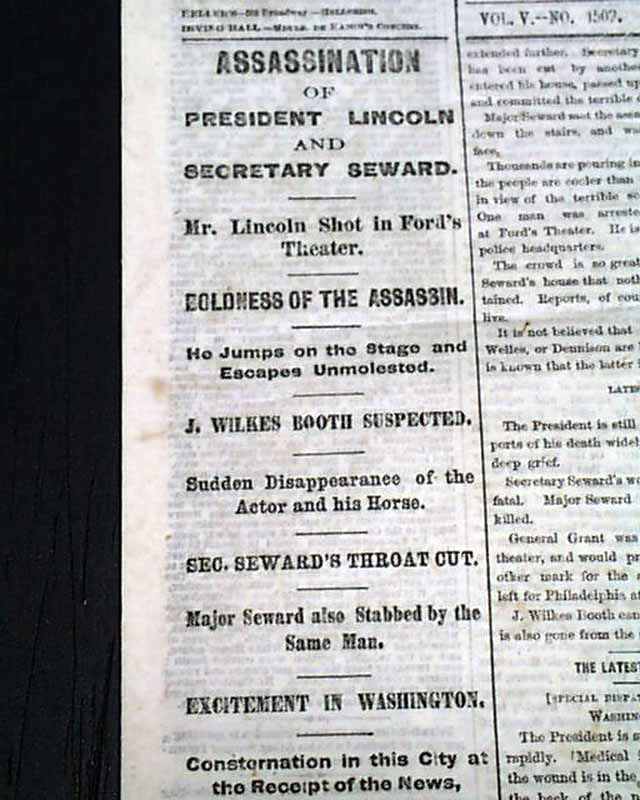
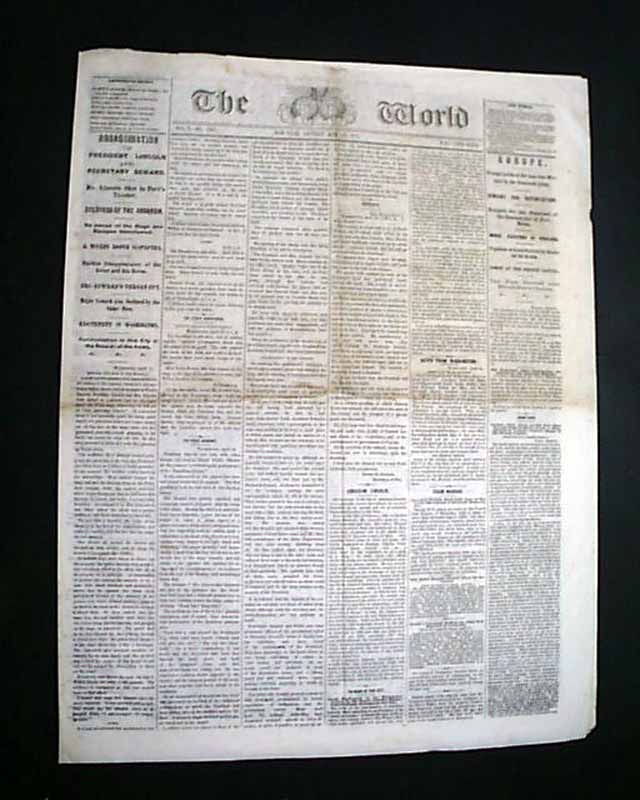
The top of the first column of the front page reports one of the most historic & tragic events of the 19th century: the assassination of President Abraham Lincoln.
The headlines include: "ASSASSINATION of PRESIDENT LINCOLN and SECRETARY SEWARD" "Mr. Lincoln Shot in Ford's Theater" "Boldness of the Assassin" "He Jumps on the State and Escapes Unmolested" "J. Wilkes Booth Suspected" "Sudden Disappearance of the Actor and his Horse" "Sec. Seward's Throat Cut" "Excitement In Washington" and more.
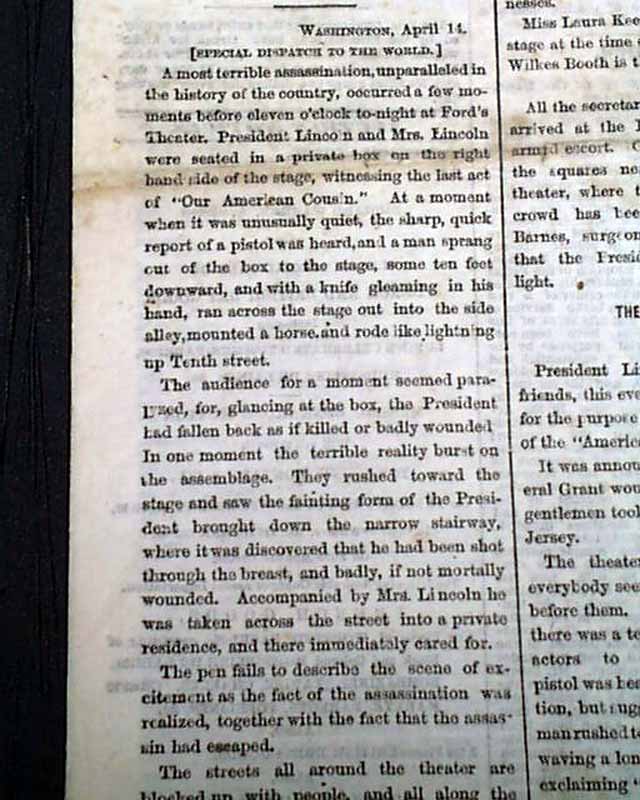
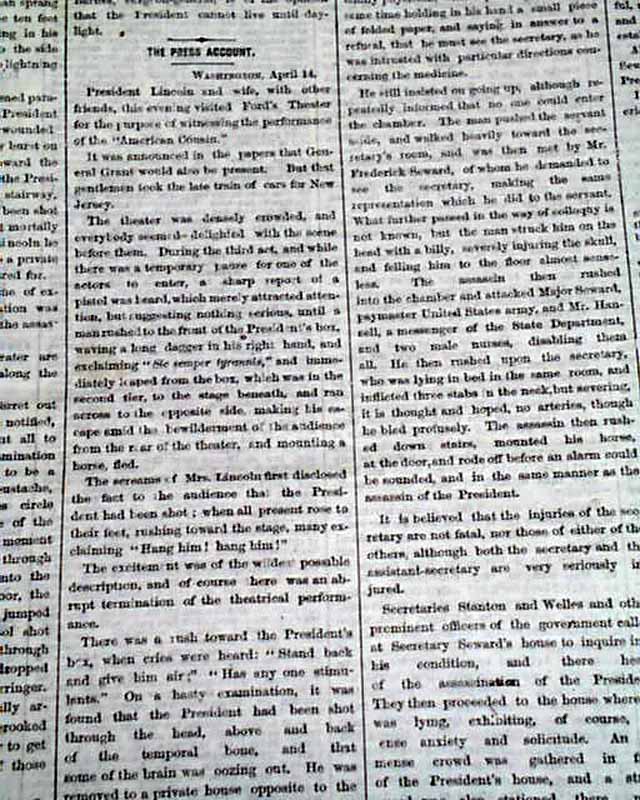
The report begins: "A most terrible assassination, unparalleled in the history of the country, occurred a few moments before eleven o'clock to-night at Ford's Theater. President Lincoln and Mrs. Lincoln were seated in a private box on the right hand side of the stage, witnessing the last act of 'Our American Cousin'...the sharp, quick report of a pistol was heard and a man sprung out of the box to the stage...with a knife gleaming in his hand...The audience for a moment seemed paralyzed for, glancing at the box, the President had fallen back as it killed or badly wounded..." with much more.
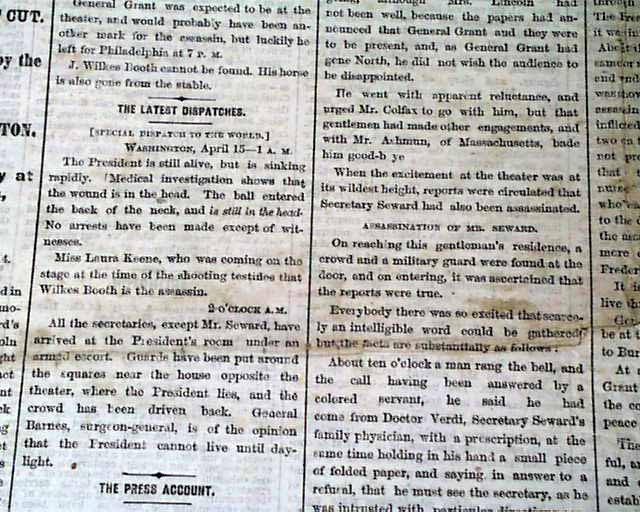
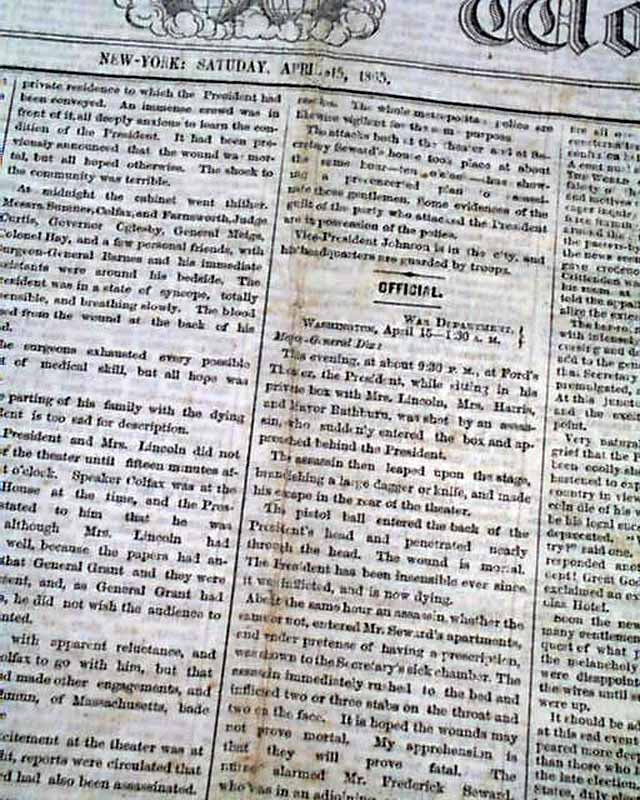
There are several dispatches, one from 12:15 a.m. noting: "The President is still alive. Just now reports of his death widely prevail and cause deep grief..." and another at 1 a.m. "The President is still alive but is sinking rapidly. Medical investigation shows that the wound is in the head. The ball entered the back of the neck & is still in the head...".
The last dispatch before press time is 1:30 a.m. which notes: "...The pistol ball entered the back of the President's head and penetrated nearly through the head. The wound is mortal. The President has been insensible ever since it was inflicted and is now dying...".
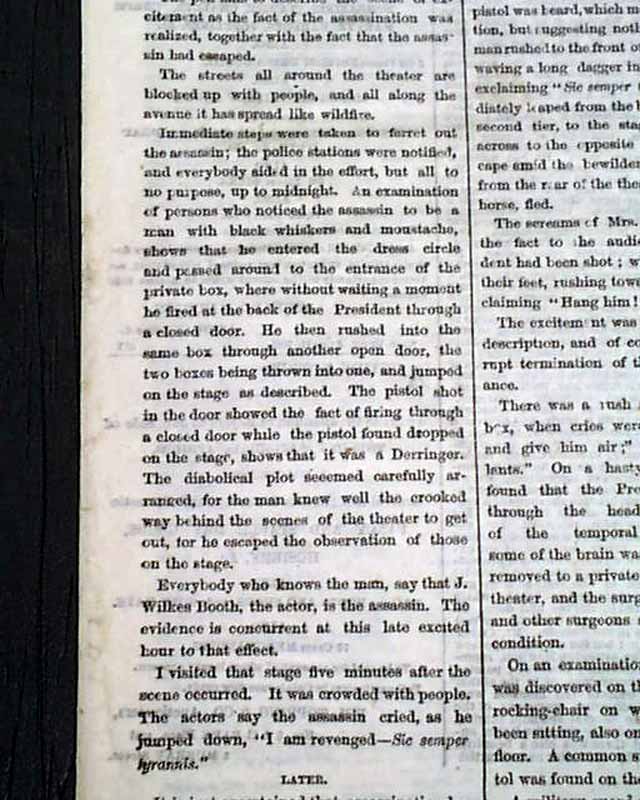
A wealth of other details on the assassination fills much of the front page.
This is a very early edition as the news dispatches note that the President had yet to die by the time this issue went to press.
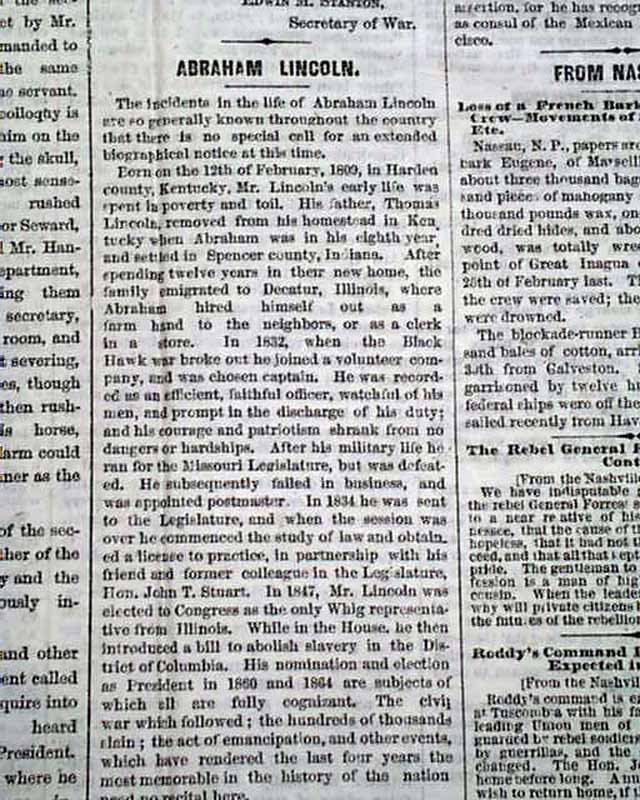
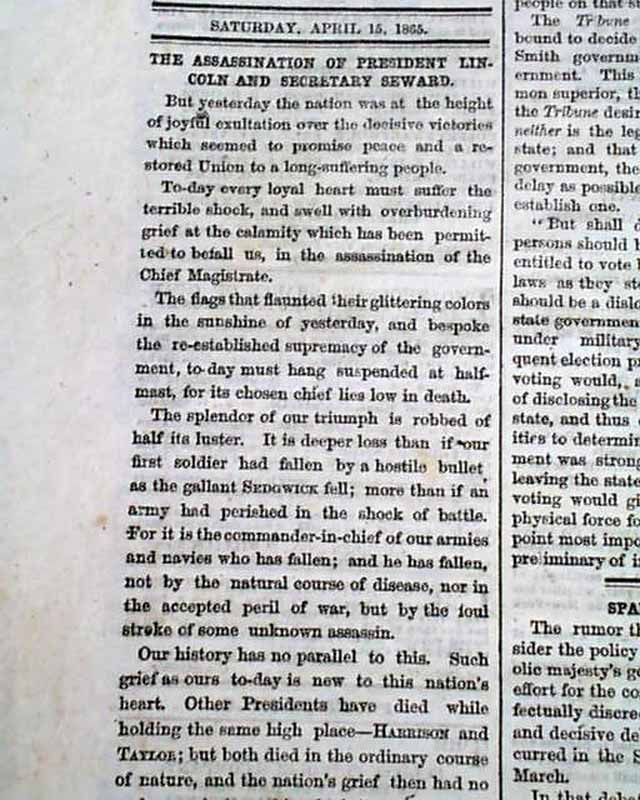
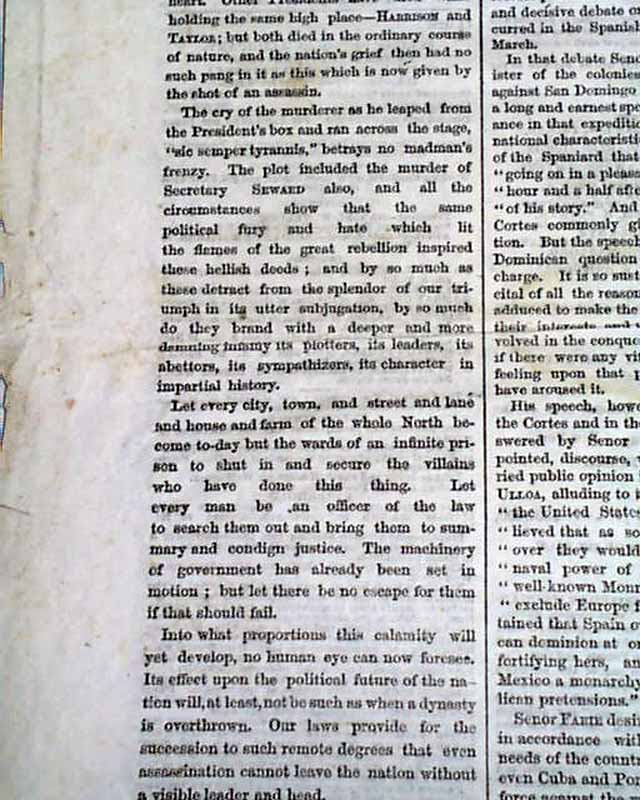
Inside has a very nice editorial headed: "The Assassination Of President Lincoln and Secretary Seward".
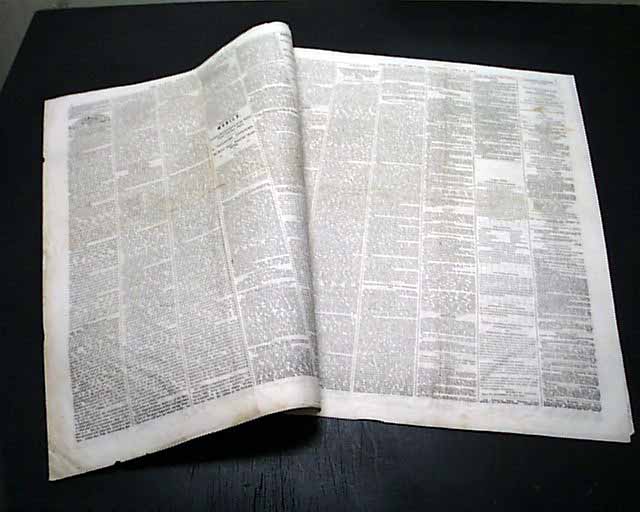
Complete in 8 pages, a never-bound issue, light foxing to an upper quadrant of the front page, good condition.
Background: The assassination of President Abraham Lincoln on April 15, 1865, stands as a cataclysmic turning point in American history, representing the first assassination of a U.S. president and the violent climax of the Civil War era. Occurring just days after Confederate General Robert E. Lee’s surrender at Appomattox, the event shattered the nation’s fleeting moment of celebratory relief and plunged a fractured country into unprecedented grief and political chaos. The strike at Ford’s Theater by John Wilkes Booth was not an isolated act of vengeance but part of a larger, coordinated conspiracy to decapitate the Union government—simultaneously targeting Vice President Andrew Johnson and Secretary of State William Seward—in a desperate bid to revive the Confederate cause. By mortally wounding Lincoln as he watched the play Our American Cousin, Booth silenced the primary architect of Union victory and the chief proponent of a merciful, balanced Reconstruction. The immediate media coverage, captured in frantic, real-time telegraph dispatches as Lincoln lay dying at the Petersen House, underscores the profound shock that united a bitter press and a divided public in mourning, ultimately altering the trajectory of American civil rights and sectional reunion by leaving the wounds of the Civil War to heal under a fractured and far more hostile political landscape.
* Abraham Lincoln assassination (1st report)
* Ford's Theater - John Wilkes Booth
The top of the first column of the front page reports one of the most historic & tragic events of the 19th century: the assassination of President Abraham Lincoln.
The headlines include: "ASSASSINATION of PRESIDENT LINCOLN and SECRETARY SEWARD" "Mr. Lincoln Shot in Ford's Theater" "Boldness of the Assassin" "He Jumps on the State and Escapes Unmolested" "J. Wilkes Booth Suspected" "Sudden Disappearance of the Actor and his Horse" "Sec. Seward's Throat Cut" "Excitement In Washington" and more.
The report begins: "A most terrible assassination, unparalleled in the history of the country, occurred a few moments before eleven o'clock to-night at Ford's Theater. President Lincoln and Mrs. Lincoln were seated in a private box on the right hand side of the stage, witnessing the last act of 'Our American Cousin'...the sharp, quick report of a pistol was heard and a man sprung out of the box to the stage...with a knife gleaming in his hand...The audience for a moment seemed paralyzed for, glancing at the box, the President had fallen back as it killed or badly wounded..." with much more.
There are several dispatches, one from 12:15 a.m. noting: "The President is still alive. Just now reports of his death widely prevail and cause deep grief..." and another at 1 a.m. "The President is still alive but is sinking rapidly. Medical investigation shows that the wound is in the head. The ball entered the back of the neck & is still in the head...".
The last dispatch before press time is 1:30 a.m. which notes: "...The pistol ball entered the back of the President's head and penetrated nearly through the head. The wound is mortal. The President has been insensible ever since it was inflicted and is now dying...".
A wealth of other details on the assassination fills much of the front page.
This is a very early edition as the news dispatches note that the President had yet to die by the time this issue went to press.
Inside has a very nice editorial headed: "The Assassination Of President Lincoln and Secretary Seward".
Complete in 8 pages, a never-bound issue, light foxing to an upper quadrant of the front page, good condition.
Background: The assassination of President Abraham Lincoln on April 15, 1865, stands as a cataclysmic turning point in American history, representing the first assassination of a U.S. president and the violent climax of the Civil War era. Occurring just days after Confederate General Robert E. Lee’s surrender at Appomattox, the event shattered the nation’s fleeting moment of celebratory relief and plunged a fractured country into unprecedented grief and political chaos. The strike at Ford’s Theater by John Wilkes Booth was not an isolated act of vengeance but part of a larger, coordinated conspiracy to decapitate the Union government—simultaneously targeting Vice President Andrew Johnson and Secretary of State William Seward—in a desperate bid to revive the Confederate cause. By mortally wounding Lincoln as he watched the play Our American Cousin, Booth silenced the primary architect of Union victory and the chief proponent of a merciful, balanced Reconstruction. The immediate media coverage, captured in frantic, real-time telegraph dispatches as Lincoln lay dying at the Petersen House, underscores the profound shock that united a bitter press and a divided public in mourning, ultimately altering the trajectory of American civil rights and sectional reunion by leaving the wounds of the Civil War to heal under a fractured and far more hostile political landscape.
Category: Post-Civil War


