



A newspaper for spiritualists and occultists...
Item # 709880
November 13, 1875
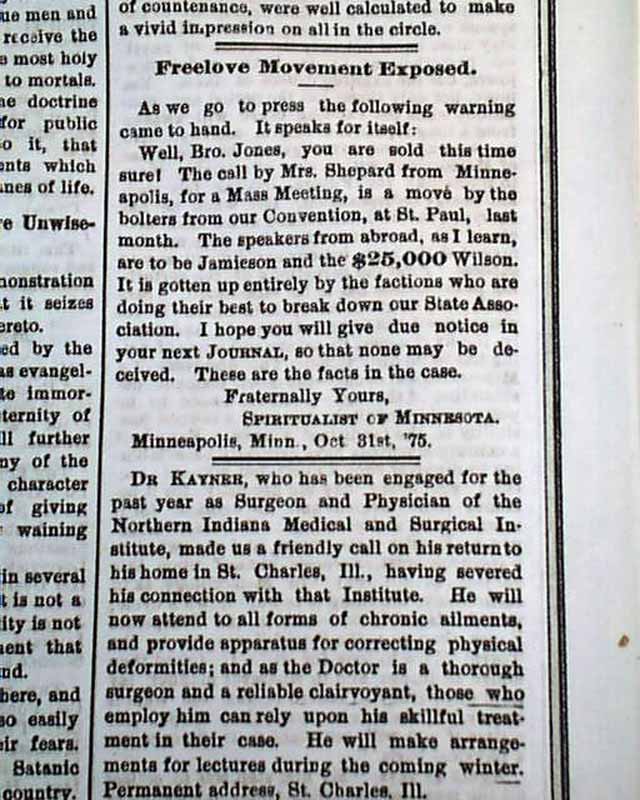
RELIGIO PHILOSOPHICAL JOURNAL, Chicago, Nov. 13, 1875
* Spiritualism - Mediums
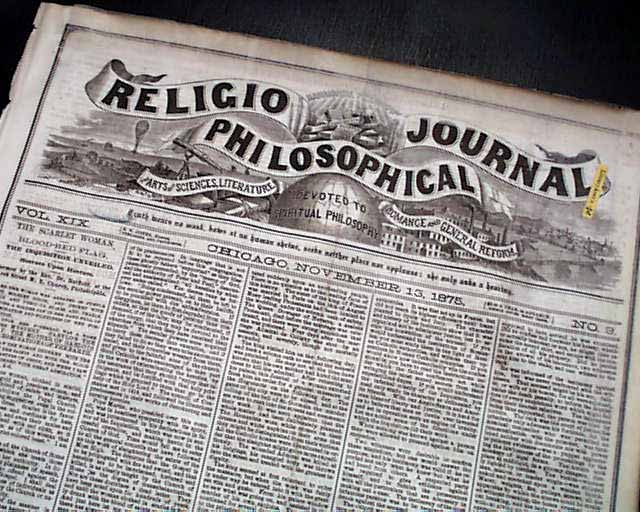
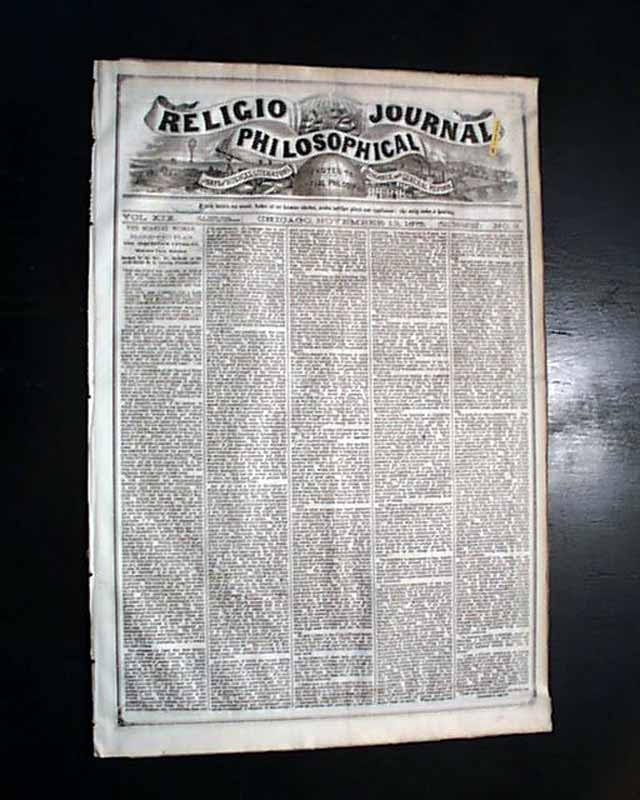
A quite uncommon title which, as noted in the decorative masthead, is "Devoted To Spiritual Philosophy". This interesting newspaper was begun in 1865 by an association of dozens of the leading spiritualists of the day. Its masthead is a graphic depiction of the progressive, free-religious views of the association showing "Harmonial Philosophy" shedding its light on the Bible, Koran, Zend-Avesta and Shaster, surrounded by scenes of nineteenth-century progress (steamships, balloons, telescopes, factories, etc.). Files of this newspaper are held by the "International Assoc. for the Preservation of Spirtualists and Occult Periodicals".
Eight pages, archival strengthening at the margins, small library label within masthead.
background: Published in the wake of the Great Chicago Fire and the burgeoning Industrial Revolution, the November 13, 1875, issue of the Religio-Philosophical Journal serves as a vibrant artifact of the "Harmonial Philosophy" that sought to bridge the gap between ancient theology and modern mechanical triumph. By juxtaposing sacred texts like the Zend-Avesta and the Koran with the cutting-edge imagery of steamships and telescopes, the journal reflected a uniquely American brand of Spiritualism that viewed mediumship not as a supernatural anomaly, but as a scientific frontier akin to the telegraph. This "free-religious" perspective, championed by the ill-fated editor S.S. Jones, positioned Chicago as a radical hub for intellectual liberty, where the evolution of the soul was believed to move in lockstep with the expansion of the factory and the laboratory. Today, the preservation of these eight-page issues by organizations like IAPSOP allows historians to trace how 19th-century thinkers attempted to dismantle religious dogmatism in favor of a universal, progressive truth that embraced both the séance room and the soot of the industrial age.
* Spiritualism - Mediums
A quite uncommon title which, as noted in the decorative masthead, is "Devoted To Spiritual Philosophy". This interesting newspaper was begun in 1865 by an association of dozens of the leading spiritualists of the day. Its masthead is a graphic depiction of the progressive, free-religious views of the association showing "Harmonial Philosophy" shedding its light on the Bible, Koran, Zend-Avesta and Shaster, surrounded by scenes of nineteenth-century progress (steamships, balloons, telescopes, factories, etc.). Files of this newspaper are held by the "International Assoc. for the Preservation of Spirtualists and Occult Periodicals".
Eight pages, archival strengthening at the margins, small library label within masthead.
background: Published in the wake of the Great Chicago Fire and the burgeoning Industrial Revolution, the November 13, 1875, issue of the Religio-Philosophical Journal serves as a vibrant artifact of the "Harmonial Philosophy" that sought to bridge the gap between ancient theology and modern mechanical triumph. By juxtaposing sacred texts like the Zend-Avesta and the Koran with the cutting-edge imagery of steamships and telescopes, the journal reflected a uniquely American brand of Spiritualism that viewed mediumship not as a supernatural anomaly, but as a scientific frontier akin to the telegraph. This "free-religious" perspective, championed by the ill-fated editor S.S. Jones, positioned Chicago as a radical hub for intellectual liberty, where the evolution of the soul was believed to move in lockstep with the expansion of the factory and the laboratory. Today, the preservation of these eight-page issues by organizations like IAPSOP allows historians to trace how 19th-century thinkers attempted to dismantle religious dogmatism in favor of a universal, progressive truth that embraced both the séance room and the soot of the industrial age.
Category: Post-Civil War


