

A "newspaper" for commoners...
Item # 705752
January 01, 1756
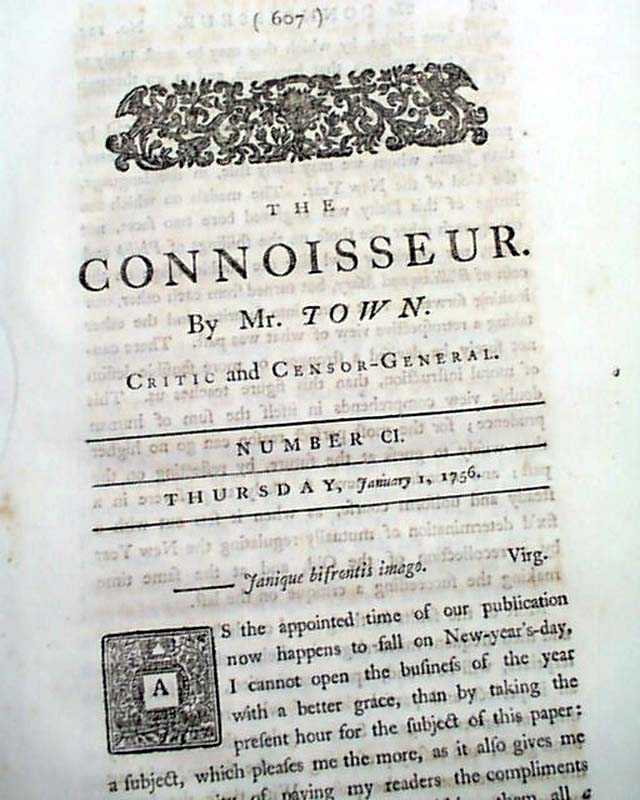
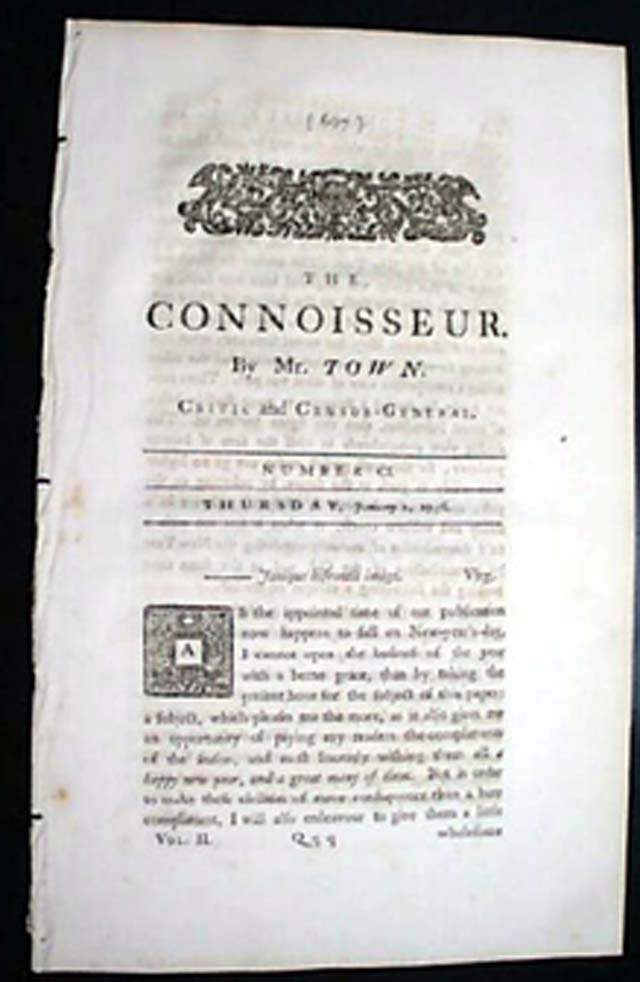
THE CONNOISSEUR "By Mr. Town [pseud.], Critic, and Censor-General", London, Jan. 1, 1756
* Rare 18th century British publication
A weekly paper which lasted about 2 1/2 years as a "commoner's" counterpart to "The World" (which we sell as well), a periodical of about the same time which dealt more with the interests of aristocrats.
James Boswell says in his "Life of Johnson", "...I mentioned the periodical paper called 'THE CONNOISSEUR'. He said it wanted matter. — No doubt it had not the deep thinking of Johnson's writings. But surely it has just views of the surface of life, and a very sprightly manner. His opinion of 'THE WORLD' was not much higher than of 'THE CONNOISSEUR'...".
Six pages, 7 by 11 1/4 inches, wide margins, very nice condition.
AI notes: The Connoisseur, a London weekly newspaper published from 1754 to 1756, appeared under the pseudonymous masthead “By Mr. Town, Critic and Censor‑General”, a fictional persona created by George Colman the Elder and Bonnell Thornton to offer witty, satirical commentary on contemporary society. Issued weekly, each of its 140 issues typically featured a single essay blending literary criticism, social observation, and moral reflection, often lampooning the fashions, vices, and follies of mid‑18th‑century London life. Following in the tradition of periodicals like The Spectator, The Connoisseur combined moral instruction with entertainment, attracting contributions from notable writers including Thomas Warton, William Cowper, Robert Lloyd, John Duncombe, and Orator Henley. Its tone was urbane and ironic, aimed at a readership interested in taste, refinement, and the cultural trends of the capital, yet its satire sometimes blurred into complicity with the very social behaviors it critiqued. Though contemporary figures such as Samuel Johnson criticized it for lacking substantive depth, the newspaper played an important role in the flourishing periodical culture of Georgian England, leaving a legacy as a primary source for scholars examining literary style, social manners, and the public discourse of London in the 1750s.
* Rare 18th century British publication
A weekly paper which lasted about 2 1/2 years as a "commoner's" counterpart to "The World" (which we sell as well), a periodical of about the same time which dealt more with the interests of aristocrats.
James Boswell says in his "Life of Johnson", "...I mentioned the periodical paper called 'THE CONNOISSEUR'. He said it wanted matter. — No doubt it had not the deep thinking of Johnson's writings. But surely it has just views of the surface of life, and a very sprightly manner. His opinion of 'THE WORLD' was not much higher than of 'THE CONNOISSEUR'...".
Six pages, 7 by 11 1/4 inches, wide margins, very nice condition.
AI notes: The Connoisseur, a London weekly newspaper published from 1754 to 1756, appeared under the pseudonymous masthead “By Mr. Town, Critic and Censor‑General”, a fictional persona created by George Colman the Elder and Bonnell Thornton to offer witty, satirical commentary on contemporary society. Issued weekly, each of its 140 issues typically featured a single essay blending literary criticism, social observation, and moral reflection, often lampooning the fashions, vices, and follies of mid‑18th‑century London life. Following in the tradition of periodicals like The Spectator, The Connoisseur combined moral instruction with entertainment, attracting contributions from notable writers including Thomas Warton, William Cowper, Robert Lloyd, John Duncombe, and Orator Henley. Its tone was urbane and ironic, aimed at a readership interested in taste, refinement, and the cultural trends of the capital, yet its satire sometimes blurred into complicity with the very social behaviors it critiqued. Though contemporary figures such as Samuel Johnson criticized it for lacking substantive depth, the newspaper played an important role in the flourishing periodical culture of Georgian England, leaving a legacy as a primary source for scholars examining literary style, social manners, and the public discourse of London in the 1750s.
Category: The 1600's and 1700's


