

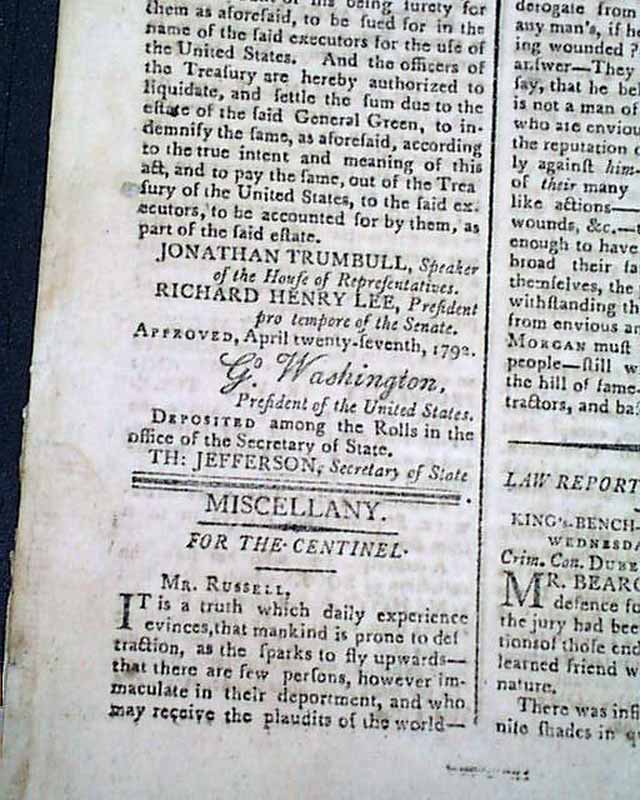
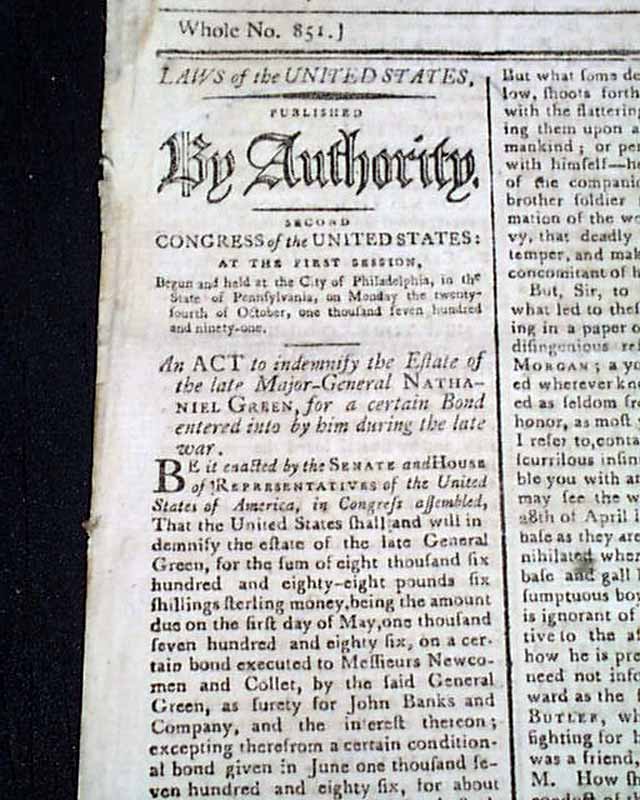
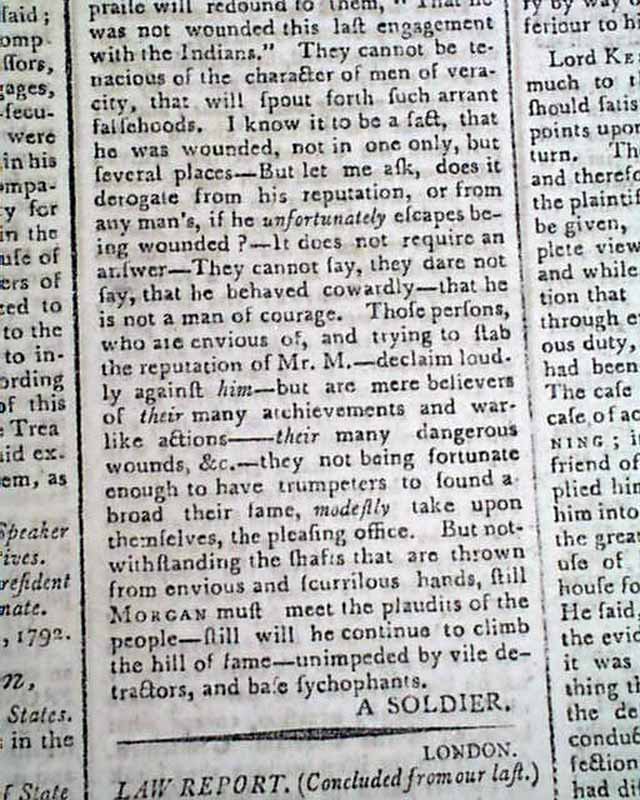
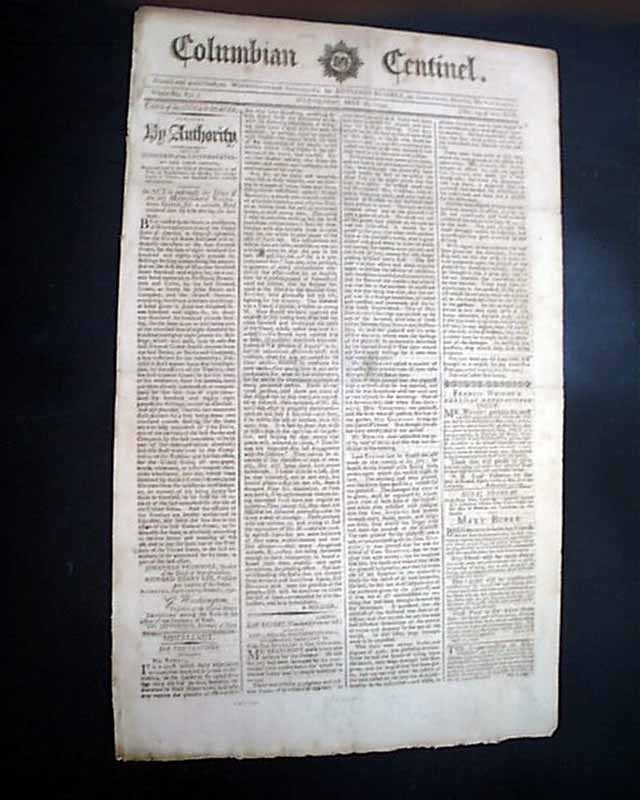
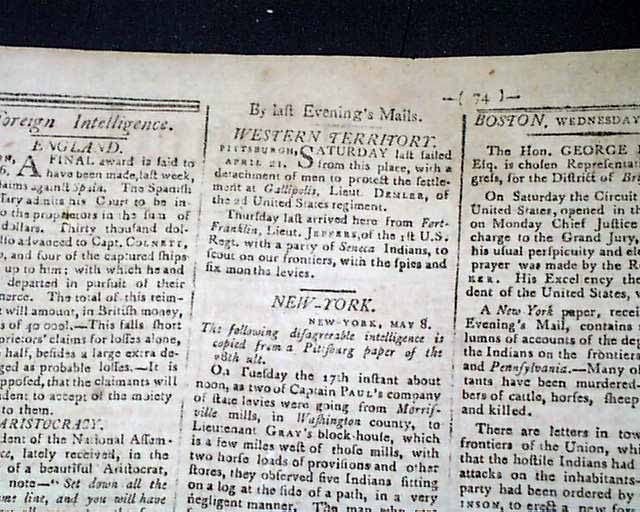
Washington signs an Act of Congress concerning General Greene... Indian troubles near Pittsburgh...
Item # 703610Sorry, but this item is no longer available. Please be in touch at info@rarenewspapers.com if you would like to be placed on a want list or are interested in a potential alternate issue.
May 16, 1792
COLUMBIAN CENTINEL, Boston, May 16, 1792
* President George Washington
* United States Congress Act
* General Nathaniel Greene
The front page has almost a full column Act of Congress concerning General Nathaniel Greene. It is signed in script type by the President: Go. Washington.
Page 2 has a report concerning trouble with the Indians in the Pittsburgh vicinity. Another item mentions: "...from the frontiers of the Union which mention that the hostile Indians had made several attacks on the inhabitants--and that a party had been ordered by Gen. Wilkinson, to erect a new fort between fort Jefferson and fort Washington."
Four pages, never-trimmed margins, very nice condition.
AI notes: After General Nathaniel Greene's death in 1786, his estate became a complicated and burdensome matter for his widow, Catharine Greene, and their children. Despite his distinguished service during the American Revolution, particularly in the southern campaigns, Greene had accrued substantial personal debt due to his out-of-pocket expenditures supporting the Continental Army. Though Congress had attempted to compensate him during his lifetime with land grants in places like Georgia, these grants were largely speculative and difficult to manage. After his death, the family struggled to capitalize on these lands, and Catharine worked tirelessly to settle debts and manage the estate. The 1792 Act for the Relief of General Nathaniel Greene, which offered additional land to his heirs, helped but did not resolve the financial difficulties, as much of the land was still undeveloped or difficult to access. Despite her efforts, the Greene family faced continued financial instability, and the legacy of their patriarch was overshadowed by the struggles to secure the estate’s value. Ultimately, General Greene's recognition as a revolutionary hero remained intact, but the financial hardships faced by his family after his passing marked a tragic contrast to the sacrifices he had made for the nation.
* President George Washington
* United States Congress Act
* General Nathaniel Greene
The front page has almost a full column Act of Congress concerning General Nathaniel Greene. It is signed in script type by the President: Go. Washington.
Page 2 has a report concerning trouble with the Indians in the Pittsburgh vicinity. Another item mentions: "...from the frontiers of the Union which mention that the hostile Indians had made several attacks on the inhabitants--and that a party had been ordered by Gen. Wilkinson, to erect a new fort between fort Jefferson and fort Washington."
Four pages, never-trimmed margins, very nice condition.
AI notes: After General Nathaniel Greene's death in 1786, his estate became a complicated and burdensome matter for his widow, Catharine Greene, and their children. Despite his distinguished service during the American Revolution, particularly in the southern campaigns, Greene had accrued substantial personal debt due to his out-of-pocket expenditures supporting the Continental Army. Though Congress had attempted to compensate him during his lifetime with land grants in places like Georgia, these grants were largely speculative and difficult to manage. After his death, the family struggled to capitalize on these lands, and Catharine worked tirelessly to settle debts and manage the estate. The 1792 Act for the Relief of General Nathaniel Greene, which offered additional land to his heirs, helped but did not resolve the financial difficulties, as much of the land was still undeveloped or difficult to access. Despite her efforts, the Greene family faced continued financial instability, and the legacy of their patriarch was overshadowed by the struggles to secure the estate’s value. Ultimately, General Greene's recognition as a revolutionary hero remained intact, but the financial hardships faced by his family after his passing marked a tragic contrast to the sacrifices he had made for the nation.
Category: The 1600's and 1700's


