

George Washington and Sam Adams...
Item # 703603
July 05, 1794
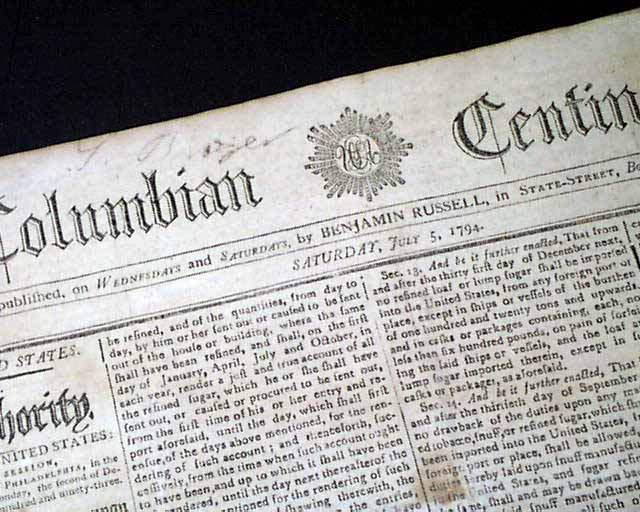
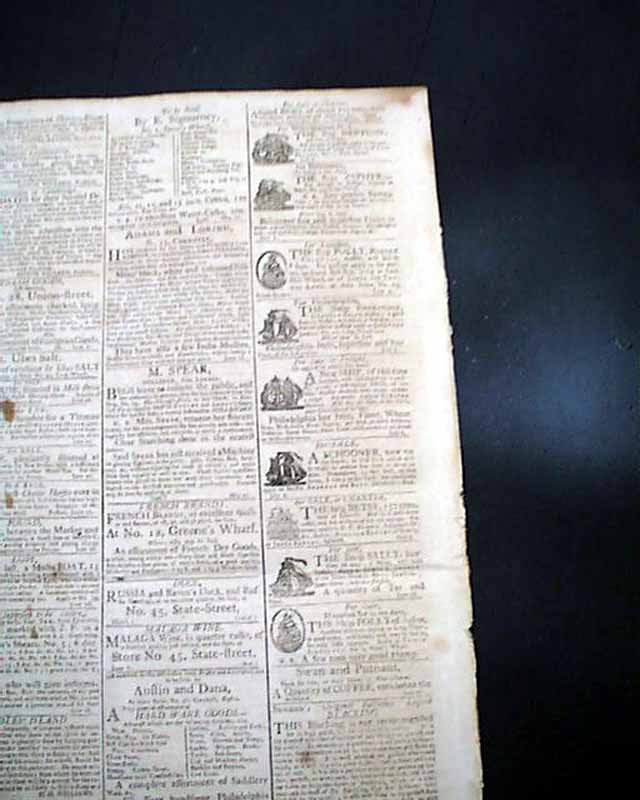
COLUMBIAN CENTINEL, Boston, July 5, 1794
* President George Washington
* Samuel Adams
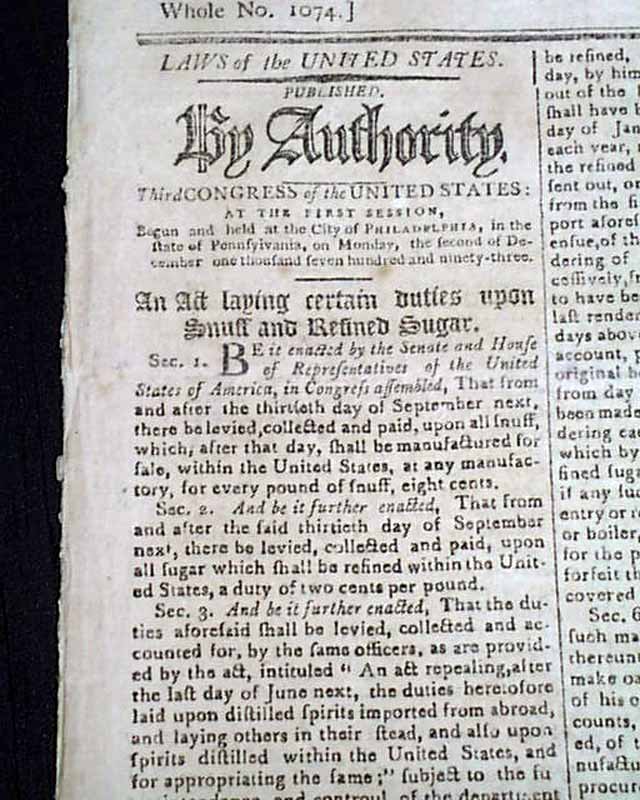
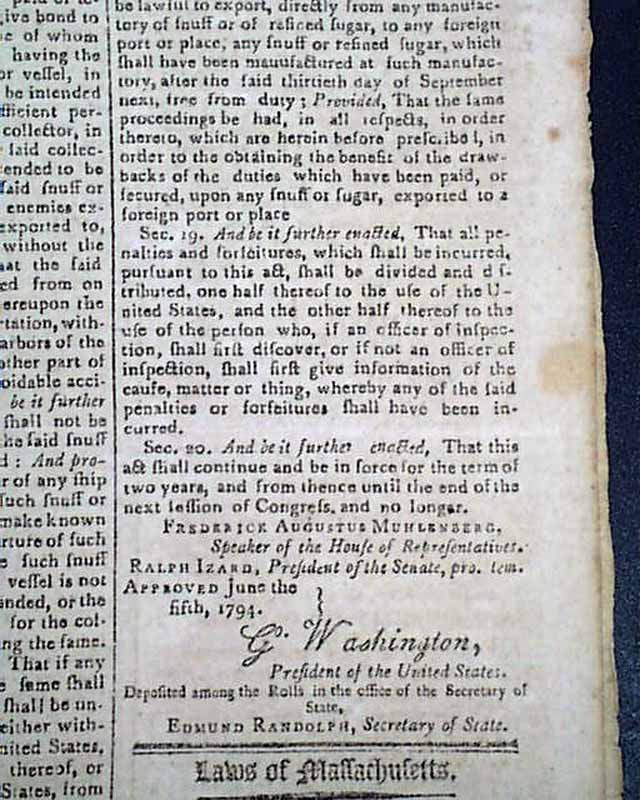
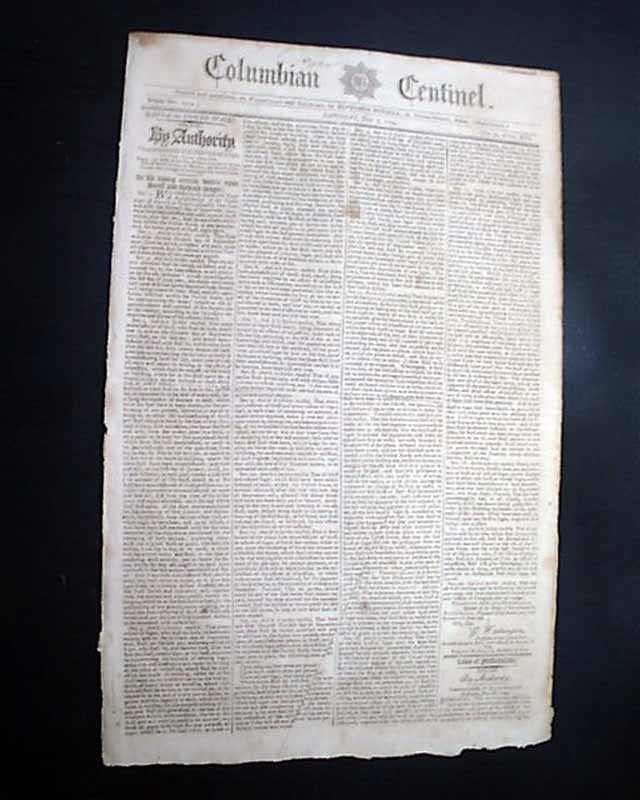
Almost the entire front page is taken up with: "An Act Laying Certain Duties Upon Snuff and Refined Sugar" which is signed in script type at its conclusion by the President: Go. Washington.
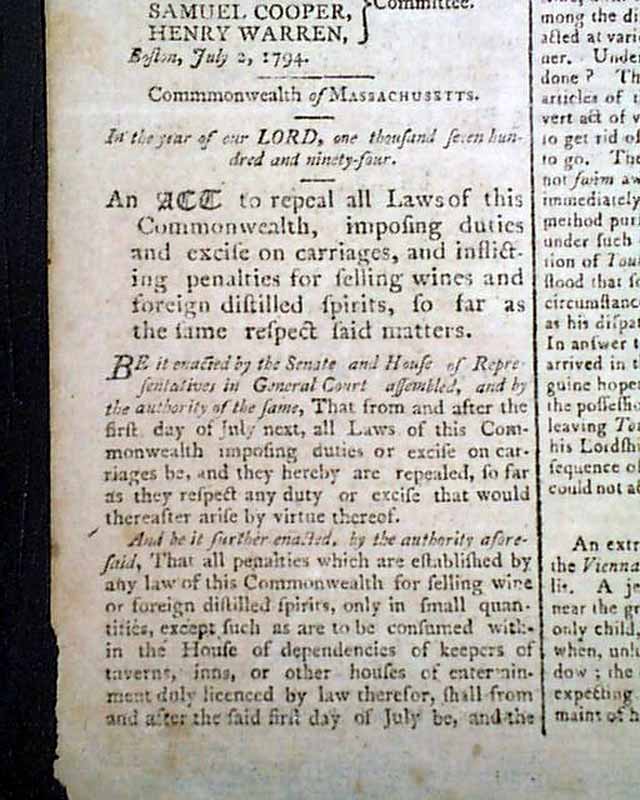
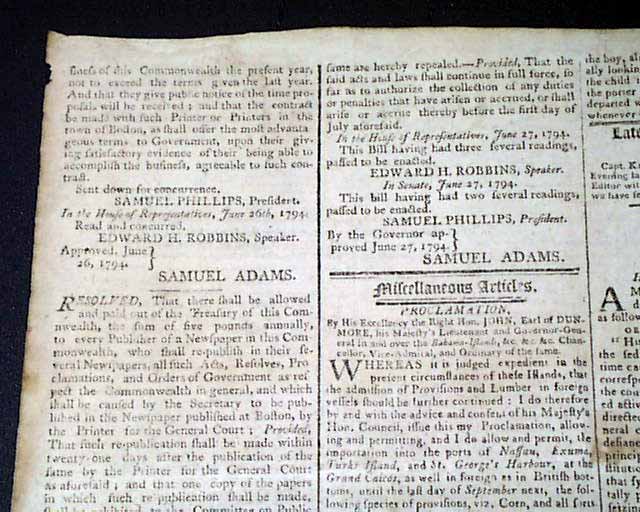
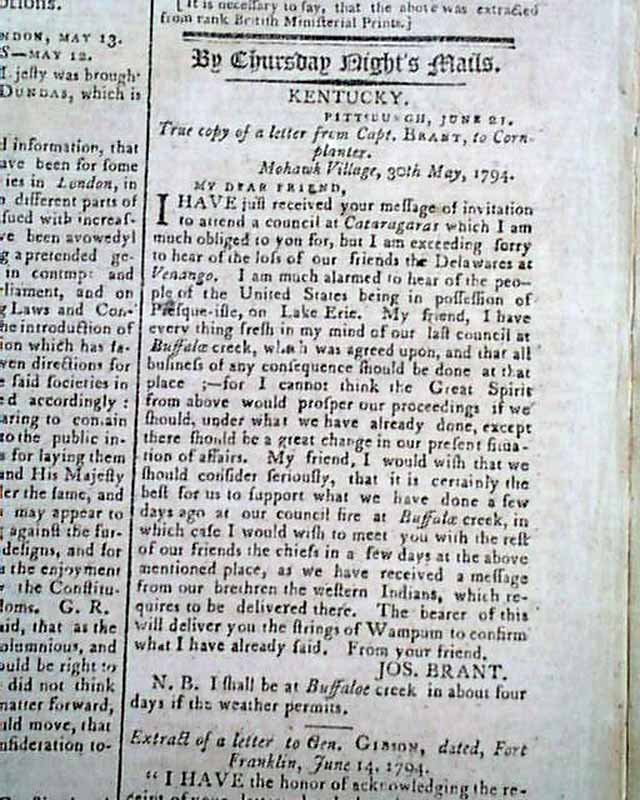
This is followed by two Acts of the Massachusetts legislature, carrying over to page 2, each signed in type: Samuel Adams. Page 2 also has a letter from Capt. Brant to the Indian Chief Cornplanter, dated at Mohawk Village.
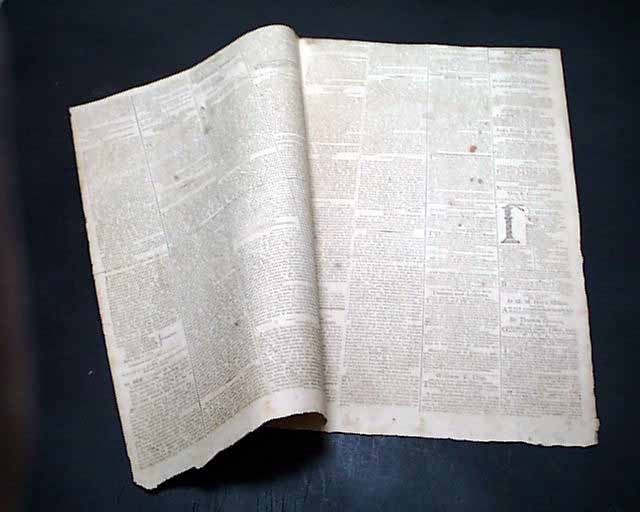
Four pages, very nice condition.
Background: The July 5, 1794, issue of the Columbian Centinel serves as a profound primary source documenting a "stress test" for the young United States, capturing the federal government’s aggressive efforts to establish financial sovereignty and frontier security. The front-page "Act Laying Certain Duties Upon Snuff and Refined Sugar," signed by George Washington, represents Alexander Hamilton’s controversial "Whiskey Tax" era, where the federal government’s right to levy internal taxes sparked the Whiskey Rebellion that very same year. The presence of Samuel Adams as Governor of Massachusetts highlights the era’s shift from revolutionary fervor to the bureaucratic reality of state governance, while the correspondence between Captain Joseph Brant and Cornplanter provides a window into the high-stakes diplomacy of the Northwest Indian War. This specific moment in 1794 was a pivot point: the U.S. was simultaneously proving it could collect taxes to pay off war debts and asserting its military presence in the West, all while the "founding generation" navigated the transition from being rebels against a crown to being the enforcers of their own new laws.
* President George Washington
* Samuel Adams
Almost the entire front page is taken up with: "An Act Laying Certain Duties Upon Snuff and Refined Sugar" which is signed in script type at its conclusion by the President: Go. Washington.
This is followed by two Acts of the Massachusetts legislature, carrying over to page 2, each signed in type: Samuel Adams. Page 2 also has a letter from Capt. Brant to the Indian Chief Cornplanter, dated at Mohawk Village.
Four pages, very nice condition.
Background: The July 5, 1794, issue of the Columbian Centinel serves as a profound primary source documenting a "stress test" for the young United States, capturing the federal government’s aggressive efforts to establish financial sovereignty and frontier security. The front-page "Act Laying Certain Duties Upon Snuff and Refined Sugar," signed by George Washington, represents Alexander Hamilton’s controversial "Whiskey Tax" era, where the federal government’s right to levy internal taxes sparked the Whiskey Rebellion that very same year. The presence of Samuel Adams as Governor of Massachusetts highlights the era’s shift from revolutionary fervor to the bureaucratic reality of state governance, while the correspondence between Captain Joseph Brant and Cornplanter provides a window into the high-stakes diplomacy of the Northwest Indian War. This specific moment in 1794 was a pivot point: the U.S. was simultaneously proving it could collect taxes to pay off war debts and asserting its military presence in the West, all while the "founding generation" navigated the transition from being rebels against a crown to being the enforcers of their own new laws.
Category: The 1600's and 1700's


