

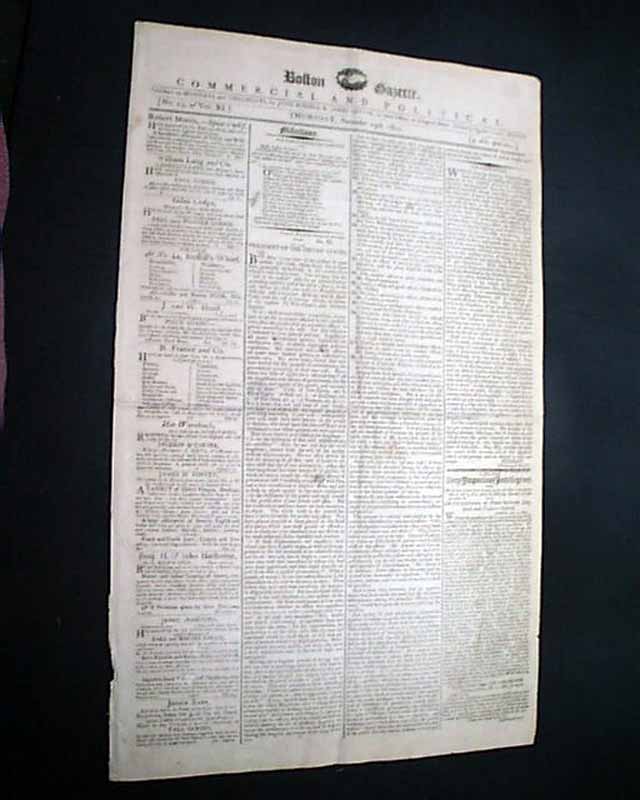
Peace between England and France... Life of Benedict Arnold...
Item # 702808This item is currently up for auction on eBay (item #110588487331). You’re welcome to bid there, or email us at info@rarenewspapers.com if you’d prefer to buy directly at the web-price. If it remains unsold, we’ll be in touch.
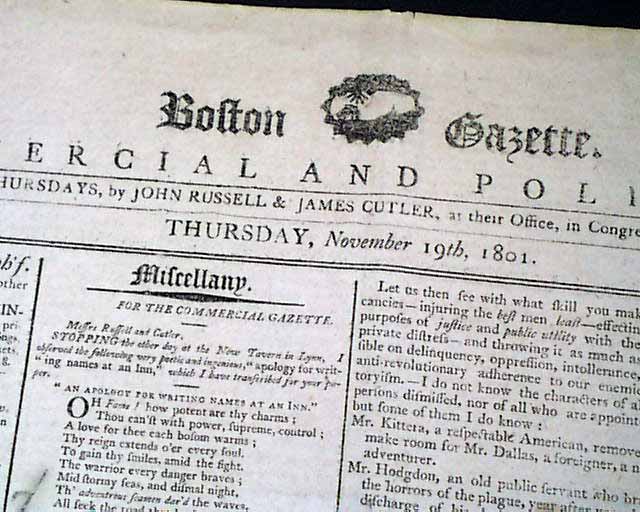
November 19, 1801
BOSTON GAZETTE, Nov. 19, 1801
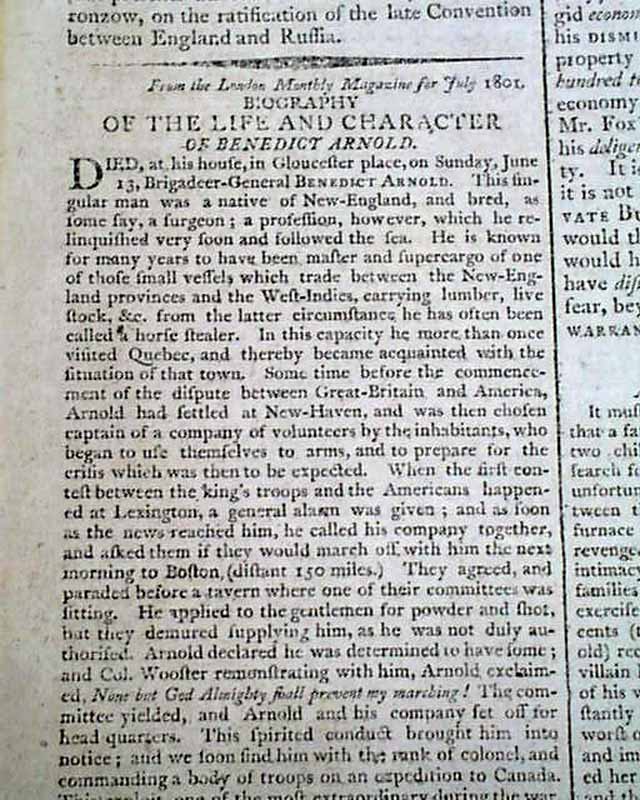
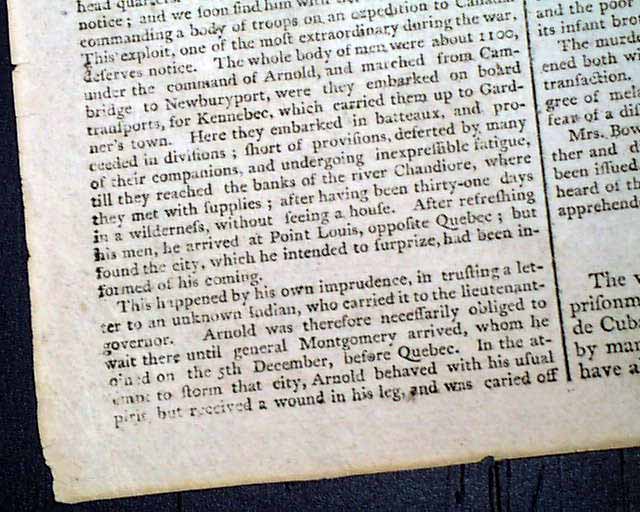
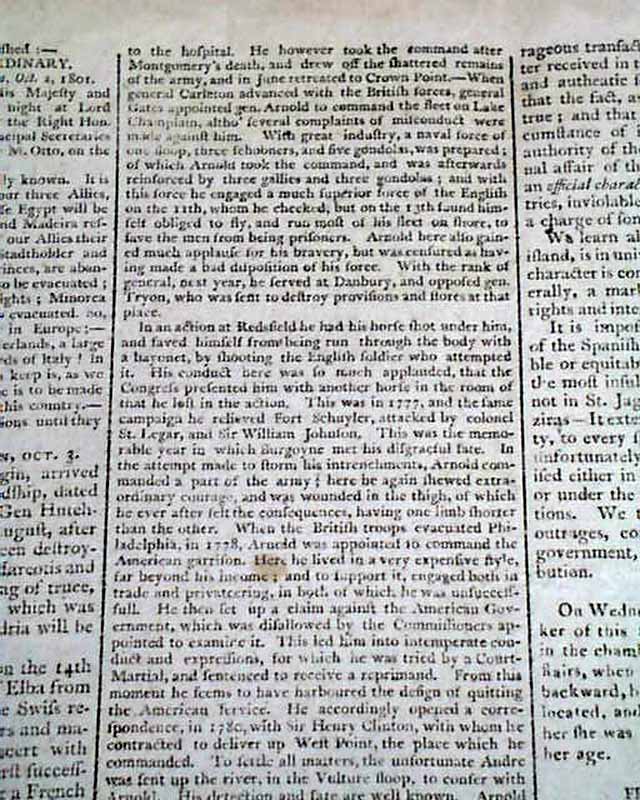
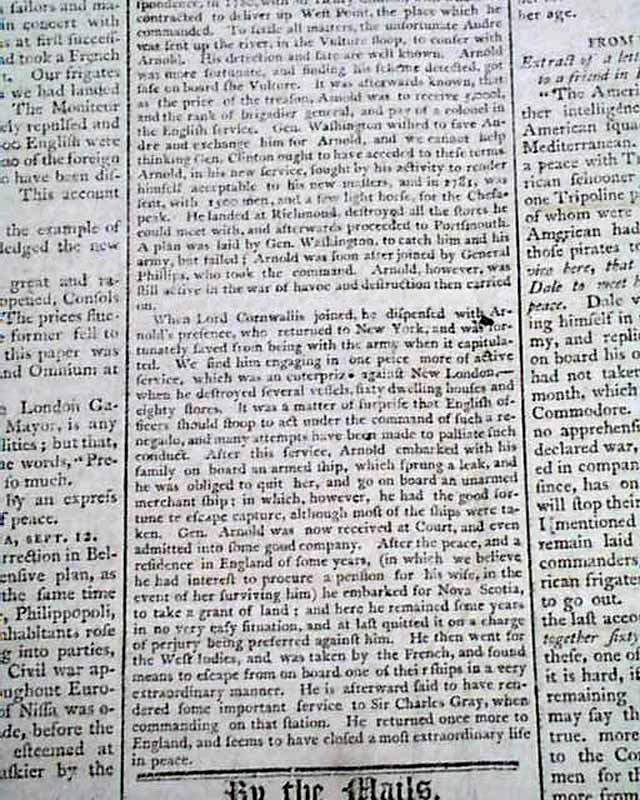
* Infamous traitor, Benedict Arnold
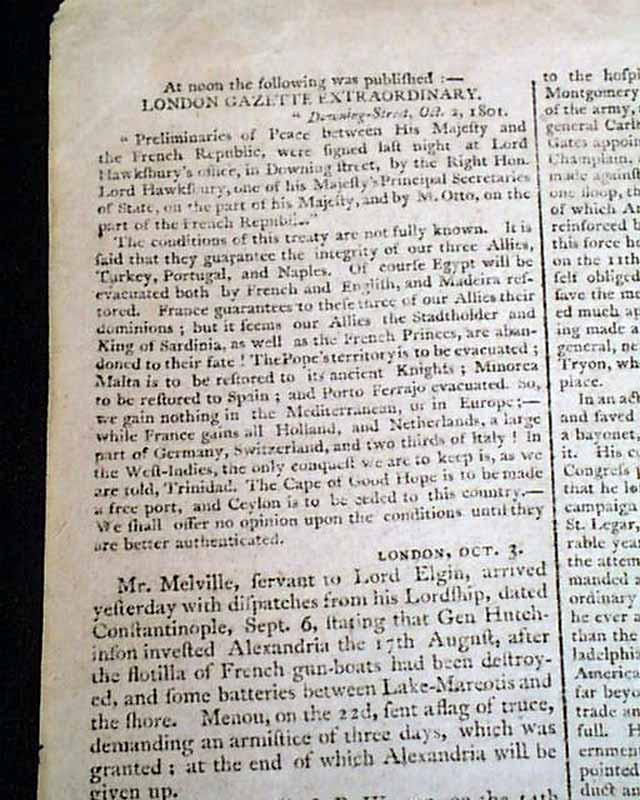
* Signing of the Treaty of Amiens
Page 2 begins with a report from the London Gazette Extraordinary, announcing that the peace treaty known as the Treaty of Amiens had been signed, and from the city where it happened: London.
The Treaty of Amiens temporarily ended hostilities between France and England at the end of the War of the Second Coalition. It marked the end of the French Revolutionary Wars, but after a short peace it set the stage for the Napoleonic Wars.
Also on page 2 is a nearly full-column report headed: "Biography Of The Life And Character of Benedict Arnold".
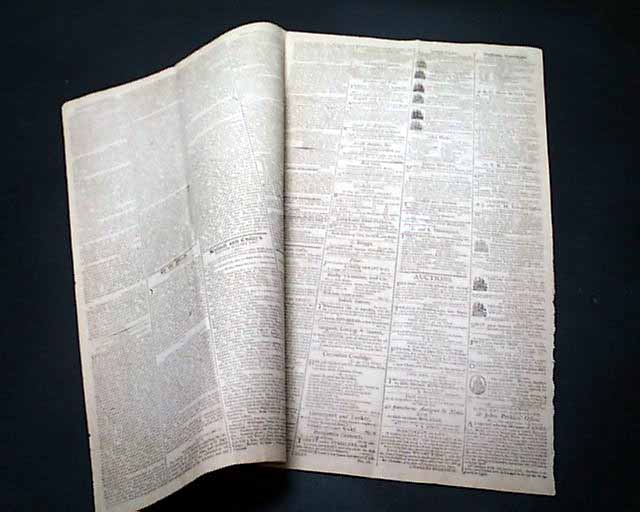
Four pages, very nice condition.
Background: The November 19, 1801 issue of the Boston Gazette captures a fleeting, high-stakes pivot point in global history by simultaneously documenting the signing of the Treaty of Amiens and the death of America’s most infamous traitor, Benedict Arnold. The treaty, which temporarily halted hostilities between Great Britain and Revolutionary France to end the War of the Second Coalition, brought a rare moment of euphoric relief to a war-weary Western world; however, this "peace" was highly ironic, lasting a mere 14 months before collapsing into the even more devastating Napoleonic Wars. Juxtaposed against this global geopolitical shift was the extensive biography of Benedict Arnold, who had died in London just five months prior on June 14, 1801. Because transatlantic news could only travel as fast as a sailing ship, this column represents the definitive, post-mortem reckoning of the American public with the man who symbolized the ultimate betrayal of their fragile, young republic. Preserved on durable rag-linen paper, this specific artifact bridges the conclusion of the American and French Revolutionary eras, standing as a tangible time capsule of a moment when the world briefly paused between a decade of revolution and a decade of total imperial warfare.
* Infamous traitor, Benedict Arnold
* Signing of the Treaty of Amiens
Page 2 begins with a report from the London Gazette Extraordinary, announcing that the peace treaty known as the Treaty of Amiens had been signed, and from the city where it happened: London.
The Treaty of Amiens temporarily ended hostilities between France and England at the end of the War of the Second Coalition. It marked the end of the French Revolutionary Wars, but after a short peace it set the stage for the Napoleonic Wars.
Also on page 2 is a nearly full-column report headed: "Biography Of The Life And Character of Benedict Arnold".
Four pages, very nice condition.
Background: The November 19, 1801 issue of the Boston Gazette captures a fleeting, high-stakes pivot point in global history by simultaneously documenting the signing of the Treaty of Amiens and the death of America’s most infamous traitor, Benedict Arnold. The treaty, which temporarily halted hostilities between Great Britain and Revolutionary France to end the War of the Second Coalition, brought a rare moment of euphoric relief to a war-weary Western world; however, this "peace" was highly ironic, lasting a mere 14 months before collapsing into the even more devastating Napoleonic Wars. Juxtaposed against this global geopolitical shift was the extensive biography of Benedict Arnold, who had died in London just five months prior on June 14, 1801. Because transatlantic news could only travel as fast as a sailing ship, this column represents the definitive, post-mortem reckoning of the American public with the man who symbolized the ultimate betrayal of their fragile, young republic. Preserved on durable rag-linen paper, this specific artifact bridges the conclusion of the American and French Revolutionary eras, standing as a tangible time capsule of a moment when the world briefly paused between a decade of revolution and a decade of total imperial warfare.
Category: Pre-Civil War


