

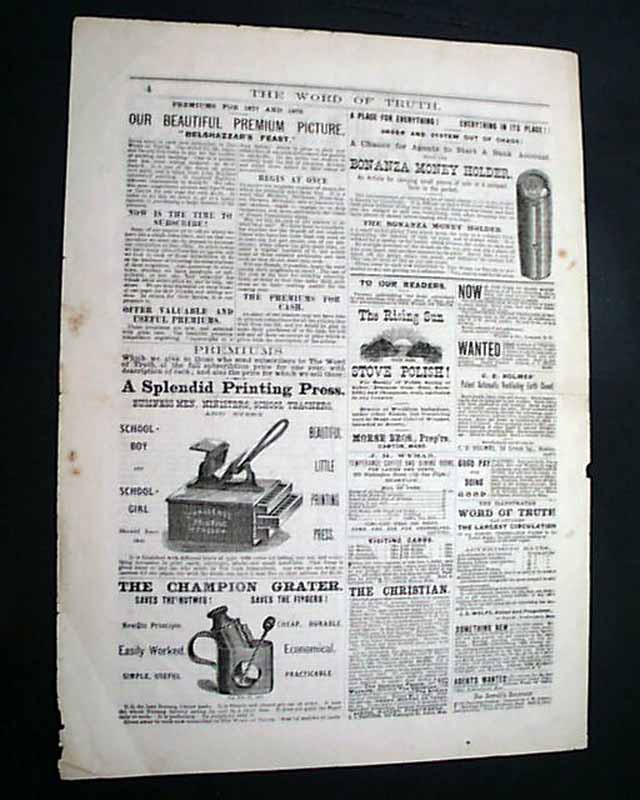
An uncommon temperance newspaper...
Item # 702087
December 06, 1877
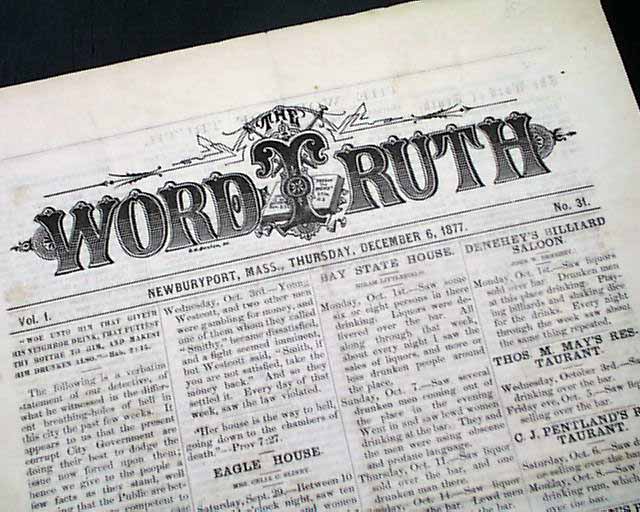
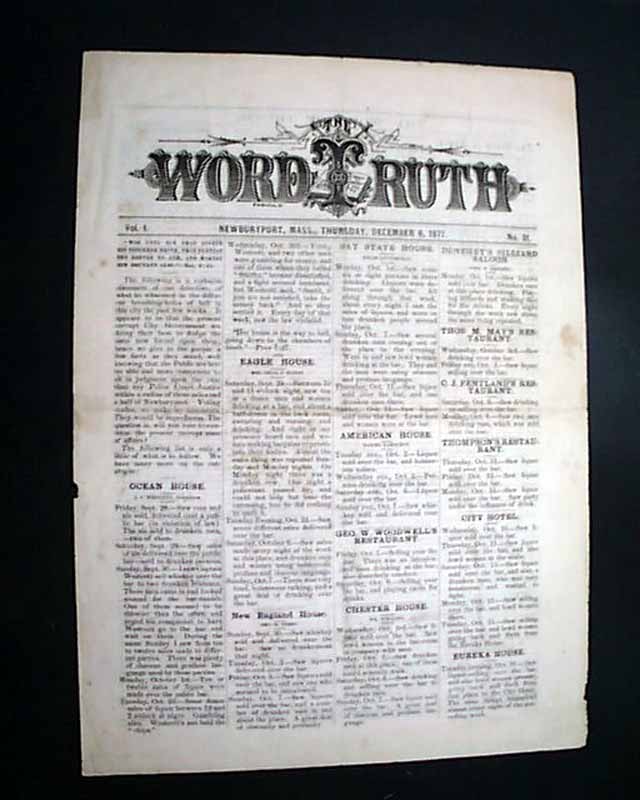
THE WORD OF TRUTH, Newburyport, Massachusetts, Dec. 6, 1877
* Temperance movement publication
* Anti-alcohol - pro-prohibition (rare)
This is a volume 1 issue of a temperance newspaper with a religious emphasis as well.
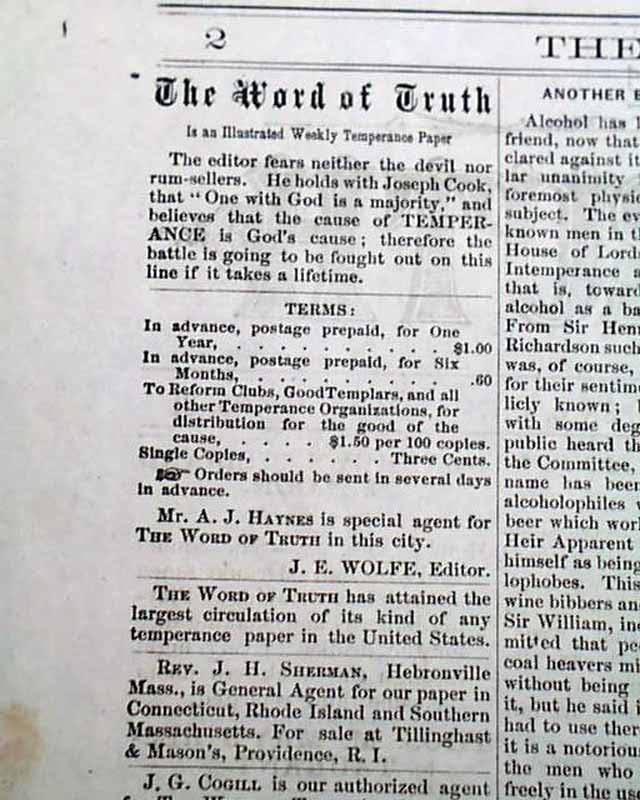
Page 2 begins with: "The editor fears neither the devil nor rum-sellers. He holds with Joseph Cook that 'One with God is a majority', and believe that the cause of TEMPERANCE is God's cause; therefore the battle is going to be fought out on this line if it takes a lifetime."
Four pages, 11 3/4 by 16 1/4 inches, minor wear at the margins, a few archival mends at the margins, good condition.
Background: The publication of The Word of Truth on December 6, 1877, in Newburyport, Massachusetts, represents a pivotal moment in the post-Civil War Temperance Movement, characterized by a militant fusion of evangelical Christianity and social reform. By invoking the rhetoric of Joseph Cook, a titan of the Boston lecture circuit, the editor positioned the newspaper not merely as a local bulletin, but as a "moral battlefield" where the eradication of alcohol was framed as a divine mandate. This specific issue emerged during the rise of the "Women's Crusade" and the Woman’s Christian Temperance Union (WCTU), a period when reformers shifted from gentle persuasion to aggressive legislative lobbying and moral condemnation of "rum-sellers." The editor’s defiant claim that "One with God is a majority" reflects the uncompromising perfectionist theology of the era, which viewed the saloon as the primary obstacle to both spiritual salvation and the economic stability of the American family. In the broader context of New England history, this four-page volume serves as a primary artifact of the "dry" vs. "wet" cultural war that would eventually culminate in the national experiment of Prohibition, showcasing the localized intensity of a movement that sought to legislate morality through the power of the printing press and the pulpit.
* Temperance movement publication
* Anti-alcohol - pro-prohibition (rare)
This is a volume 1 issue of a temperance newspaper with a religious emphasis as well.
Page 2 begins with: "The editor fears neither the devil nor rum-sellers. He holds with Joseph Cook that 'One with God is a majority', and believe that the cause of TEMPERANCE is God's cause; therefore the battle is going to be fought out on this line if it takes a lifetime."
Four pages, 11 3/4 by 16 1/4 inches, minor wear at the margins, a few archival mends at the margins, good condition.
Background: The publication of The Word of Truth on December 6, 1877, in Newburyport, Massachusetts, represents a pivotal moment in the post-Civil War Temperance Movement, characterized by a militant fusion of evangelical Christianity and social reform. By invoking the rhetoric of Joseph Cook, a titan of the Boston lecture circuit, the editor positioned the newspaper not merely as a local bulletin, but as a "moral battlefield" where the eradication of alcohol was framed as a divine mandate. This specific issue emerged during the rise of the "Women's Crusade" and the Woman’s Christian Temperance Union (WCTU), a period when reformers shifted from gentle persuasion to aggressive legislative lobbying and moral condemnation of "rum-sellers." The editor’s defiant claim that "One with God is a majority" reflects the uncompromising perfectionist theology of the era, which viewed the saloon as the primary obstacle to both spiritual salvation and the economic stability of the American family. In the broader context of New England history, this four-page volume serves as a primary artifact of the "dry" vs. "wet" cultural war that would eventually culminate in the national experiment of Prohibition, showcasing the localized intensity of a movement that sought to legislate morality through the power of the printing press and the pulpit.
Category: Post-Civil War


