

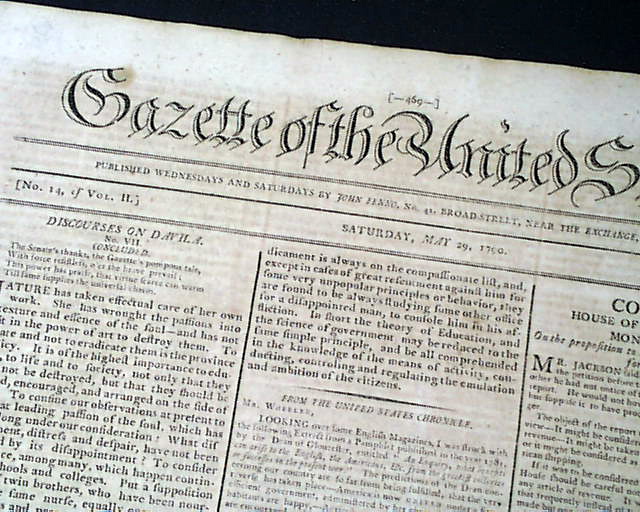
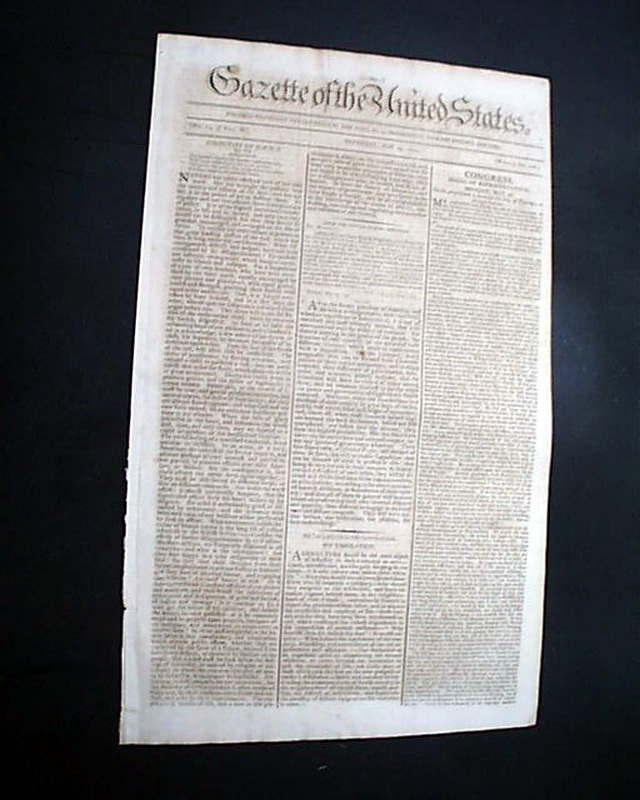
Two Acts of Congress signed by George Washington... Will of Ben Franklin...
Item # 701458Sorry, but this item is no longer available. Please be in touch at info@rarenewspapers.com if you would like to be placed on a want list or are interested in a potential alternate issue.
May 29, 1790
GAZETTE OF THE UNITED STATES, New York, May 29, 1790
* President George Washington
* John Adams & Thomas Jefferson
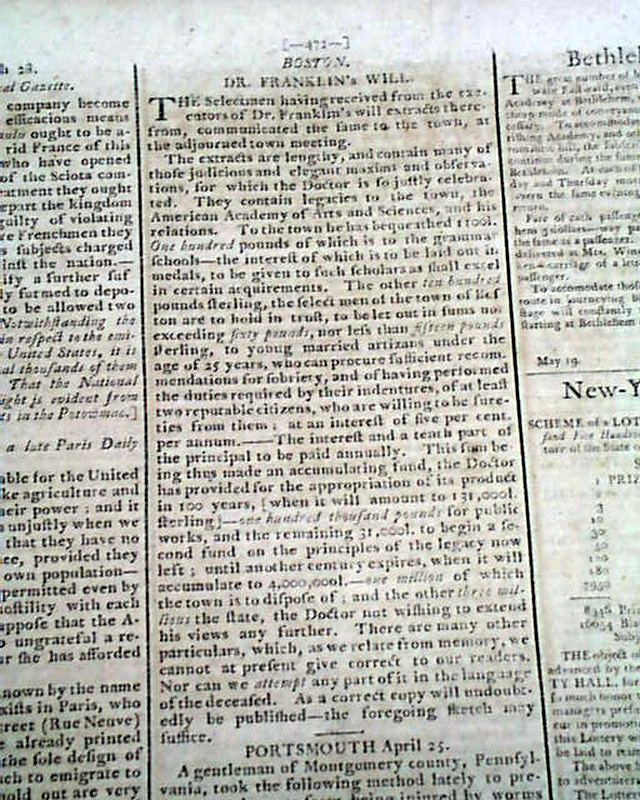
* Benjamin Franklin's will
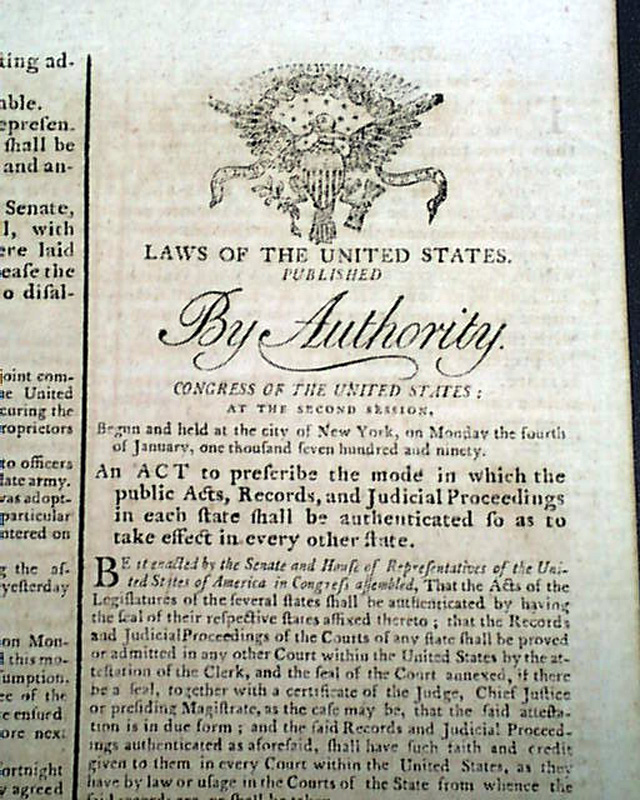
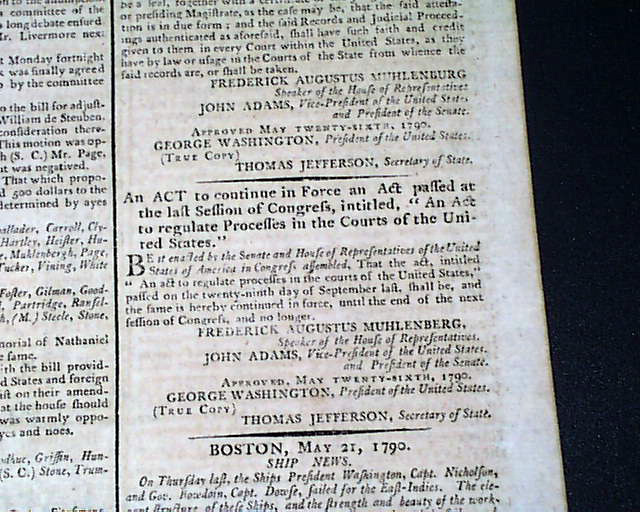
On page 3 beneath a woodcut of an eagle and shield are: "Laws Of The United States Published By Authority" containing: "An Act to prescribe the mode in which the public Acts, Records, and Judicial Proceedings in each state...", signed in type: John Adams, George Washington & Thomas Jefferson, plus a second Act concerning regulating the processes in the Courts of the United States, also signed in type by the same three gentlemen.
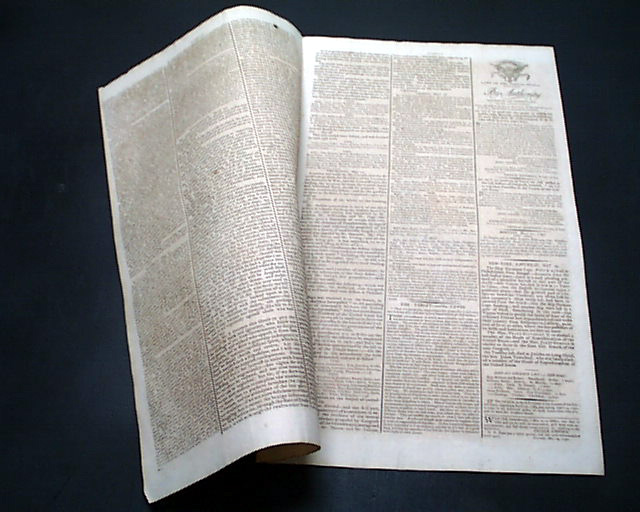
Beginning on the front page and taking all of page 2 & most of page 3 are discussions from Congress during this formative year. The back page has some details about the will of Benjamin Franklin which provides some interesting information.
Also included is the conclusion of one of John Adams' Discourses on Davila (#VII), the first part of which was included in the preceding issue.
Four pages, great condition.
background: This specific issue of the Gazette of the United States serves as a high-fidelity snapshot of the American experiment's "scaffolding" being bolted into place. By publishing the Full Faith and Credit Act, the paper documented the transition of thirteen independent-minded sovereigns into a unified legal Union, ensuring that a debt or a marriage in Maryland couldn't be ignored simply by crossing into Pennsylvania. The juxtaposition of this heavy-duty legislation with the personal details of Benjamin Franklin’s will and the intellectual density of John Adams’ Discourses on Davila reveals the dual nature of the era: it was a time of rigorous administrative world-building mixed with deep philosophical anxiety about the survival of republics. Because the Gazette acted as the unofficial organ of the Federalist administration, holding this paper is less like reading a history book and more like holding the original "operating system" manual for the United States government, signed off by the very architects—Washington, Adams, and Jefferson—who were currently inhabitng the roles they had only recently invented.
* President George Washington
* John Adams & Thomas Jefferson
* Benjamin Franklin's will
On page 3 beneath a woodcut of an eagle and shield are: "Laws Of The United States Published By Authority" containing: "An Act to prescribe the mode in which the public Acts, Records, and Judicial Proceedings in each state...", signed in type: John Adams, George Washington & Thomas Jefferson, plus a second Act concerning regulating the processes in the Courts of the United States, also signed in type by the same three gentlemen.
Beginning on the front page and taking all of page 2 & most of page 3 are discussions from Congress during this formative year. The back page has some details about the will of Benjamin Franklin which provides some interesting information.
Also included is the conclusion of one of John Adams' Discourses on Davila (#VII), the first part of which was included in the preceding issue.
Four pages, great condition.
background: This specific issue of the Gazette of the United States serves as a high-fidelity snapshot of the American experiment's "scaffolding" being bolted into place. By publishing the Full Faith and Credit Act, the paper documented the transition of thirteen independent-minded sovereigns into a unified legal Union, ensuring that a debt or a marriage in Maryland couldn't be ignored simply by crossing into Pennsylvania. The juxtaposition of this heavy-duty legislation with the personal details of Benjamin Franklin’s will and the intellectual density of John Adams’ Discourses on Davila reveals the dual nature of the era: it was a time of rigorous administrative world-building mixed with deep philosophical anxiety about the survival of republics. Because the Gazette acted as the unofficial organ of the Federalist administration, holding this paper is less like reading a history book and more like holding the original "operating system" manual for the United States government, signed off by the very architects—Washington, Adams, and Jefferson—who were currently inhabitng the roles they had only recently invented.
Category: The 1600's and 1700's


