Presumed dead, she was not... On the Cheyenne Massacre...
Item # 699902
·
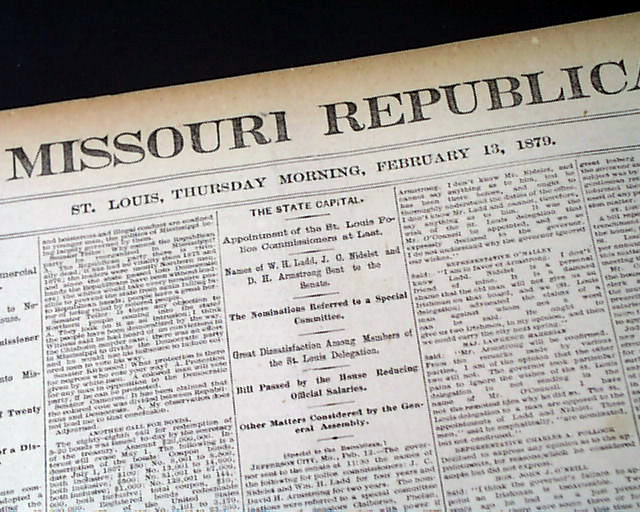
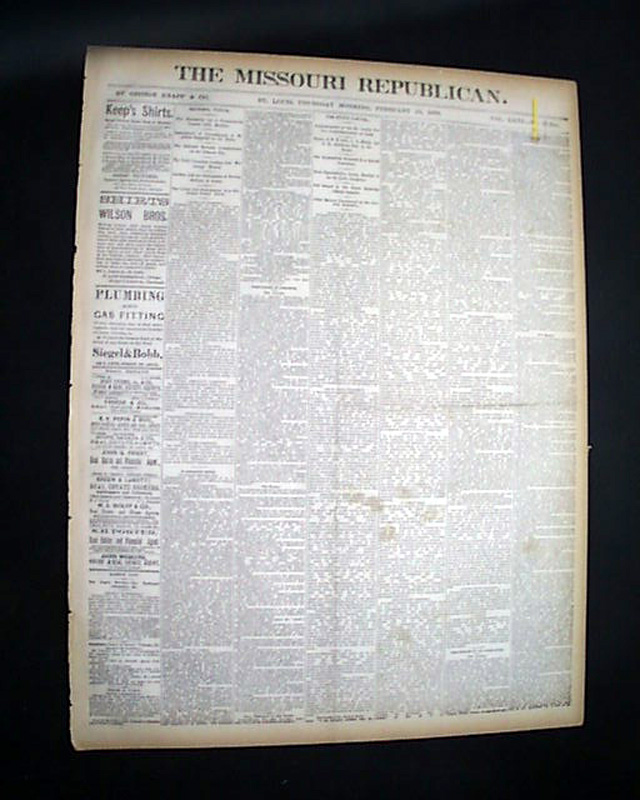
THE MISSOURI REPUBLICAN, St. Louis, Feb. 13, 1879
* The "Risen From the Dead" Phenomenon
* The Cheyennes "Seven Surviving Braves"
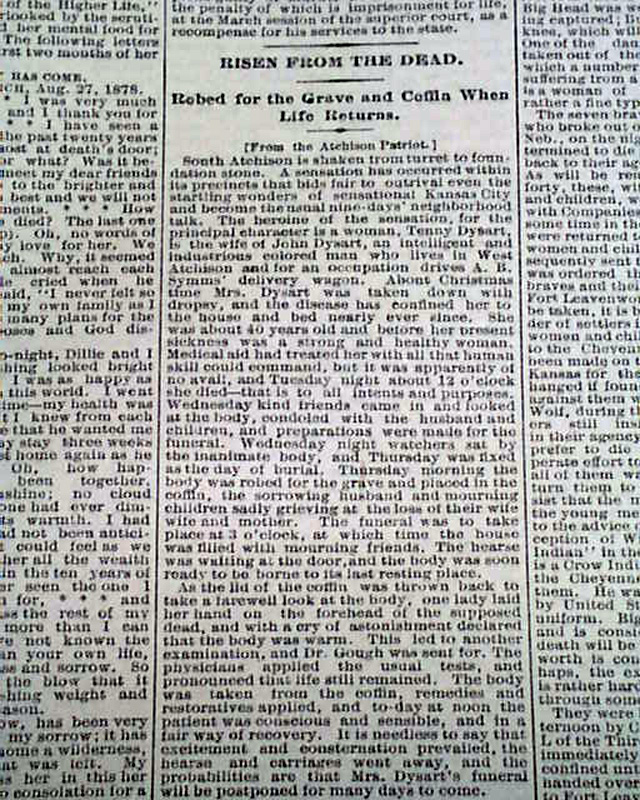
Page 3 has a curious article: "Risen From The Dead" "Robed for the Grave and Coffin When Life Returns" being a case of a woman presumed dead, was not. It ends with: "...needless to say that excitement & consternation prevailed, the hearse and carriages went away, and the probabilities are that Mrs. 'desert's funeral will be postponed for many days to come."
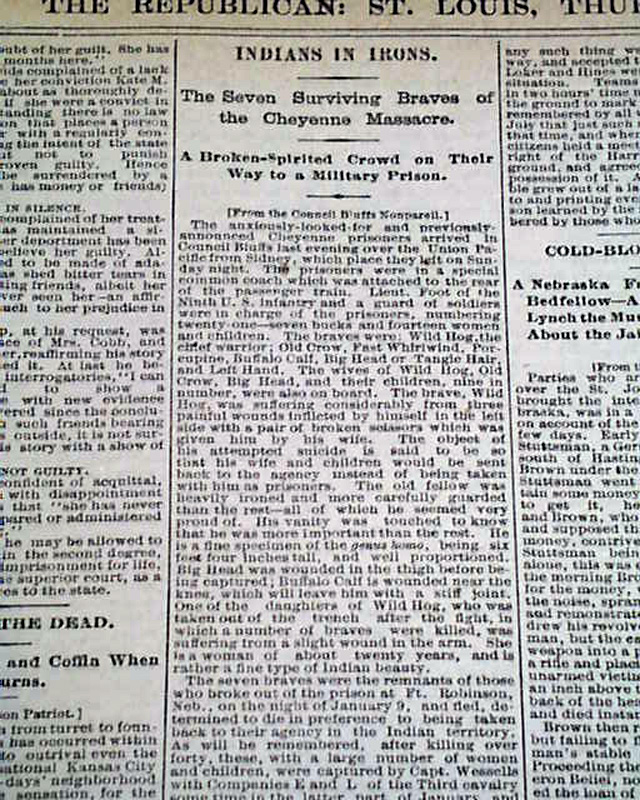
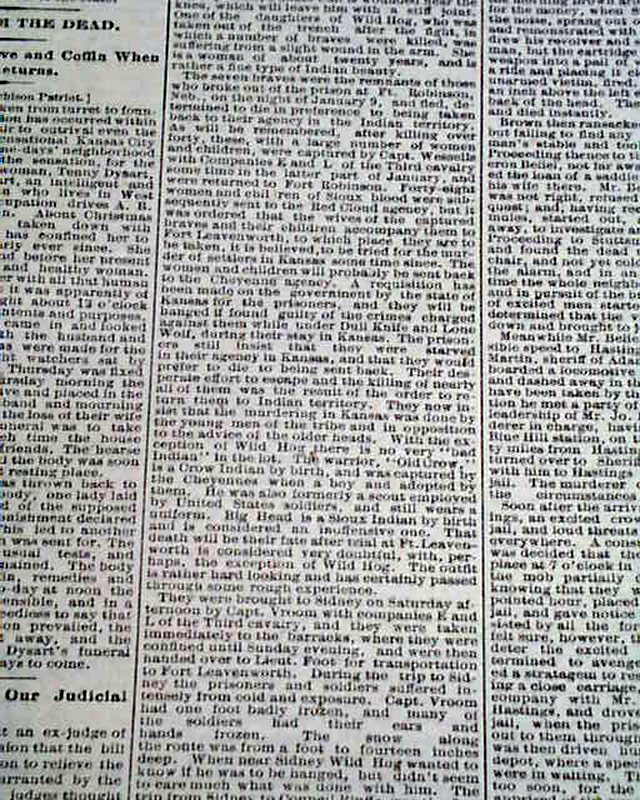
Also on page 3: "Indians In Irons" "The Seven Surviving Braves of the Cheyenne Massacre" "A Broken-Spirited Crowd on Their Way to a Military Prison" taking over half a column. This latter report is on the "Fort Robinson Breakout" about which much can be found online.
Eight pages, nice condition.
background: The "Seven Surviving Braves" mentioned in the 1879 issue—specifically Wild Hog, Old Crow, Tangle Hair, Strong Left Hand, Porcupine, Noisy Walker, and Blacksmith—represented the final, legal chapter of the Northern Cheyenne’s desperate flight from confinement. Having survived the brutal January breakout at Fort Robinson where their families were starved and shot in the snow, these seven men were shackled and transported to Kansas to stand trial for the deaths of settlers killed during their initial trek north. The "broken-spirited" description in the Missouri Republican reflects the grim reality of their condition: several were severely wounded (one was reportedly moved by wheelbarrow), and leader Wild Hog had even attempted suicide with a knife upon his arrest to avoid the indignity of irons. Despite the public outcry and the "hostile crowds" that met their train, the case eventually collapsed in a Lawrence, Kansas court later that year due to a lack of evidence and the growing public realization of the atrocities committed against them, ultimately leading to their release and the eventual establishment of a permanent Northern Cheyenne reservation in their Montana homeland.
* The "Risen From the Dead" Phenomenon
* The Cheyennes "Seven Surviving Braves"
Page 3 has a curious article: "Risen From The Dead" "Robed for the Grave and Coffin When Life Returns" being a case of a woman presumed dead, was not. It ends with: "...needless to say that excitement & consternation prevailed, the hearse and carriages went away, and the probabilities are that Mrs. 'desert's funeral will be postponed for many days to come."
Also on page 3: "Indians In Irons" "The Seven Surviving Braves of the Cheyenne Massacre" "A Broken-Spirited Crowd on Their Way to a Military Prison" taking over half a column. This latter report is on the "Fort Robinson Breakout" about which much can be found online.
Eight pages, nice condition.
background: The "Seven Surviving Braves" mentioned in the 1879 issue—specifically Wild Hog, Old Crow, Tangle Hair, Strong Left Hand, Porcupine, Noisy Walker, and Blacksmith—represented the final, legal chapter of the Northern Cheyenne’s desperate flight from confinement. Having survived the brutal January breakout at Fort Robinson where their families were starved and shot in the snow, these seven men were shackled and transported to Kansas to stand trial for the deaths of settlers killed during their initial trek north. The "broken-spirited" description in the Missouri Republican reflects the grim reality of their condition: several were severely wounded (one was reportedly moved by wheelbarrow), and leader Wild Hog had even attempted suicide with a knife upon his arrest to avoid the indignity of irons. Despite the public outcry and the "hostile crowds" that met their train, the case eventually collapsed in a Lawrence, Kansas court later that year due to a lack of evidence and the growing public realization of the atrocities committed against them, ultimately leading to their release and the eventual establishment of a permanent Northern Cheyenne reservation in their Montana homeland.
Category: Post-Civil War
Price
$34
100% Authentic: Original printing, never a reproduction.
Other issues you may like
§ related
A Cheyenne wants a dead commissioner...
MEMPHIS DAILY APPEAL, Tennessee, Sept. 17, 1875 The top of a ftpg. middle column has heads: "THE INDIANS" "Progress f the Work o the Commissioners at Red...
Sep 1875
$35
Mormon thugs in Idaho... Cheyenne Massacre... Edison's invention... Sitting Bull...
THE MISSOURI REPUBLICAN, St. Louis, Jan. 25, 1879 Page 2 has several varied reports including: "Mormon Thugs In Idaho" "Driving A Gentle From His...
Jan 1879
$68
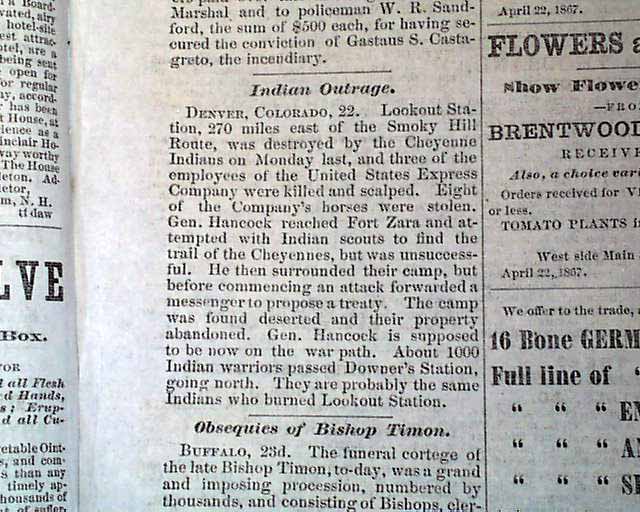
Attack by the Cheyenne Indians...
CONCORD DAILY MONITOR, New Hampshire, April 23, 1867 Page 3 has a report headed: "Indian Outrage" which reports on an Indian attack, noting in part:...
Apr 1867
$29
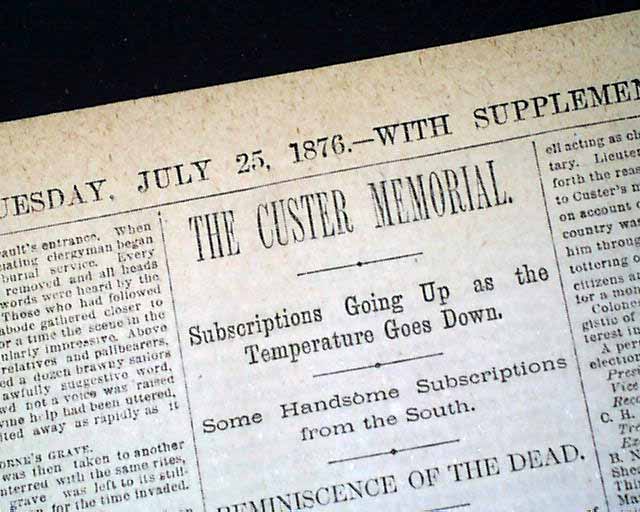
The Great Sioux War of 1876... Post Custer Massacre...
THE NEW YORK HERALD, July 25, 1876.
* Great Sioux War of 1876-77 - Indians
* Lakota and Cheyenne
* Post Custer Massacre
Page 3 has:
* THE...
* Great Sioux War of 1876-77 - Indians
* Lakota and Cheyenne
* Post Custer Massacre
Page 3 has:
* THE...
Jul 1876
$38