An interesting title...
Item # 698744
·
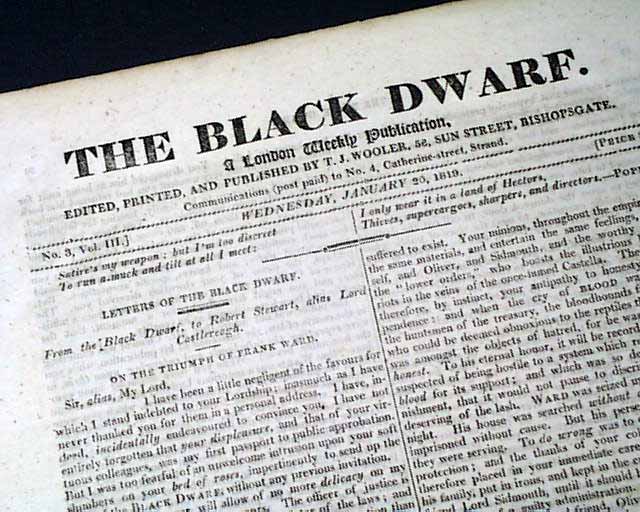
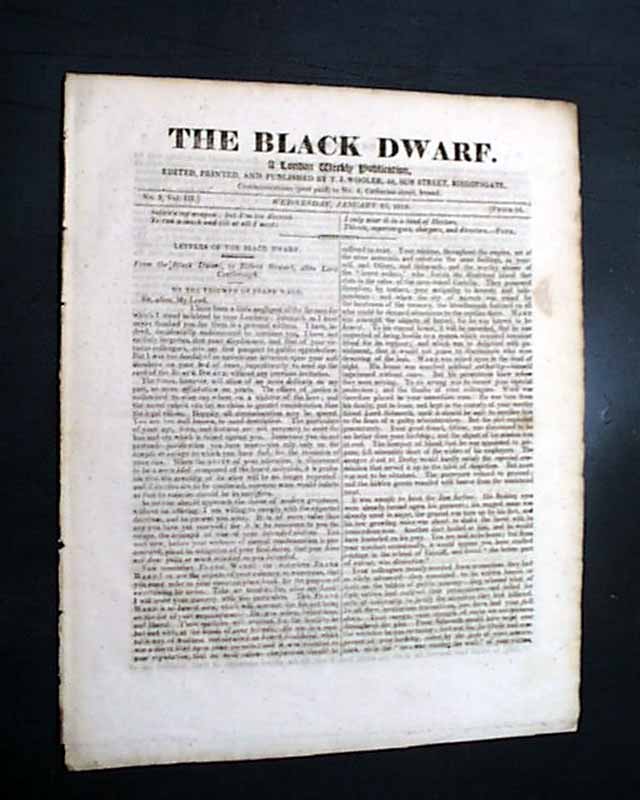
THE BLACK DWARF, London, Jan. 20, 1819
* London's radical press
* Post-Napoleonic movement
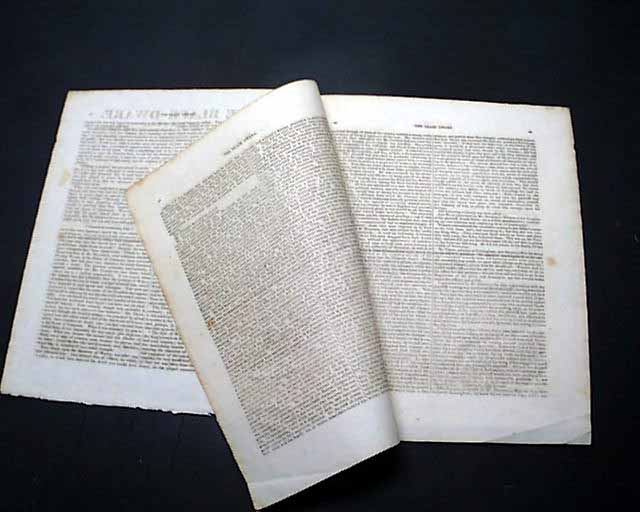
A satirical, radical newspaper that began in 1817. An eight page issue, never-trimmed margins, 8 3/4 by 11 inches, very nice condition. An interesting newspaper for the title alone.
background: The name The Black Dwarf represents two distinct eras of London’s radical press, both defined by their fierce opposition to the political establishment through satire and provocative reporting. The original iteration, founded by Thomas Jonathan Wooler in 1817, was a cornerstone of the post-Napoleonic movement for parliamentary reform; it utilized a fictional "outsider" persona to critique British corruption, famously surviving high-profile government attempts to suppress it via libel trials. This spirit was resurrected in May 1968 by a socialist collective including Tariq Ali, who deliberately continued the 19th-century volume numbering to link the student uprisings and anti-Vietnam War protests of the "New Left" to the earlier radical tradition. While the 1817 version fought for universal suffrage and the 1968 version championed global revolution, both publications served as vital, irreverent platforms for voices that the mainstream media sought to exclude, ultimately shaping the landscape of British political dissent.
* London's radical press
* Post-Napoleonic movement
A satirical, radical newspaper that began in 1817. An eight page issue, never-trimmed margins, 8 3/4 by 11 inches, very nice condition. An interesting newspaper for the title alone.
background: The name The Black Dwarf represents two distinct eras of London’s radical press, both defined by their fierce opposition to the political establishment through satire and provocative reporting. The original iteration, founded by Thomas Jonathan Wooler in 1817, was a cornerstone of the post-Napoleonic movement for parliamentary reform; it utilized a fictional "outsider" persona to critique British corruption, famously surviving high-profile government attempts to suppress it via libel trials. This spirit was resurrected in May 1968 by a socialist collective including Tariq Ali, who deliberately continued the 19th-century volume numbering to link the student uprisings and anti-Vietnam War protests of the "New Left" to the earlier radical tradition. While the 1817 version fought for universal suffrage and the 1968 version championed global revolution, both publications served as vital, irreverent platforms for voices that the mainstream media sought to exclude, ultimately shaping the landscape of British political dissent.
Category: Pre-Civil War
Price
$38
100% Authentic: Original printing, never a reproduction.
Other issues you may like
§ related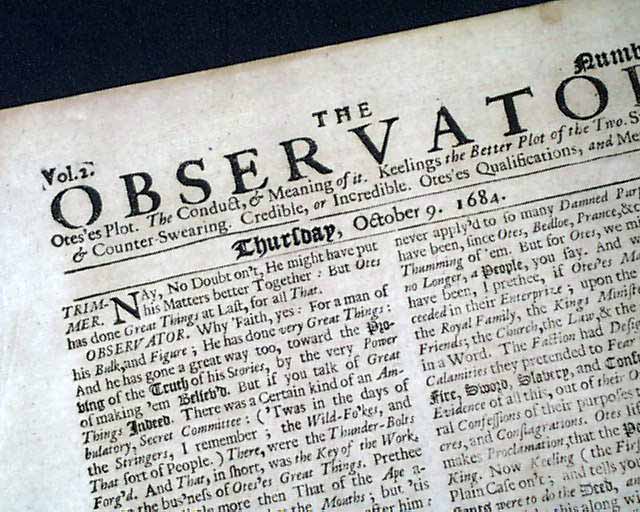
Handsome, 340 year old newspaper... published by Charles Brome...
THE OBSERVATOR, London, England, Oct. 9, 1684
* Architect of the Partisan Press
* A Watershed for Women in Journalism
* During the reign of King Charles II
A...
* Architect of the Partisan Press
* A Watershed for Women in Journalism
* During the reign of King Charles II
A...
$48
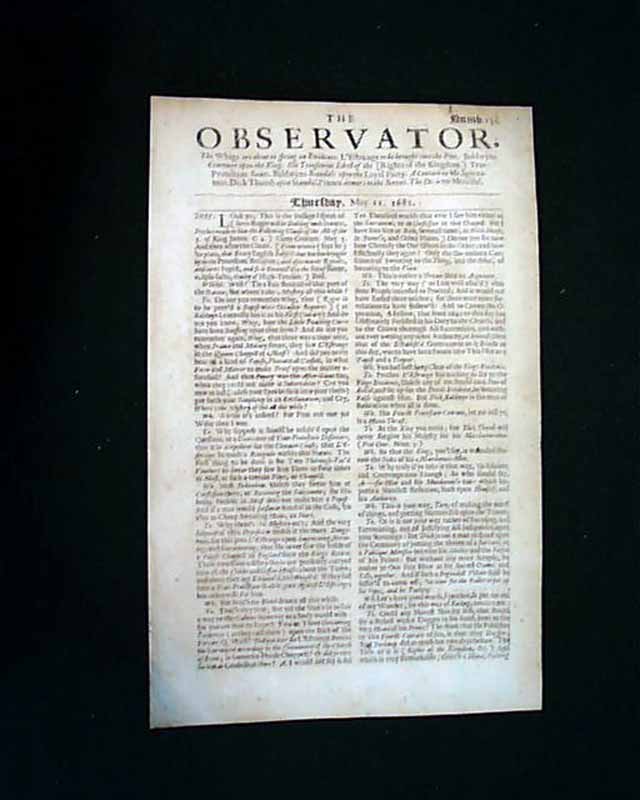
From the 1600's by a woman publisher... Joanna Brome...
THE OBSERVATOR, London, England, 1682 A dialogue newspaper founded by Sir Roger L'Estrange, a Tory pamphleteer, as a vehicle for attacking dissenters and...
$75
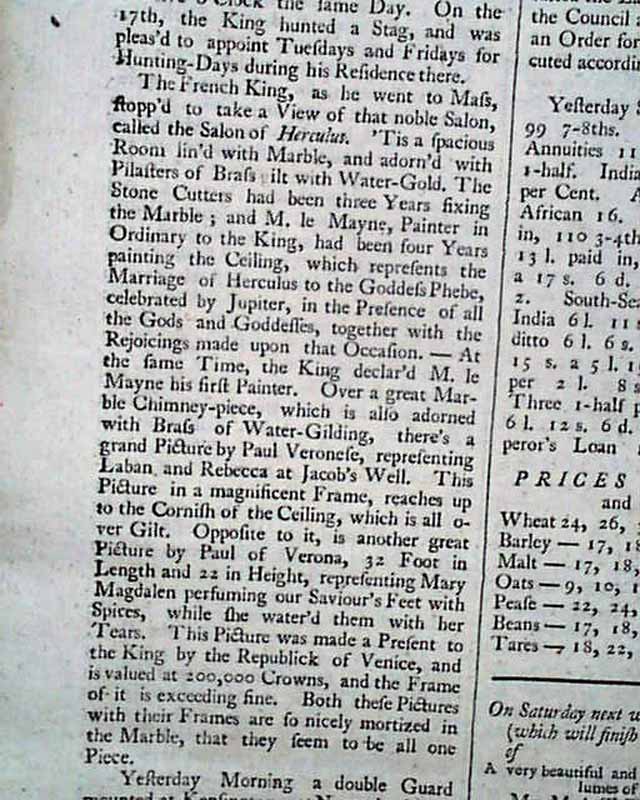
Quite rare & early newspaper...
THE OLD WHIG, OR THE CONSISTENT PROTESTANT, London, September 30, 1736 This is a very rare title, and early as well for a folio-size newspaper (measures 9...
Sep 1736
$46
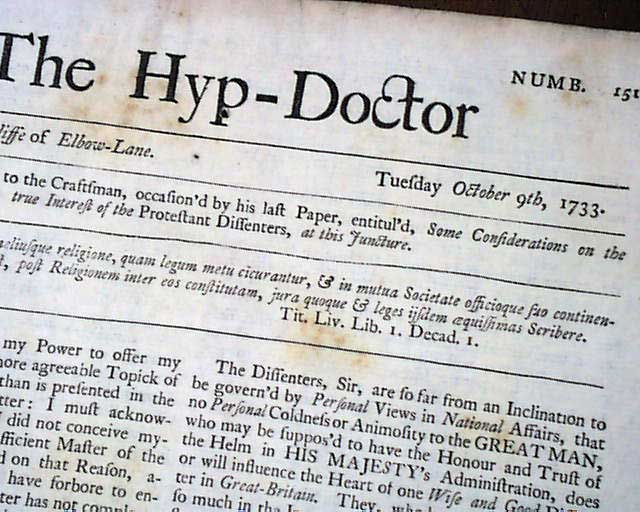
A rare title which rarely comes into hands of collectors...
THE HYP-DOCTOR, London, Oct. 9, 1733
* Very rare 18th century publication
The title is an archaic phrase for a "hodgepodge of nonsense". This curious...
* Very rare 18th century publication
The title is an archaic phrase for a "hodgepodge of nonsense". This curious...
May 1733
$78