

Improvements to be made at the St. Augustine harbor... A river to the Pacific Ocean?
Item # 694234
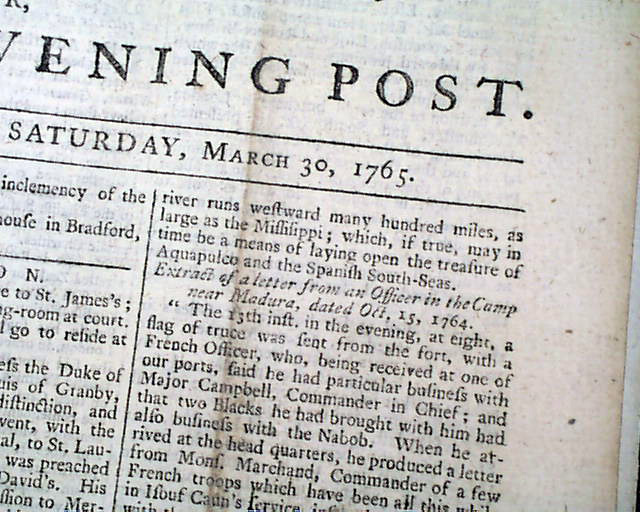
March 30, 1765
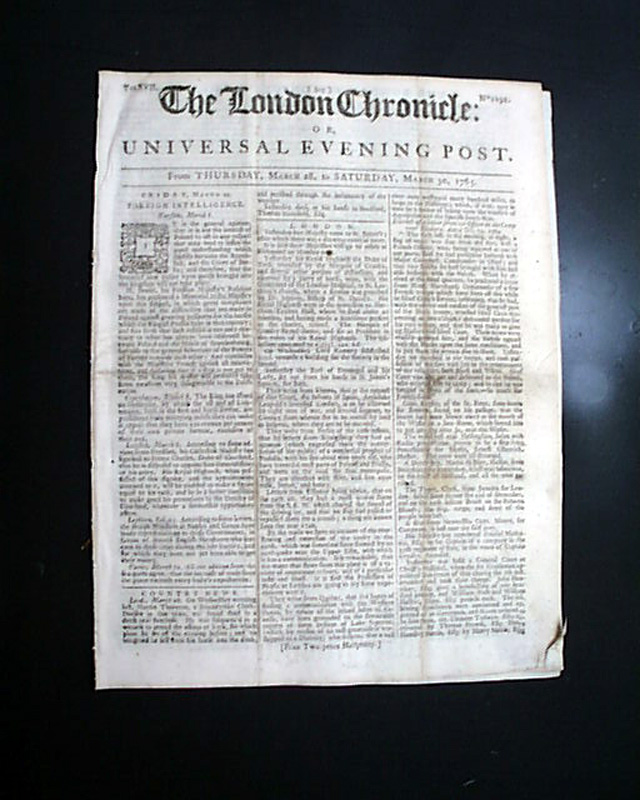
THE LONDON CHRONICLE, England, March 30, 1765
* The Myth of the "River of the West"
* The Florida Land Rush - Infrastructure as Power
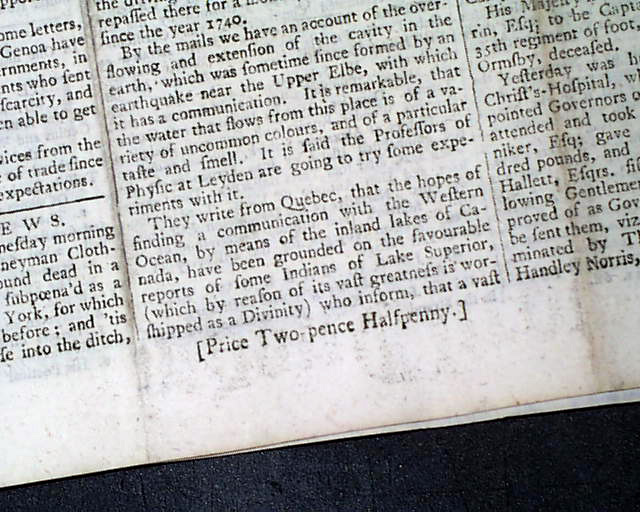
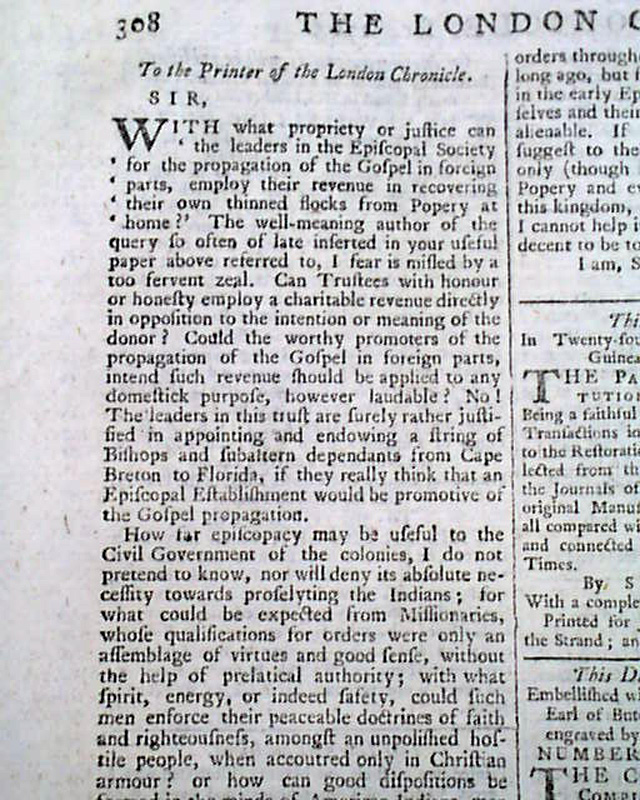
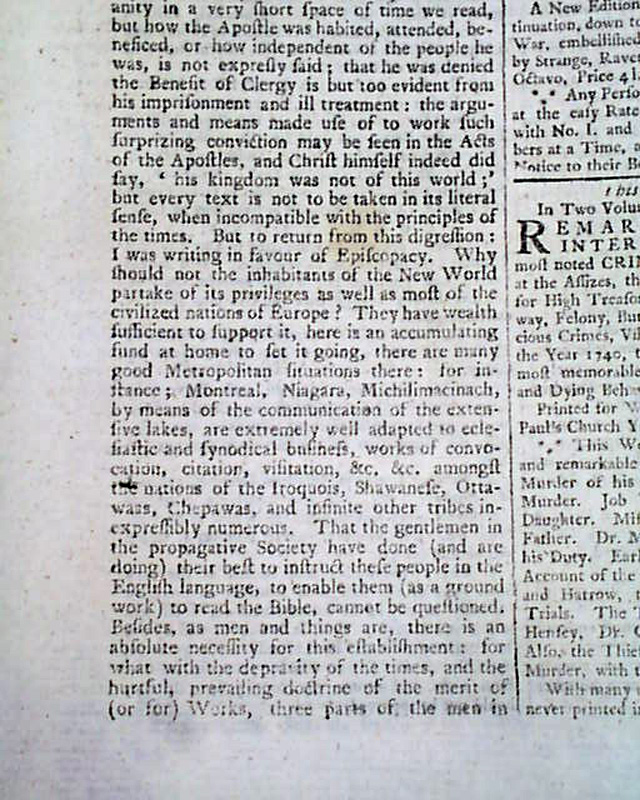
The front page has a report that the Indians know of a river heading west that would connect to the Pacific Ocean. Page 4 has over a column taken up with an article concerning the evangelizing of the Indians, mentioning Montreal, Niagara, Michilimacinach and the Iroquois, Shawnees, Ottawas, and Chippewas.
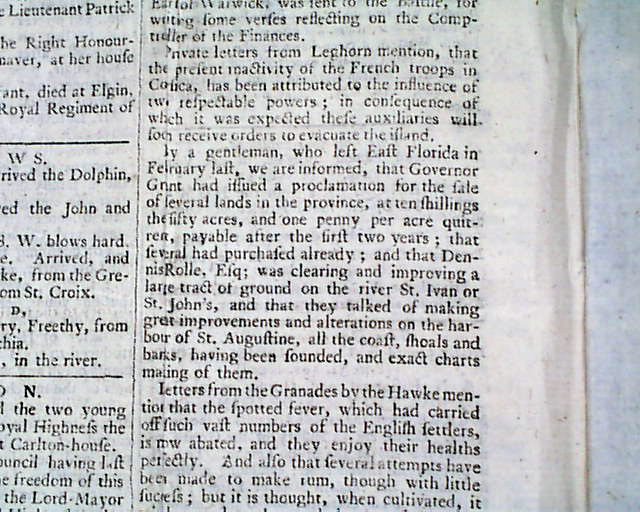
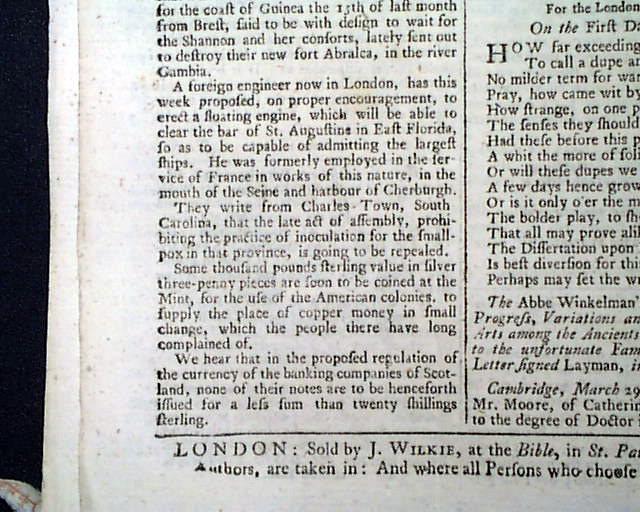
Page 6 has an item noting: "...who left East Florida...that Governor Grant had issued a proclamation for the sale of several lands in the province at ten shillings the 50 acres...they talked of making great improvements & alternations on the harbour of St. Augustine...". The back page also has a bit concerning the improvement of the St. Augustine harbor.
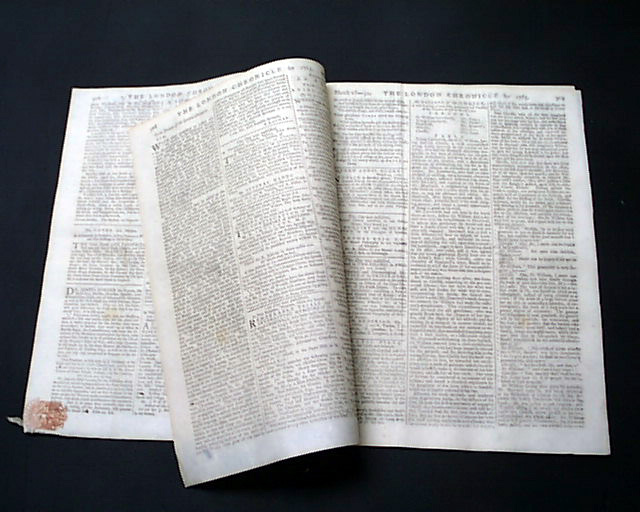
Eight pages, 8 1/4 by 11 inches, minor foxing at front page folds, full red tax stamp on page 2, good condition.
background: The March 30, 1765, edition of The London Chronicle captures a British Empire at a restless peak, aggressively cataloging its new North American spoils following the Treaty of Paris. By highlighting the "River of the West," the paper reflects the era’s obsessive search for a Northwest Passage—a mythical water route to the Pacific that fueled geopolitical competition for decades before the realities of the Continental Divide were understood. Simultaneously, the focus on missionary work among tribes like the Iroquois and Ottawas in recently ceded French territories (Montreal, Michilimackinac) reveals a strategy of cultural diplomacy aimed at stabilizing a frontier still reeling from Pontiac's War. This spirit of expansion is mirrored in the Florida reports, where Governor James Grant's bargain-bin land prices (roughly 2.4 pence per acre) and harbor improvements in St. Augustine illustrate Britain’s urgent need to populate its new southern "buffer" colony. These snippets together reveal a brief, optimistic window in London where the continent seemed like an endless, profitable puzzle, just weeks before the Stamp Act sparked the colonial resistance that would eventually dismantle this entire imperial vision.
* The Myth of the "River of the West"
* The Florida Land Rush - Infrastructure as Power
The front page has a report that the Indians know of a river heading west that would connect to the Pacific Ocean. Page 4 has over a column taken up with an article concerning the evangelizing of the Indians, mentioning Montreal, Niagara, Michilimacinach and the Iroquois, Shawnees, Ottawas, and Chippewas.
Page 6 has an item noting: "...who left East Florida...that Governor Grant had issued a proclamation for the sale of several lands in the province at ten shillings the 50 acres...they talked of making great improvements & alternations on the harbour of St. Augustine...". The back page also has a bit concerning the improvement of the St. Augustine harbor.
Eight pages, 8 1/4 by 11 inches, minor foxing at front page folds, full red tax stamp on page 2, good condition.
background: The March 30, 1765, edition of The London Chronicle captures a British Empire at a restless peak, aggressively cataloging its new North American spoils following the Treaty of Paris. By highlighting the "River of the West," the paper reflects the era’s obsessive search for a Northwest Passage—a mythical water route to the Pacific that fueled geopolitical competition for decades before the realities of the Continental Divide were understood. Simultaneously, the focus on missionary work among tribes like the Iroquois and Ottawas in recently ceded French territories (Montreal, Michilimackinac) reveals a strategy of cultural diplomacy aimed at stabilizing a frontier still reeling from Pontiac's War. This spirit of expansion is mirrored in the Florida reports, where Governor James Grant's bargain-bin land prices (roughly 2.4 pence per acre) and harbor improvements in St. Augustine illustrate Britain’s urgent need to populate its new southern "buffer" colony. These snippets together reveal a brief, optimistic window in London where the continent seemed like an endless, profitable puzzle, just weeks before the Stamp Act sparked the colonial resistance that would eventually dismantle this entire imperial vision.
Category: The 1600's and 1700's


