

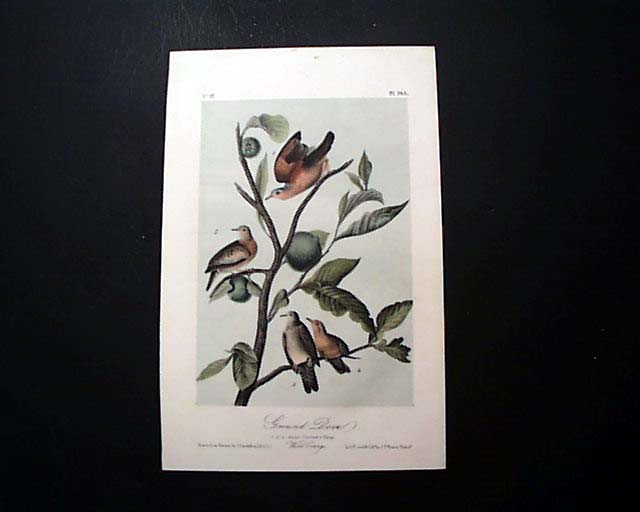
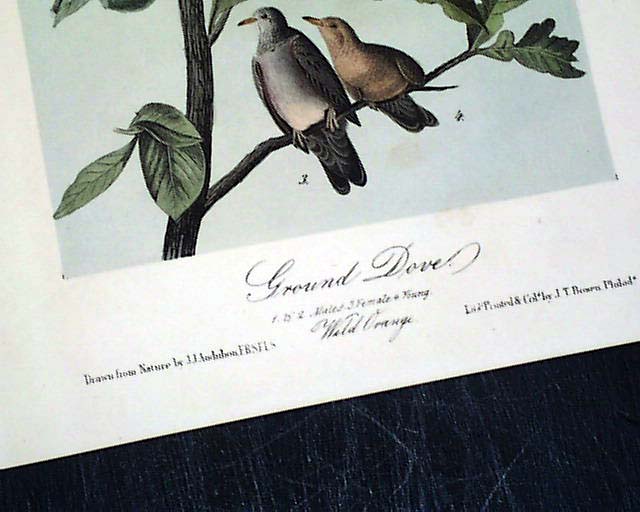
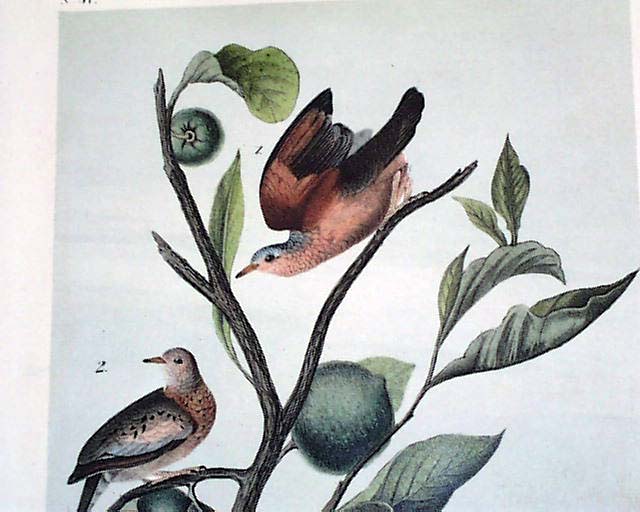
Audubon bird print: "Ground Dove", plate 283...
Item # 566211Sorry, but this item is no longer available. Please be in touch at info@rarenewspapers.com if you would like to be placed on a want list or are interested in a potential alternate issue.
January 01, 1856
* Audubon's "Birds Of America" series
* Hand-colored print: "Ground Dove
This is a full page plate taken from the second royal octavo edition of John James Audubon's "The Birds of America", circa 1856, measuring 6 1/2 by 10 1/4 inches. The plate is titled: "Ground Dove", being plate #283 (see).
The royal octavo edition of "The Birds of America" was Audubon's desire to create a more affordable edition of his double elephant folio edition of "The Birds of America". Satisfied with his research as well as the portrayals of all of America's birds, Audubon now chose to offer a miniature version of "The Birds of America". In addition, as a revolutionary entrepreneur, Audubon wanted to create another revenue stream for his family.
As is the case with many prolific, independent artists, Audubon continued to improve on what was already viewed by most as perfection. During the mid 19th Century, there were no photo-mechanical means of reproduction, so each composition was redrawn by hand, with the aid of the Camera Lucida. For the royal octavo edition of "The Birds of America", Audubon and his assistants translated the 435 compositions of the double elephant folio into 500 renewed images. Each bird was presented as single species. Groups of unrelated birds were separated and divided according to species, and presented on a new botanical perch or within a renewed landscape.
For this royal octavo edition, Audubon enlisted America's premier lithographers, J.T. Bowen and Co. in Philadelphia to produce the work. Every one of the compositions was drawn on a limestone tablet, inked, printed and then hand-colored with watercolor.
* Hand-colored print: "Ground Dove
This is a full page plate taken from the second royal octavo edition of John James Audubon's "The Birds of America", circa 1856, measuring 6 1/2 by 10 1/4 inches. The plate is titled: "Ground Dove", being plate #283 (see).
The royal octavo edition of "The Birds of America" was Audubon's desire to create a more affordable edition of his double elephant folio edition of "The Birds of America". Satisfied with his research as well as the portrayals of all of America's birds, Audubon now chose to offer a miniature version of "The Birds of America". In addition, as a revolutionary entrepreneur, Audubon wanted to create another revenue stream for his family.
As is the case with many prolific, independent artists, Audubon continued to improve on what was already viewed by most as perfection. During the mid 19th Century, there were no photo-mechanical means of reproduction, so each composition was redrawn by hand, with the aid of the Camera Lucida. For the royal octavo edition of "The Birds of America", Audubon and his assistants translated the 435 compositions of the double elephant folio into 500 renewed images. Each bird was presented as single species. Groups of unrelated birds were separated and divided according to species, and presented on a new botanical perch or within a renewed landscape.
For this royal octavo edition, Audubon enlisted America's premier lithographers, J.T. Bowen and Co. in Philadelphia to produce the work. Every one of the compositions was drawn on a limestone tablet, inked, printed and then hand-colored with watercolor.
Category: Documents & Broadsides


