

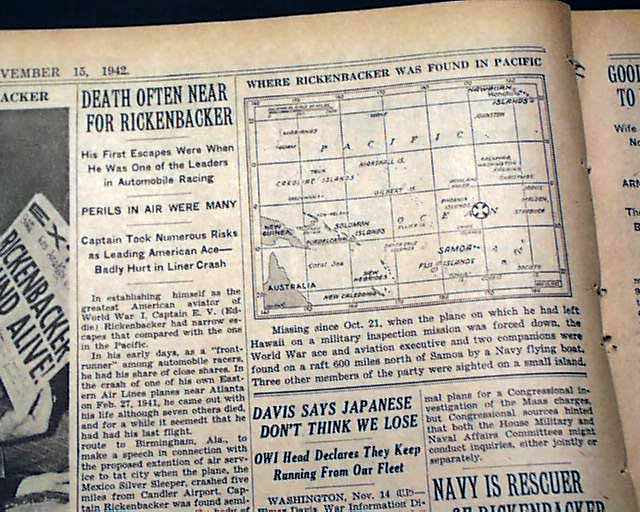

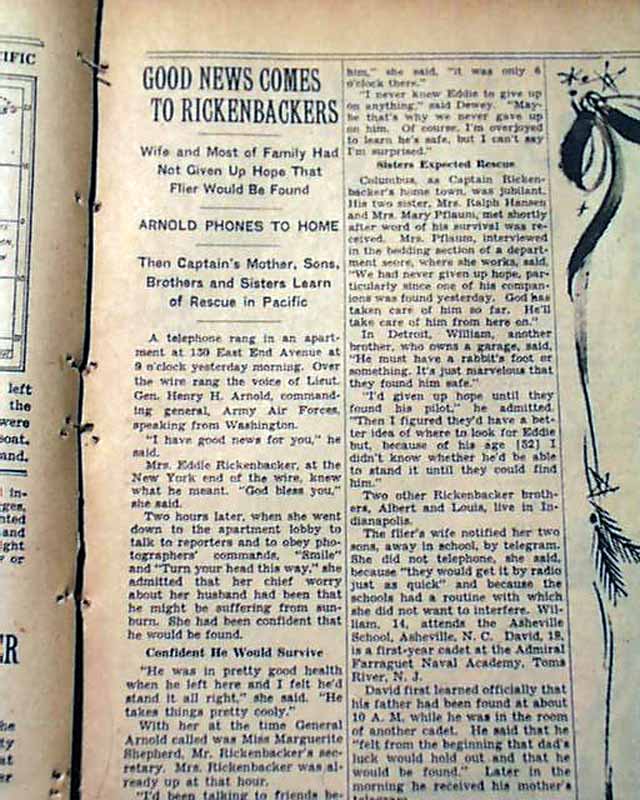
Eddie Rickenbacker found alive....
Item # 565615Sorry, but this item is no longer available. Please be in touch at info@rarenewspapers.com if you would like to be placed on a want list or are interested in a potential alternate issue.
November 15, 1942
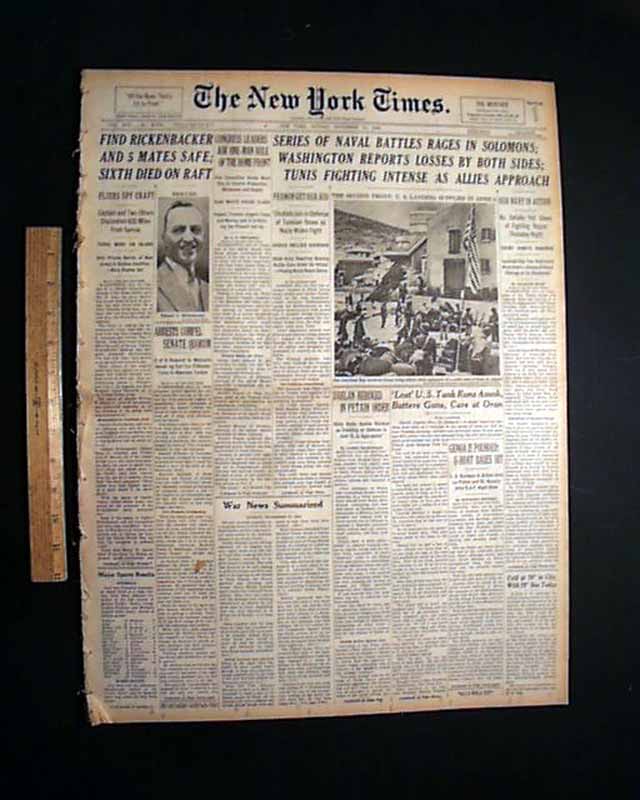
THE NEW YORK TIMES, New York, NY, November 15, 1942
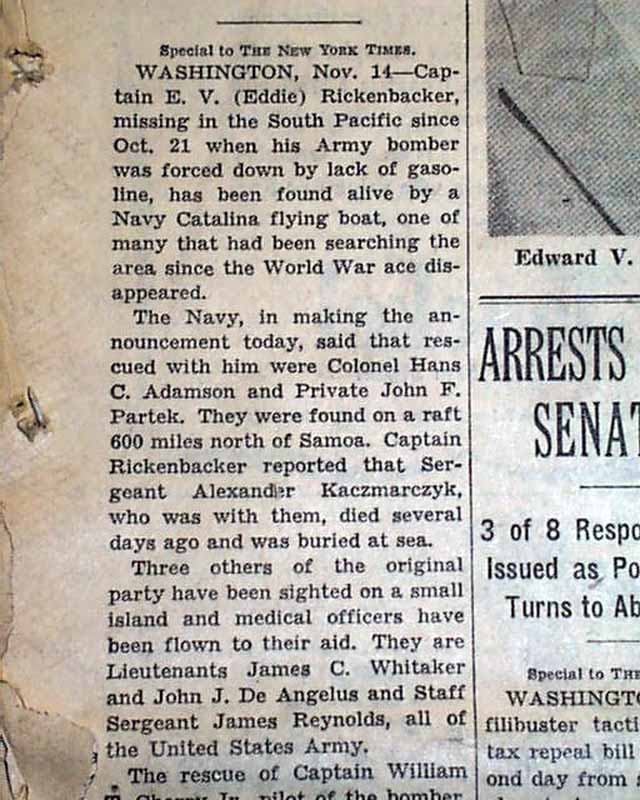
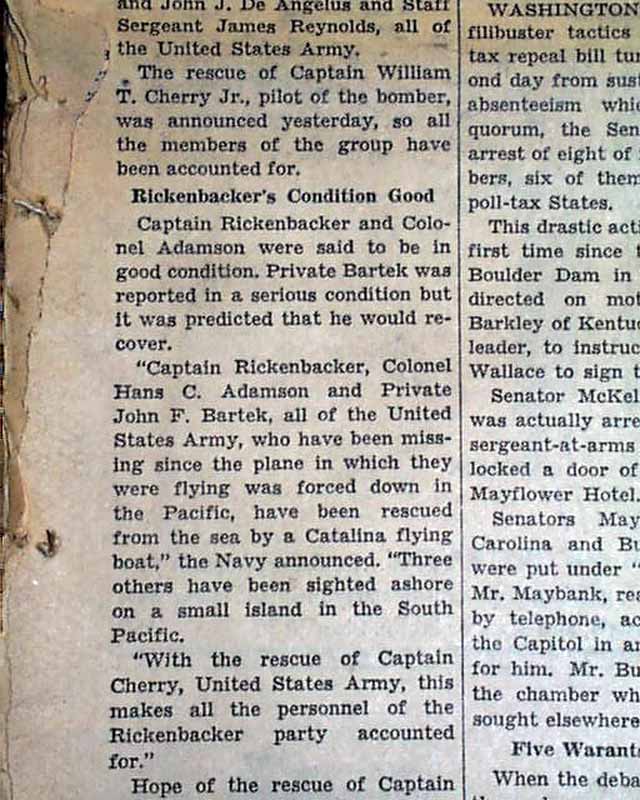
* Eddie Rickenbacker found alive
* American World War I airplane fighter ace
* Adrift at sea for 24 days
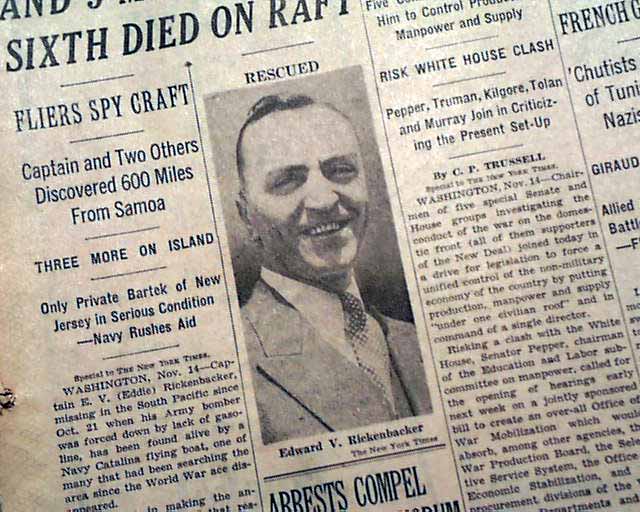
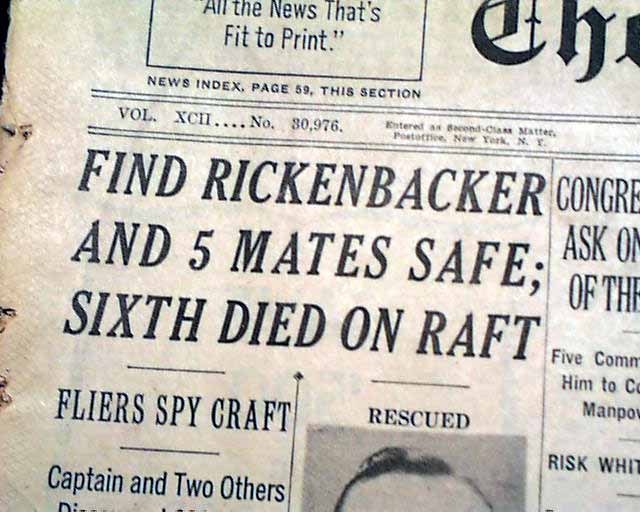
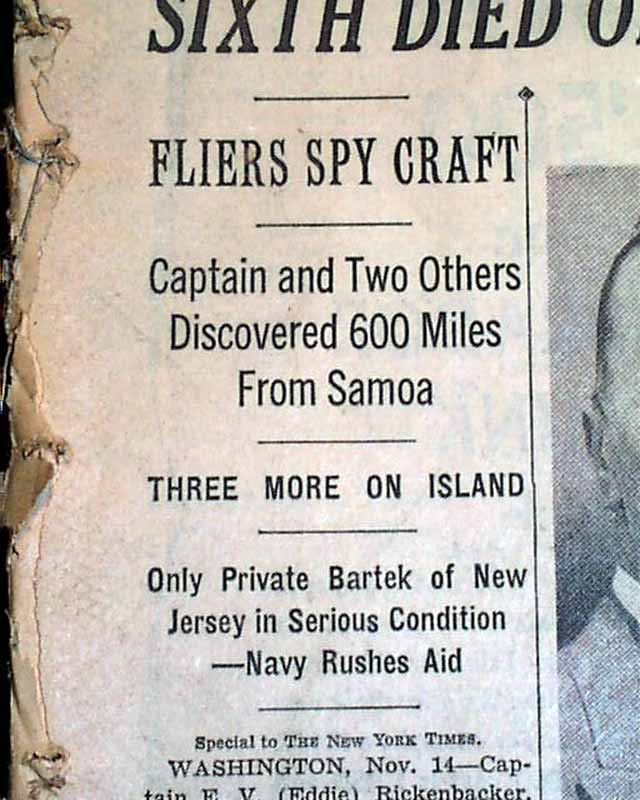
This 70+ page newspaper has a two column headline on the front page: "FIND RICKENBACKER AND 5 MATES SAFE; SIXTH DIED ON RAFT" with subheads that include: "Captain and Two Others Discovered 600 Miles From Samoa" and more with photo of Rickenbacker. (see)
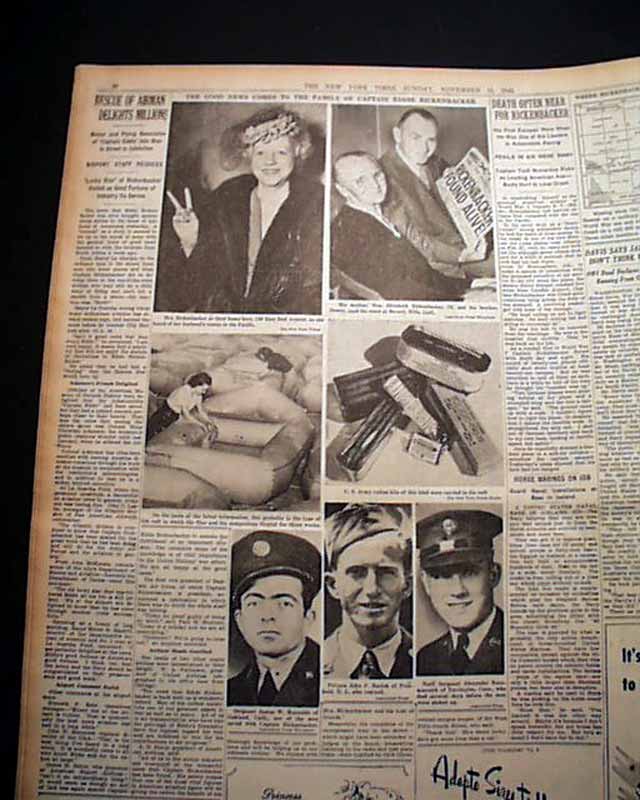
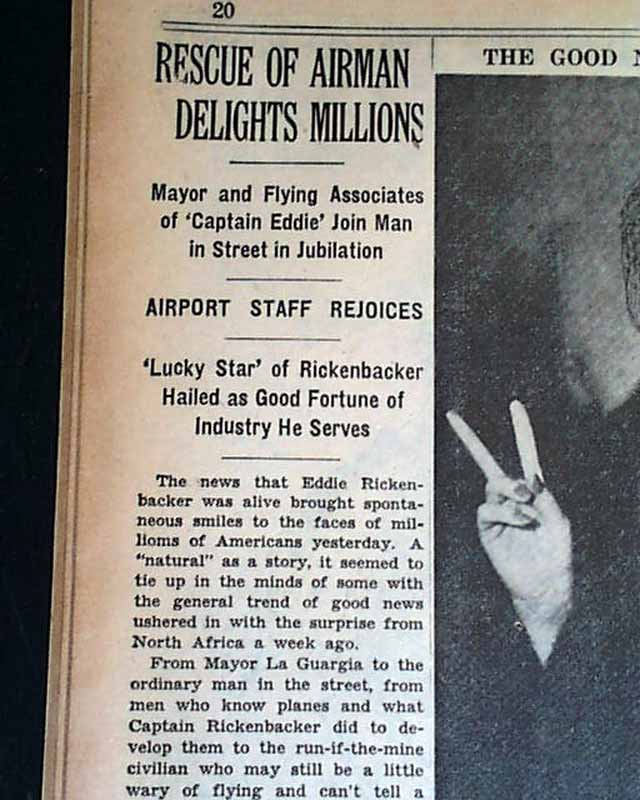
Much more on pages 20 and 21.
Tells of the rescue of Captain Eddie Rickenbacker after he was adrift at sea for 24 days. Nice to have in this famous NYC title.
Other news of the day throughout. Little spine wear, otherwise in good condition.
wikipedia notes: One of Rickenbacker's most famous near-death experiences occurred in October 1942. He was sent on a tour of the Pacific theater to review conditions and operations, and to personally deliver a secret message to General Douglas MacArthur. After visiting bases in Hawaii, the B-17D, 40-3089, in which he was flying went hundreds of miles off course from its first scheduled stop at Canton Island. The navigation failure was due to an out-of-true octant which introduced bias in the navigation calculations. The octant had suffered a severe shock in a pre-takeoff incident. This accident spurred the development of improved navigation tools and survival gear for aircraft. The pilots were forced to ditch the plane in the Pacific Ocean, dangerously close to Japanese-held enemy territory.
For 24 days, Rickenbacker, Hans Adamson, his friend and business partner, and the crew drifted at sea. Rickenbacker was still suffering from his prior airplane crash, Adamson sustained serious injuries in the water landing, and others in the crew were hurt to varying degrees. The crew's food supply ran out after three days. On the eighth day, a seagull landed on Rickenbacker's head. He painstakingly captured it, and the survivors meticulously divided it equally and used part of it for fishing bait. They lived on sporadic rain water and similar food "miracles". Rickenbacker assumed leadership, encouraging and browbeating the others to keep their spirits up. He encouraged them to turn to Christianity for solace using Psalm 46. One serviceman died and was buried at sea. The U.S. Army Air Forces intended to abandon the search for the lost crew after more than two weeks, but Rickenbacker's wife convinced them to extend it for another week. Once again, the press reported that Rickenbacker had died.
Navy pilots rescued the surviving members of the crew on November 13, 1942, off the coast of Nukufetau near Samoa. The men were suffering from exposure, dehydration, and starvation. Rickenbacker completed his assignment and delivered his message to MacArthur, which has never been made public.
Rickenbacker initially thought that he had been lost for 21 days, and wrote a book about the experience titled Seven Came Through, published by Doubleday, Doran. It was not until later that he recalculated and corrected himself in his 1967 autobiography.
Rickenbacker's ordeal was used as an example for Alcoholics Anonymous when the first of their Twelve Traditions was formulated: Our common welfare should come first; personal recovery depends upon A.A. unity."
* Eddie Rickenbacker found alive
* American World War I airplane fighter ace
* Adrift at sea for 24 days
This 70+ page newspaper has a two column headline on the front page: "FIND RICKENBACKER AND 5 MATES SAFE; SIXTH DIED ON RAFT" with subheads that include: "Captain and Two Others Discovered 600 Miles From Samoa" and more with photo of Rickenbacker. (see)
Much more on pages 20 and 21.
Tells of the rescue of Captain Eddie Rickenbacker after he was adrift at sea for 24 days. Nice to have in this famous NYC title.
Other news of the day throughout. Little spine wear, otherwise in good condition.
wikipedia notes: One of Rickenbacker's most famous near-death experiences occurred in October 1942. He was sent on a tour of the Pacific theater to review conditions and operations, and to personally deliver a secret message to General Douglas MacArthur. After visiting bases in Hawaii, the B-17D, 40-3089, in which he was flying went hundreds of miles off course from its first scheduled stop at Canton Island. The navigation failure was due to an out-of-true octant which introduced bias in the navigation calculations. The octant had suffered a severe shock in a pre-takeoff incident. This accident spurred the development of improved navigation tools and survival gear for aircraft. The pilots were forced to ditch the plane in the Pacific Ocean, dangerously close to Japanese-held enemy territory.
For 24 days, Rickenbacker, Hans Adamson, his friend and business partner, and the crew drifted at sea. Rickenbacker was still suffering from his prior airplane crash, Adamson sustained serious injuries in the water landing, and others in the crew were hurt to varying degrees. The crew's food supply ran out after three days. On the eighth day, a seagull landed on Rickenbacker's head. He painstakingly captured it, and the survivors meticulously divided it equally and used part of it for fishing bait. They lived on sporadic rain water and similar food "miracles". Rickenbacker assumed leadership, encouraging and browbeating the others to keep their spirits up. He encouraged them to turn to Christianity for solace using Psalm 46. One serviceman died and was buried at sea. The U.S. Army Air Forces intended to abandon the search for the lost crew after more than two weeks, but Rickenbacker's wife convinced them to extend it for another week. Once again, the press reported that Rickenbacker had died.
Navy pilots rescued the surviving members of the crew on November 13, 1942, off the coast of Nukufetau near Samoa. The men were suffering from exposure, dehydration, and starvation. Rickenbacker completed his assignment and delivered his message to MacArthur, which has never been made public.
Rickenbacker initially thought that he had been lost for 21 days, and wrote a book about the experience titled Seven Came Through, published by Doubleday, Doran. It was not until later that he recalculated and corrected himself in his 1967 autobiography.
Rickenbacker's ordeal was used as an example for Alcoholics Anonymous when the first of their Twelve Traditions was formulated: Our common welfare should come first; personal recovery depends upon A.A. unity."
Category: The 20th Century


