

1951 Rosenberg's spy trial... Al Capone affiliate arrested...
Item # 562282Sorry, but this item is no longer available. Please be in touch at info@rarenewspapers.com if you would like to be placed on a want list or are interested in a potential alternate issue.
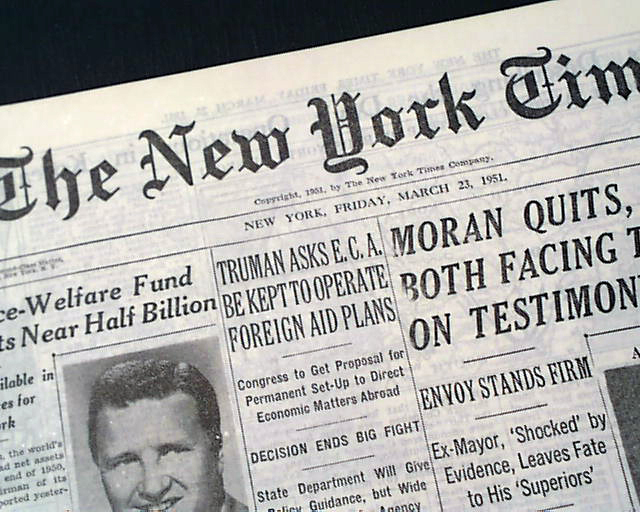
March 23, 1951
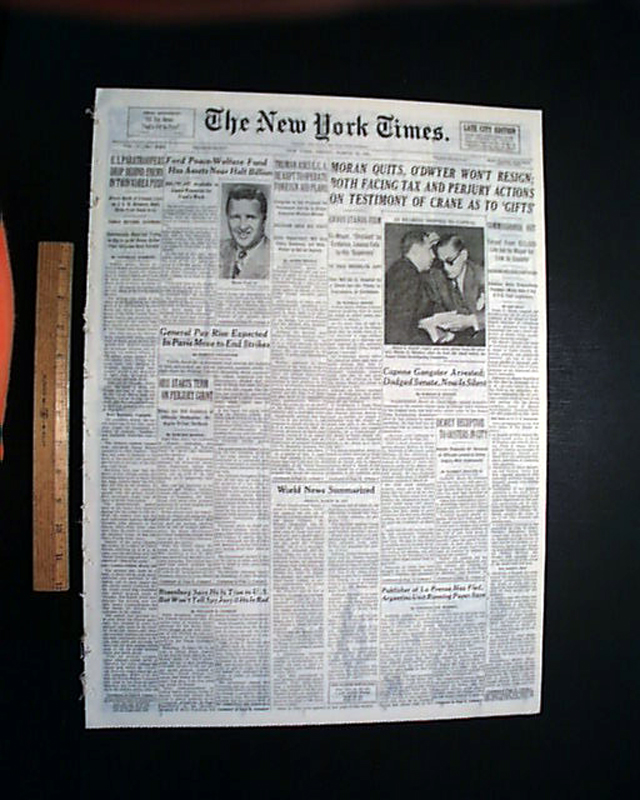
THE NEW YORK TIMES, New York, NY, March 23, 1951
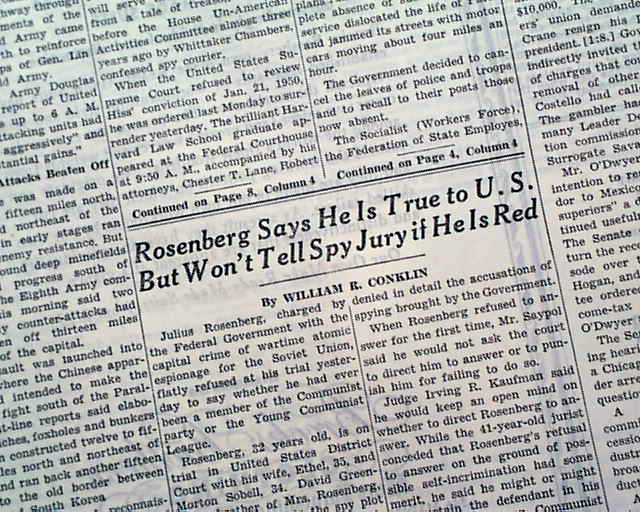
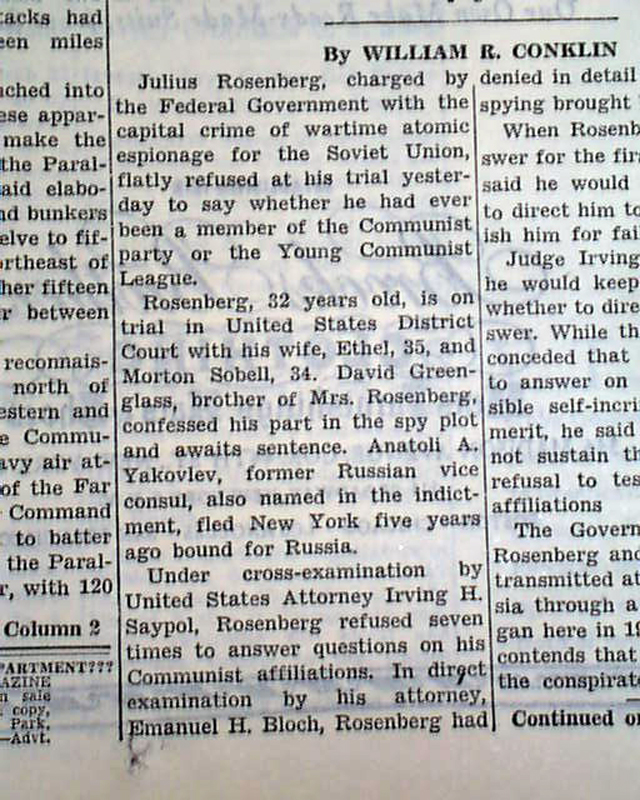
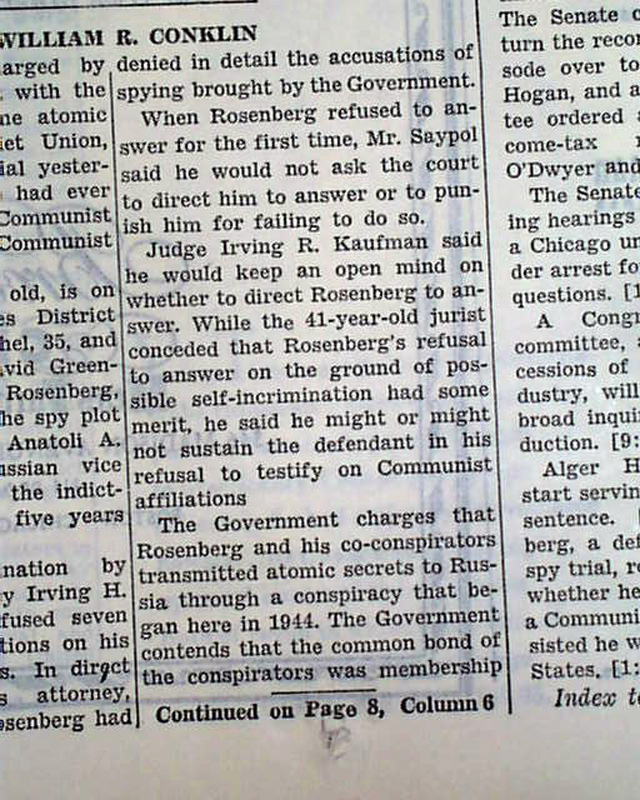
* Julius & Ethel Rosenberg trial... Russian spies... atomic bomb info.
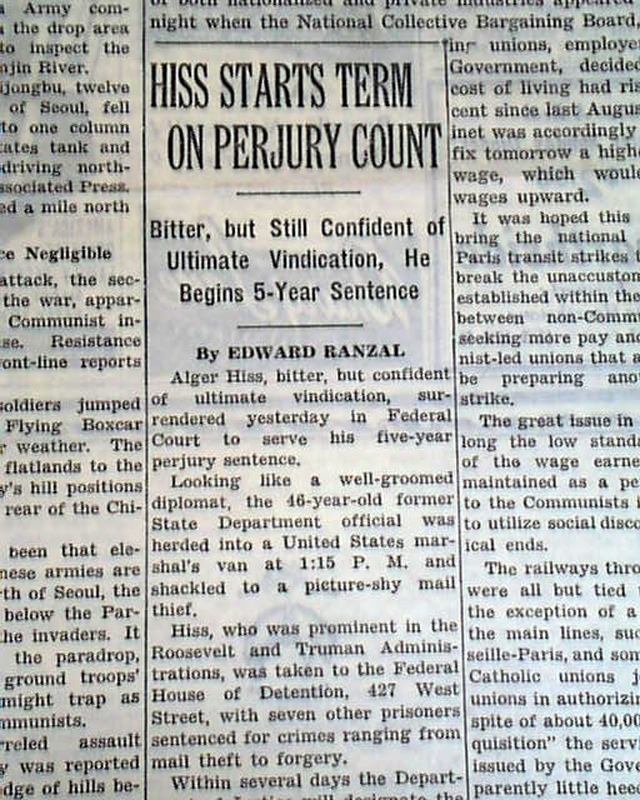
* Alger Hiss
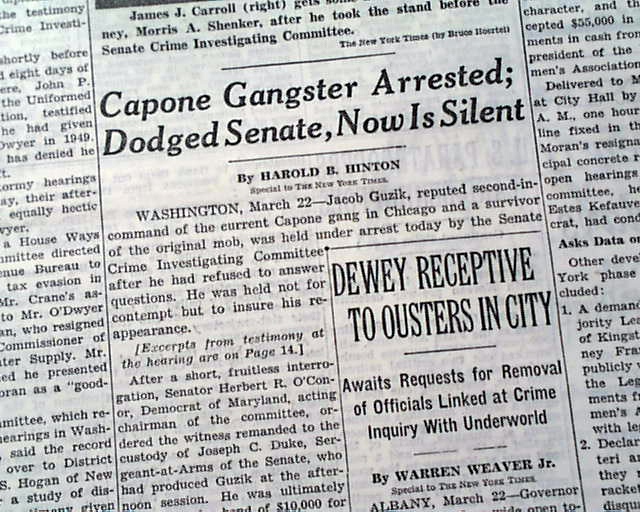
* Jacob Guzik, Al Capone's #2 man), arrested
This 42 page newspaper has a two column headline near the bottom of the front page:"Rosenberg Says He Is True to U. S. But Won't Tell Spy Jury if He Is Red".
Other news of the day throughout including reports on the Alger Hiss verdict and the Chicago Capone gang.
Rag edition in great condition.
wikipedia notes: The trial of the Rosenbergs and Sobell began on March 6, 1951. The judge was Irving Kaufman and the attorney for the Rosenbergs was Emanuel Hirsch Bloch. The prosecution's primary witness, David Greenglass, stated that his sister Ethel typed notes containing U.S. nuclear secrets in the Rosenberg apartment in September 1945. He also testified that he turned over to Julius Rosenberg a sketch of the cross-section of an implosion-type atom bomb (the "Fat Man" bomb dropped on Nagasaki, Japan, as opposed to a bomb with the "gun method" triggering device as used in the "Little Boy" bomb dropped on Hiroshima).[citation needed] The notes allegedly typed by Ethel apparently contained little that was relevant to the Soviet atomic bomb project and some suggest Ethel was indicted along with Julius was so that the prosecution could use her to pressure Julius into giving up the names of others who were involved.[13] However, neither Julius nor Ethel Rosenberg named anyone else and during testimony each asserted their right under the U.S. Constitution's Fifth Amendment to not incriminate themselves whenever asked about involvement in the Communist Party or with its members. Then-U.S. Deputy Attorney General William P. Rogers, when later asked about the failure of the indictment of Ethel to leverage a full confession by Julius, reportedly said, "She called our bluff."
The Rosenbergs were convicted on March 29, 1951, and on April 5 were sentenced to death by Judge Irving Kaufman under Section 2 of the Espionage Act of 1917, 50 U.S. Code 32 (now 18 U.S. Code 794), which prohibits transmitting or attempting to transmit to a foreign government information "relating to the national defense."[citation needed] The conviction helped to fuel Senator Joseph McCarthy's investigations into anti-American activities by U.S. citizens. While their devotion to the Communist cause was well-documented, the Rosenbergs denied the espionage charges even as they faced the electric chair.
The Rosenbergs were the only two American civilians to be executed for espionage-related activity during the Cold War. In imposing the death penalty, Kaufman noted that he held them responsible not only for espionage but also for the deaths of the Korean War:
“ I consider your crime worse than murder...I believe your conduct in putting into the hands of the Russians the A-Bomb years before our best scientists predicted Russia would perfect the bomb has already caused, in my opinion, the Communist aggression in Korea, with the resultant casualties exceeding 50,000 and who knows but that millions more of innocent people may pay the price of your treason. Indeed, by your betrayal you undoubtedly have altered the course of history to the disadvantage of our country. No one can say that we do not live in a constant state of tension. We have evidence of your treachery all around us every day for the civilian defense activities throughout the nation are aimed at preparing us for an atom bomb attack. ”
After the publication of an investigative series in The National Guardian and the formation of the National Committee to Secure Justice in the Rosenberg Case, some Americans came to believe both Rosenbergs were innocent or received too harsh a punishment, and a grassroots campaign was started to try to stop the couple's execution. Between the trial and the executions there were widespread protests and claims of anti-Semitism.[citation needed]
Nobel Prize winner Jean-Paul Sartre called the case "a legal lynching which smears with blood a whole nation. By killing the Rosenbergs, you have quite simply tried to halt the progress of science by human sacrifice. Magic, witch-hunts, auto-da-fés, sacrifices — we are here getting to the point: your country is sick with fear... you are afraid of the shadow of your own bomb."[17] Others, including non-Communists such as Albert Einstein and Nobel-Prize-winning physical chemist Harold Urey,[citation needed] as well as Communists or left-leaning artists such as Nelson Algren, Dashiell Hammett, Jean Cocteau, Diego Rivera and Frida Kahlo, protested the position of the American government in what some[who?] termed America's Dreyfus Affair.[citation needed] In May 1951, Pablo Picasso wrote for French newspaper L’Humanité, "The hours count. The minutes count. Do not let this crime against humanity take place."[18] Pope Pius XII also condemned the execution.[19] The all-black International Longshoremen’s Association Local 968 stopped working for a day in protest.[20] Cinema artists such as Fritz Lang and Bertolt Brecht registered their protest.[21]Pope Pius XII appealed to President Dwight D. Eisenhower to spare the couple, but Eisenhower refused on February 11, 1953, and all other appeals were also unsuccessful.
Their case has been at the center of the controversy over Communism in the United States ever since, with supporters steadfastly maintaining that their conviction was an egregious example of political persecution (see McCarthyism) and likening it to the witch hunts that marred Salem and medieval Europe (a comparison that provided the inspiration for Arthur Miller's critically acclaimed play, The Crucible).
On September 12, 2008, co-defendant Morton Sobell admitted that he and Julius Rosenberg were guilty of spying for the Soviet Union. He believed Ethel was aware of the espionage, but did not actively participate.
* Julius & Ethel Rosenberg trial... Russian spies... atomic bomb info.
* Alger Hiss
* Jacob Guzik, Al Capone's #2 man), arrested
This 42 page newspaper has a two column headline near the bottom of the front page:"Rosenberg Says He Is True to U. S. But Won't Tell Spy Jury if He Is Red".
Other news of the day throughout including reports on the Alger Hiss verdict and the Chicago Capone gang.
Rag edition in great condition.
wikipedia notes: The trial of the Rosenbergs and Sobell began on March 6, 1951. The judge was Irving Kaufman and the attorney for the Rosenbergs was Emanuel Hirsch Bloch. The prosecution's primary witness, David Greenglass, stated that his sister Ethel typed notes containing U.S. nuclear secrets in the Rosenberg apartment in September 1945. He also testified that he turned over to Julius Rosenberg a sketch of the cross-section of an implosion-type atom bomb (the "Fat Man" bomb dropped on Nagasaki, Japan, as opposed to a bomb with the "gun method" triggering device as used in the "Little Boy" bomb dropped on Hiroshima).[citation needed] The notes allegedly typed by Ethel apparently contained little that was relevant to the Soviet atomic bomb project and some suggest Ethel was indicted along with Julius was so that the prosecution could use her to pressure Julius into giving up the names of others who were involved.[13] However, neither Julius nor Ethel Rosenberg named anyone else and during testimony each asserted their right under the U.S. Constitution's Fifth Amendment to not incriminate themselves whenever asked about involvement in the Communist Party or with its members. Then-U.S. Deputy Attorney General William P. Rogers, when later asked about the failure of the indictment of Ethel to leverage a full confession by Julius, reportedly said, "She called our bluff."
The Rosenbergs were convicted on March 29, 1951, and on April 5 were sentenced to death by Judge Irving Kaufman under Section 2 of the Espionage Act of 1917, 50 U.S. Code 32 (now 18 U.S. Code 794), which prohibits transmitting or attempting to transmit to a foreign government information "relating to the national defense."[citation needed] The conviction helped to fuel Senator Joseph McCarthy's investigations into anti-American activities by U.S. citizens. While their devotion to the Communist cause was well-documented, the Rosenbergs denied the espionage charges even as they faced the electric chair.
The Rosenbergs were the only two American civilians to be executed for espionage-related activity during the Cold War. In imposing the death penalty, Kaufman noted that he held them responsible not only for espionage but also for the deaths of the Korean War:
“ I consider your crime worse than murder...I believe your conduct in putting into the hands of the Russians the A-Bomb years before our best scientists predicted Russia would perfect the bomb has already caused, in my opinion, the Communist aggression in Korea, with the resultant casualties exceeding 50,000 and who knows but that millions more of innocent people may pay the price of your treason. Indeed, by your betrayal you undoubtedly have altered the course of history to the disadvantage of our country. No one can say that we do not live in a constant state of tension. We have evidence of your treachery all around us every day for the civilian defense activities throughout the nation are aimed at preparing us for an atom bomb attack. ”
After the publication of an investigative series in The National Guardian and the formation of the National Committee to Secure Justice in the Rosenberg Case, some Americans came to believe both Rosenbergs were innocent or received too harsh a punishment, and a grassroots campaign was started to try to stop the couple's execution. Between the trial and the executions there were widespread protests and claims of anti-Semitism.[citation needed]
Nobel Prize winner Jean-Paul Sartre called the case "a legal lynching which smears with blood a whole nation. By killing the Rosenbergs, you have quite simply tried to halt the progress of science by human sacrifice. Magic, witch-hunts, auto-da-fés, sacrifices — we are here getting to the point: your country is sick with fear... you are afraid of the shadow of your own bomb."[17] Others, including non-Communists such as Albert Einstein and Nobel-Prize-winning physical chemist Harold Urey,[citation needed] as well as Communists or left-leaning artists such as Nelson Algren, Dashiell Hammett, Jean Cocteau, Diego Rivera and Frida Kahlo, protested the position of the American government in what some[who?] termed America's Dreyfus Affair.[citation needed] In May 1951, Pablo Picasso wrote for French newspaper L’Humanité, "The hours count. The minutes count. Do not let this crime against humanity take place."[18] Pope Pius XII also condemned the execution.[19] The all-black International Longshoremen’s Association Local 968 stopped working for a day in protest.[20] Cinema artists such as Fritz Lang and Bertolt Brecht registered their protest.[21]Pope Pius XII appealed to President Dwight D. Eisenhower to spare the couple, but Eisenhower refused on February 11, 1953, and all other appeals were also unsuccessful.
Their case has been at the center of the controversy over Communism in the United States ever since, with supporters steadfastly maintaining that their conviction was an egregious example of political persecution (see McCarthyism) and likening it to the witch hunts that marred Salem and medieval Europe (a comparison that provided the inspiration for Arthur Miller's critically acclaimed play, The Crucible).
On September 12, 2008, co-defendant Morton Sobell admitted that he and Julius Rosenberg were guilty of spying for the Soviet Union. He believed Ethel was aware of the espionage, but did not actively participate.
Category: The 20th Century


