

The trial of Aaron Burr...
Item # 561387Sorry, but this item is no longer available. Please be in touch at info@rarenewspapers.com if you would like to be placed on a want list or are interested in a potential alternate issue.
February 10, 1807
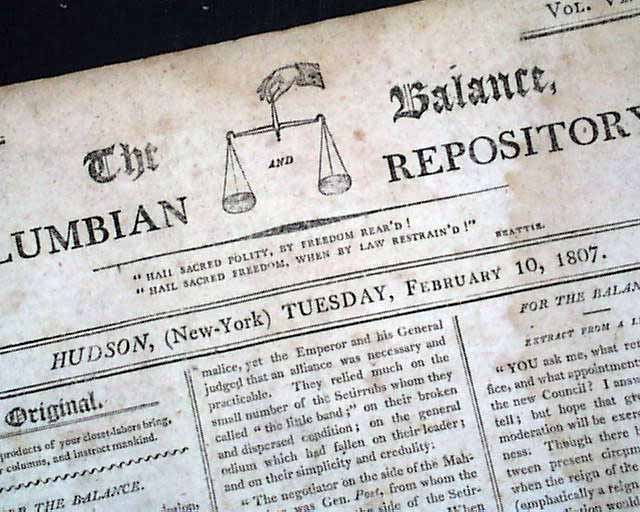
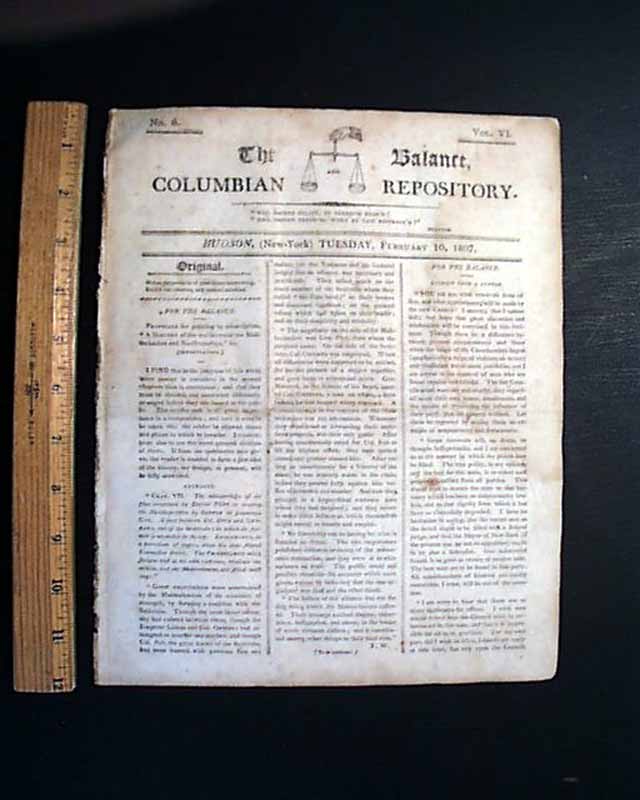
BALANCE, & COLUMBIAN REPOSITORY, Hudson, New York, February 10, 1807
* Trial of Aaron Burr
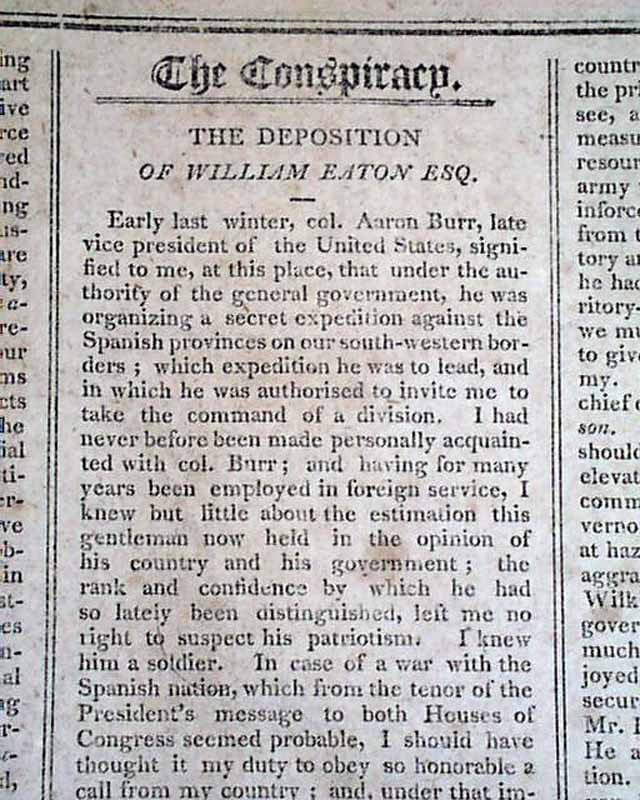
* "The Conspiracy"
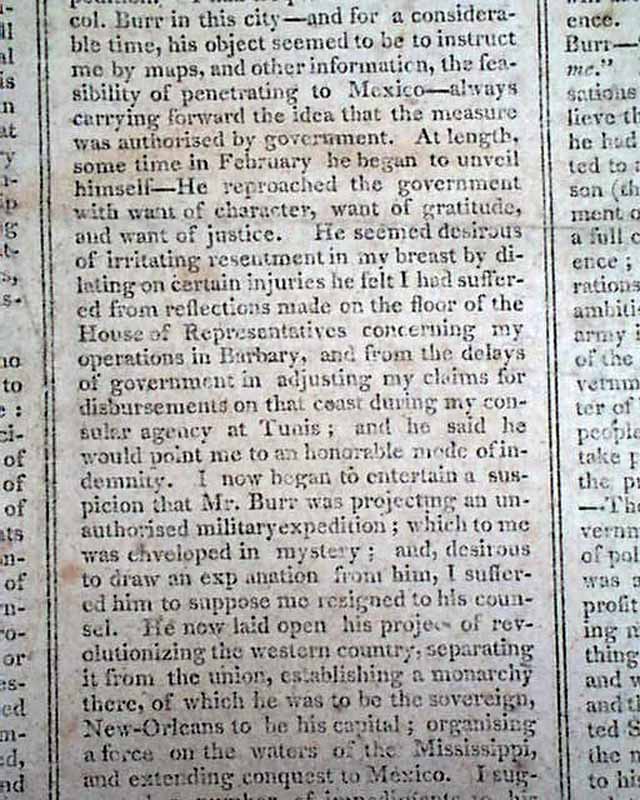
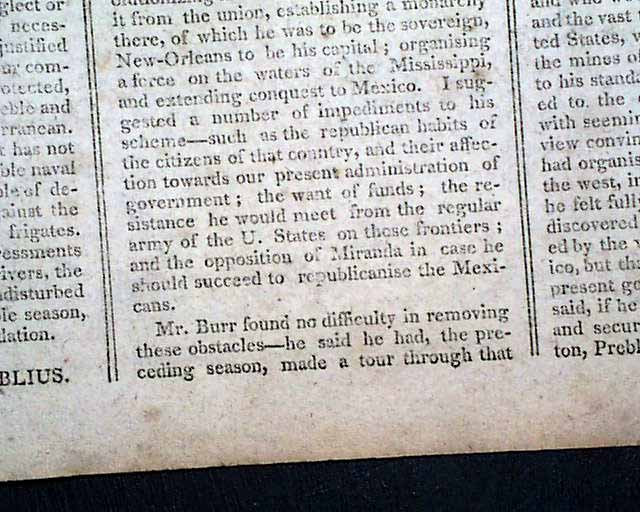
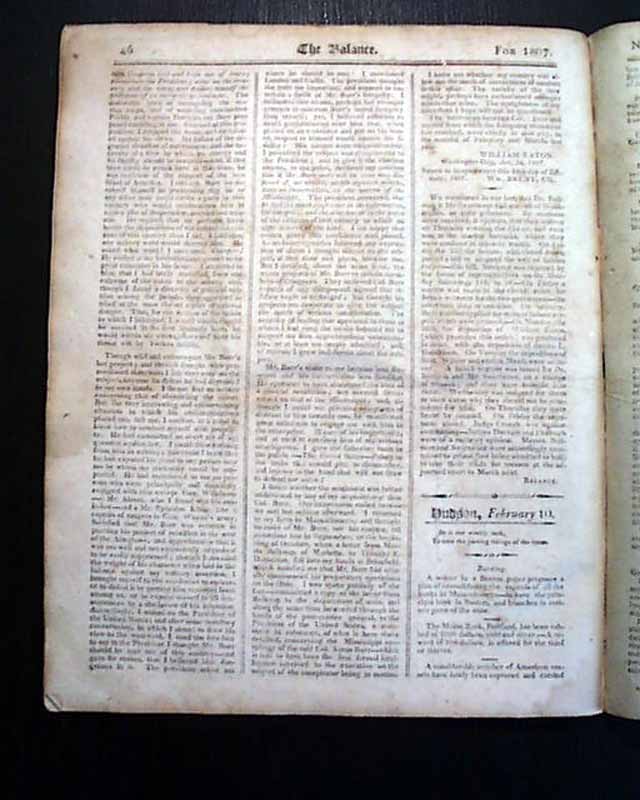
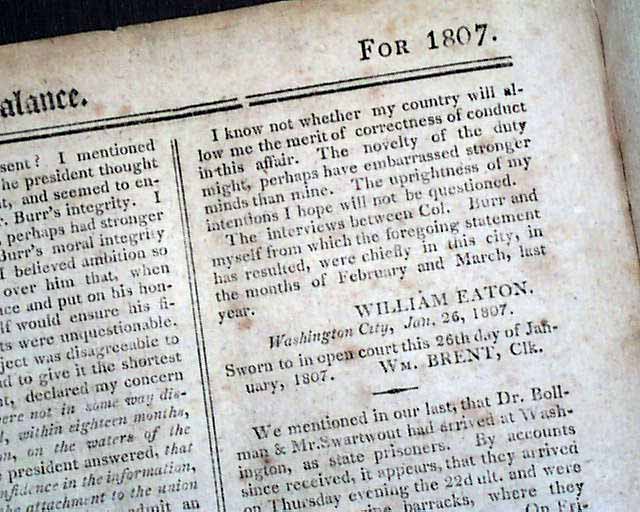
Relating to the trial of Aaron Burr, an inside page has: "The Conspiracy" "The Deposition Of William Eaton Esq." Quite lengthy, signed in type: William Eaton.
Other news of the day. Area of lite damp staining, otherwise in good condition. 8 pages.
wikipedia notes: Burr had leased 40,000 acres (160 km²) of land in the Texas part of Mexico, in the "Bastrop" lands from the Spanish government. His "conspiracy," he always avowed, was that if he settled there with a large group of (armed) "farmers" and war broke out, he would have an army with which to fight and claim land for himself, thus recouping his fortunes. However, that war in Texas didn't occur until 1836, the year of Burr's death.
In 1805, General James Wilkinson was chosen by Jefferson to be the Commander-in-Chief of the U.S. Army at New Orleans and Governor of the Louisiana Territory It was revealed years later that at the time he was a spy, secretly in the pay of the Kingdom of Spain. Wilkinson had his own reasons for aiding the Burr Conspiracy. As Territorial Governor, he could have seized power for himself, as he had attempted in earlier plots in Kentucky. Ignorant of the General's treason, Burr enlisted Wilkinson and others to his plan in a reconnaissance mission to the West in April 1805.
Another member of the Burr conspiracy was the Anglo-Irish aristocrat Harman Blennerhassett. After marrying his niece, Blennerhassett had been forced out of Ireland. He came to live as a quasi-feudal lord, owning an island now bearing his name in the Ohio River. Highly educated, Blennerhassett maintained a scientific laboratory and an impressive villa on the island. It was there that he met Burr and agreed to help finance the ambitions of Burr's group.
Like many of his countrymen, including Jefferson, Burr anticipated a war with Spain-a distinct possibility. In case of a war declaration, Andrew Jackson stood ready to help Colonel Burr, who had already purchased the land shares in Texas. Burr's expedition of perhaps eighty men carried modest arms for hunting, and no war materiel ever came to light, even when Blennerhassett Island was seized by Virginia militia (the island was just off shore from modern Parkersburg, West Virginia).
After a near-incident with Spanish forces at Natchitoches, Wilkinson decided he could best serve his conflicting interests by betraying Burr's plans to President Jefferson and also to his Spanish paymasters. Jefferson's passivity throughout most of 1806 remains baffling to this day, but he finally issued an order for Burr's arrest, declaring him a traitor even before an indictment. Burr read this in a newspaper in the Territory of Orleans on January 10, 1807. Jefferson's warrant put Federal agents on his trail. He turned himself in to the Federal authorities twice. Two judges found his actions legal and released him. But Jefferson's warrant followed Burr, who then fled for Spanish Florida; he was intercepted in the vicinity of the Missouri and Alabama Territories on February 19, 1807 and confined to Fort Stoddert after being arrested on charges of treason.[6]
Burr was treated well at Fort Stoddert. For example, in the evening of February 20, 1807, Burr appeared at the dinner table, and was introduced to Frances Gaines, the wife of the commandant Edmund P. Gaines and the daughter of Judge Harry Toulmin, the man responsible for the legal arrest of Burr. Frances and Burr played chess that evening and continued this entertainment during his confinement at the fort.
Burr's secret correspondence with Anthony Merry and the Marquis of Casa Yrujo, the British and Spanish ministers at Washington, was eventually revealed. It had been, it would seem, to secure money and to conceal his real designs, which were probably to help Mexico to overthrow Spanish power in the Southwest, and perhaps to found a dynasty in what would have become former Mexican territory. This seems to have been a misdemeanor, based on the Neutrality Act of 1794 passed to block filibuster expeditions like those questionable enterprises of George Rogers Clark and William Blount. But Jefferson sought the highest charges against Burr. It seems that both Jefferson and Burr gravely misjudged Wilkinson's character - Jefferson had personally put him in charge of the Army at New Orleans.
In 1807, on a charge of treason, Burr was brought to trial before the United States Circuit Court at Richmond, Virginia. His defense lawyers were John Wickham and Luther Martin. Burr was arraigned four times for treason before a grand jury indicted him. This is surprising, because the only physical evidence presented to the Grand Jury was Wilkinson's so-called letter from Burr, proposing stealing land in the Louisiana Purchase. During the Jury's examination it was discovered that the letter was in Wilkinson's own handwriting - a "copy," he said, because he had "lost" the original. The Grand Jury threw the letter out, and the news made a laughingstock of the General for the rest of the proceedings. The trial, presided over by Chief Justice of the United States John Marshall, began on August 3.
Article 3, Section 3 of the United States Constitution requires that treason either be admitted in open court, or proved by an overt act witnessed by two people. Since no two witnesses came forward, Burr was acquitted on September 1, in spite of the full force of the Jefferson administration's political influence thrown against him. Immediately afterward, he was tried on a more appropriate misdemeanor charge, but was again acquitted.
The trial was a major test of the Constitution. It was carefully watched drama (Henry Adams gives a full account) as Thomas Jefferson wanted a conviction. He challenged the authority of the Supreme Court and its Chief Justice John Marshall - an Adams appointee who clashed with Jefferson over Adams' last-minute judicial appointments. Thomas Jefferson believed that Aaron Burr's treason was obvious, and warranted a conviction.The actual case hinged on whether Aaron Burr was present at certain events at certain times and in certain capacities. Thomas Jefferson used all of his influence to get Marshall to move to conviction, but Marshall was not swayed.
* Trial of Aaron Burr
* "The Conspiracy"
Relating to the trial of Aaron Burr, an inside page has: "The Conspiracy" "The Deposition Of William Eaton Esq." Quite lengthy, signed in type: William Eaton.
Other news of the day. Area of lite damp staining, otherwise in good condition. 8 pages.
wikipedia notes: Burr had leased 40,000 acres (160 km²) of land in the Texas part of Mexico, in the "Bastrop" lands from the Spanish government. His "conspiracy," he always avowed, was that if he settled there with a large group of (armed) "farmers" and war broke out, he would have an army with which to fight and claim land for himself, thus recouping his fortunes. However, that war in Texas didn't occur until 1836, the year of Burr's death.
In 1805, General James Wilkinson was chosen by Jefferson to be the Commander-in-Chief of the U.S. Army at New Orleans and Governor of the Louisiana Territory It was revealed years later that at the time he was a spy, secretly in the pay of the Kingdom of Spain. Wilkinson had his own reasons for aiding the Burr Conspiracy. As Territorial Governor, he could have seized power for himself, as he had attempted in earlier plots in Kentucky. Ignorant of the General's treason, Burr enlisted Wilkinson and others to his plan in a reconnaissance mission to the West in April 1805.
Another member of the Burr conspiracy was the Anglo-Irish aristocrat Harman Blennerhassett. After marrying his niece, Blennerhassett had been forced out of Ireland. He came to live as a quasi-feudal lord, owning an island now bearing his name in the Ohio River. Highly educated, Blennerhassett maintained a scientific laboratory and an impressive villa on the island. It was there that he met Burr and agreed to help finance the ambitions of Burr's group.
Like many of his countrymen, including Jefferson, Burr anticipated a war with Spain-a distinct possibility. In case of a war declaration, Andrew Jackson stood ready to help Colonel Burr, who had already purchased the land shares in Texas. Burr's expedition of perhaps eighty men carried modest arms for hunting, and no war materiel ever came to light, even when Blennerhassett Island was seized by Virginia militia (the island was just off shore from modern Parkersburg, West Virginia).
After a near-incident with Spanish forces at Natchitoches, Wilkinson decided he could best serve his conflicting interests by betraying Burr's plans to President Jefferson and also to his Spanish paymasters. Jefferson's passivity throughout most of 1806 remains baffling to this day, but he finally issued an order for Burr's arrest, declaring him a traitor even before an indictment. Burr read this in a newspaper in the Territory of Orleans on January 10, 1807. Jefferson's warrant put Federal agents on his trail. He turned himself in to the Federal authorities twice. Two judges found his actions legal and released him. But Jefferson's warrant followed Burr, who then fled for Spanish Florida; he was intercepted in the vicinity of the Missouri and Alabama Territories on February 19, 1807 and confined to Fort Stoddert after being arrested on charges of treason.[6]
Burr was treated well at Fort Stoddert. For example, in the evening of February 20, 1807, Burr appeared at the dinner table, and was introduced to Frances Gaines, the wife of the commandant Edmund P. Gaines and the daughter of Judge Harry Toulmin, the man responsible for the legal arrest of Burr. Frances and Burr played chess that evening and continued this entertainment during his confinement at the fort.
Burr's secret correspondence with Anthony Merry and the Marquis of Casa Yrujo, the British and Spanish ministers at Washington, was eventually revealed. It had been, it would seem, to secure money and to conceal his real designs, which were probably to help Mexico to overthrow Spanish power in the Southwest, and perhaps to found a dynasty in what would have become former Mexican territory. This seems to have been a misdemeanor, based on the Neutrality Act of 1794 passed to block filibuster expeditions like those questionable enterprises of George Rogers Clark and William Blount. But Jefferson sought the highest charges against Burr. It seems that both Jefferson and Burr gravely misjudged Wilkinson's character - Jefferson had personally put him in charge of the Army at New Orleans.
In 1807, on a charge of treason, Burr was brought to trial before the United States Circuit Court at Richmond, Virginia. His defense lawyers were John Wickham and Luther Martin. Burr was arraigned four times for treason before a grand jury indicted him. This is surprising, because the only physical evidence presented to the Grand Jury was Wilkinson's so-called letter from Burr, proposing stealing land in the Louisiana Purchase. During the Jury's examination it was discovered that the letter was in Wilkinson's own handwriting - a "copy," he said, because he had "lost" the original. The Grand Jury threw the letter out, and the news made a laughingstock of the General for the rest of the proceedings. The trial, presided over by Chief Justice of the United States John Marshall, began on August 3.
Article 3, Section 3 of the United States Constitution requires that treason either be admitted in open court, or proved by an overt act witnessed by two people. Since no two witnesses came forward, Burr was acquitted on September 1, in spite of the full force of the Jefferson administration's political influence thrown against him. Immediately afterward, he was tried on a more appropriate misdemeanor charge, but was again acquitted.
The trial was a major test of the Constitution. It was carefully watched drama (Henry Adams gives a full account) as Thomas Jefferson wanted a conviction. He challenged the authority of the Supreme Court and its Chief Justice John Marshall - an Adams appointee who clashed with Jefferson over Adams' last-minute judicial appointments. Thomas Jefferson believed that Aaron Burr's treason was obvious, and warranted a conviction.The actual case hinged on whether Aaron Burr was present at certain events at certain times and in certain capacities. Thomas Jefferson used all of his influence to get Marshall to move to conviction, but Marshall was not swayed.
Category: Pre-Civil War


