

NATO...
Item # 558057Sorry, but this item is no longer available. Please be in touch at info@rarenewspapers.com if you would like to be placed on a want list or are interested in a potential alternate issue.
April 04, 1949
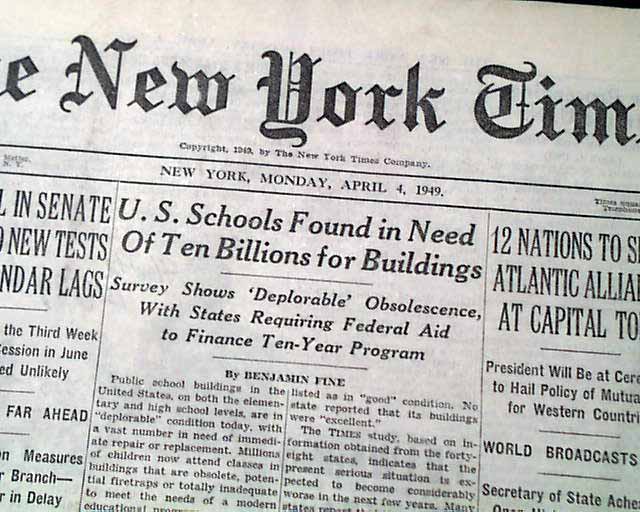
THE NEW YORK TIMES, New York, April 4, 1949
* NATO
* North Atlantic Treaty Organization
* Atlantic Defense Treaty
* Pact signed
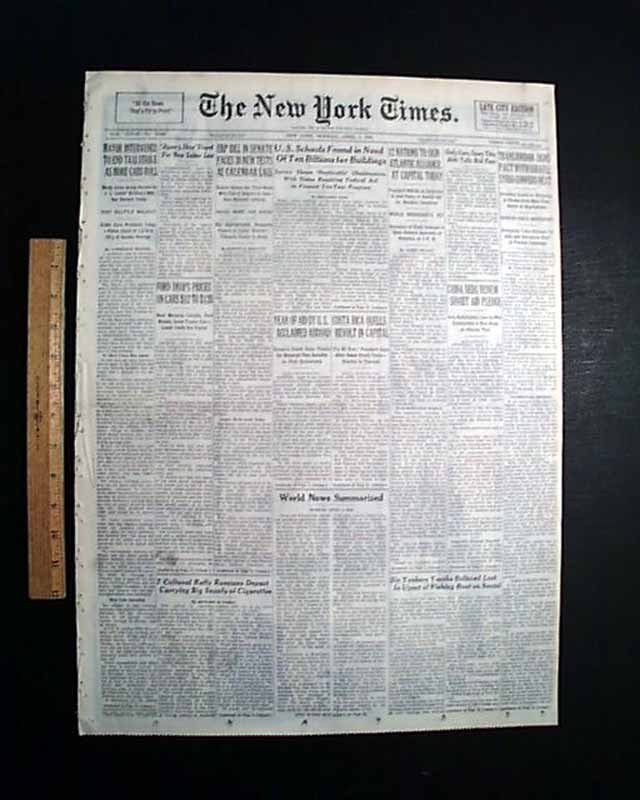
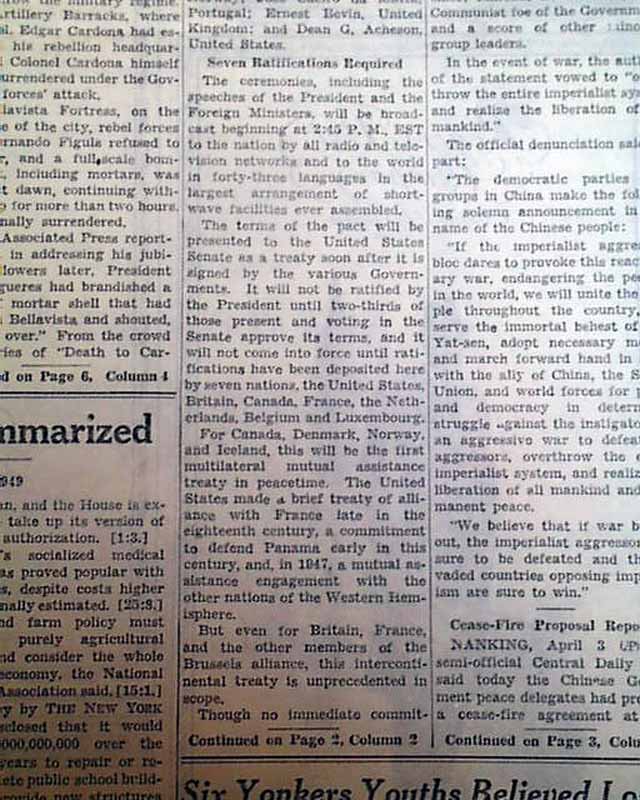
This 44 page newspaper has one column headlines on the front page that include:
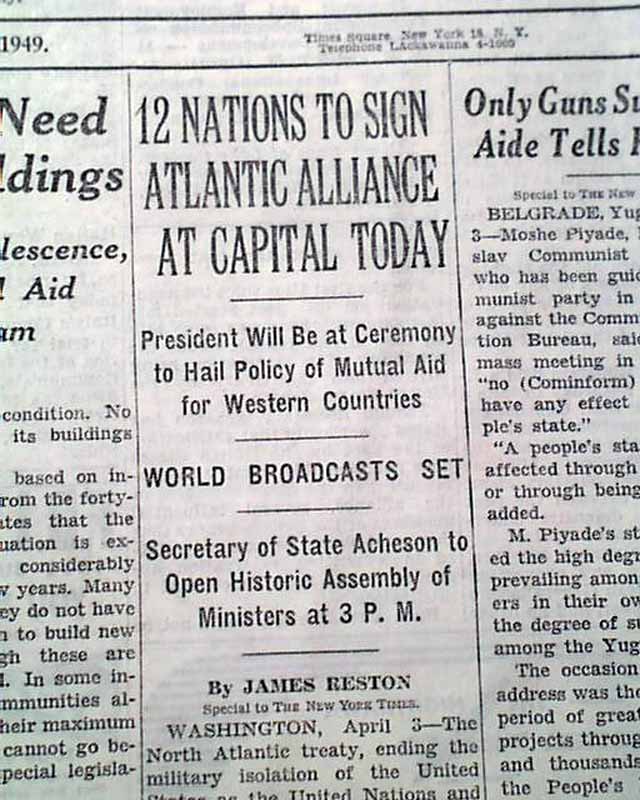
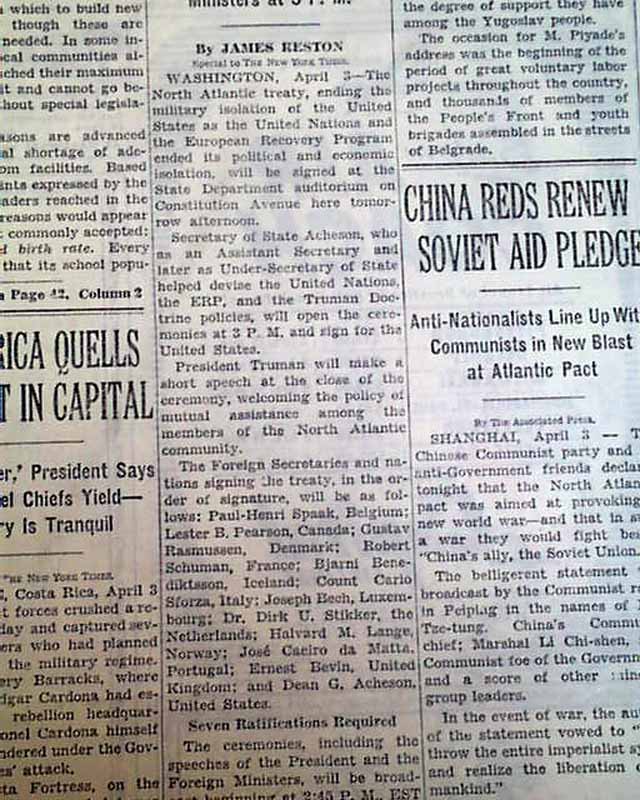
* 12 NATIONS TO SIGN ATLANTIC ALLIANCE AT CAPITAL TODAY
* President Will Be at Ceremony to Hail Policy of Mutual Aid for Western Countries
* World Broadcasts Set
and more. Nice to have in this famous title.
Other news of the day throughout. Rag edition in very nice condition.
wikipedia notes: The Treaty of Brussels, signed on 17 March 1948 by Belgium, the Netherlands, Luxembourg, France and the United Kingdom is considered the precursor to the NATO agreement. The treaty and the Soviet Berlin Blockade led to the creation of the Western European Union's Defense Organization in September 1948.[7] However, participation of the United States was thought necessary in order to counter the military power of the USSR, and therefore talks for a new military alliance began almost immediately.
These talks resulted in the North Atlantic Treaty, which was signed in Washington, D.C. on 4 April 1949. It included the five Treaty of Brussels states, as well as the United States, Canada, Portugal, Italy, Norway, Denmark and Iceland. Popular support for the Treaty was not unanimous; some Icelanders commenced a pro-neutrality, anti-membership riot in March 1949.
“ The Parties of NATO agreed that an armed attack against one or more of them in Europe or North America shall be considered an attack against them all. Consequently they agree that, if such an armed attack occurs, each of them, in exercise of the right of individual or collective self-defense will assist the Party or Parties being attacked, individually and in concert with the other Parties, such action as it deems necessary, including the use of armed force, to restore and maintain the security of the North Atlantic area. ”
Such action as it deems necessary, including the use of armed force does not necessarily mean that other member states will respond with military action against the aggressor(s). Rather they are obliged to respond, but maintain the freedom to choose how they will respond. This differs from Article IV of the Treaty of Brussels (which founded the Western European Union) which clearly states that the response however often assumed that NATO members will aid the attacked member militarily. Further, the article limits the organization's scope to Europe and North America, which explains why the invasion of the British Falkland Islands did not result in NATO involvement.
The creation of NATO brought about some standardisation of allied military terminology, procedures, and technology, which in many cases meant European countries adopting U.S. practices. The roughly 1300 Standardization Agreements (STANAGs) codifies the standardisation that NATO has achieved. Hence, the 7.62×51 NATO rifle cartridge was introduced in the 1950s as a standard firearm cartridge among many NATO countries. Fabrique Nationale's FAL became the most popular 7.62 NATO rifle in Europe and served into the early 1990s. Also, aircraft marshalling signals were standardized, so that any NATO aircraft could land at any NATO base. Other standards such as the NATO phonetic alphabet have made their way beyond NATO into civilian use.
* NATO
* North Atlantic Treaty Organization
* Atlantic Defense Treaty
* Pact signed
This 44 page newspaper has one column headlines on the front page that include:
* 12 NATIONS TO SIGN ATLANTIC ALLIANCE AT CAPITAL TODAY
* President Will Be at Ceremony to Hail Policy of Mutual Aid for Western Countries
* World Broadcasts Set
and more. Nice to have in this famous title.
Other news of the day throughout. Rag edition in very nice condition.
wikipedia notes: The Treaty of Brussels, signed on 17 March 1948 by Belgium, the Netherlands, Luxembourg, France and the United Kingdom is considered the precursor to the NATO agreement. The treaty and the Soviet Berlin Blockade led to the creation of the Western European Union's Defense Organization in September 1948.[7] However, participation of the United States was thought necessary in order to counter the military power of the USSR, and therefore talks for a new military alliance began almost immediately.
These talks resulted in the North Atlantic Treaty, which was signed in Washington, D.C. on 4 April 1949. It included the five Treaty of Brussels states, as well as the United States, Canada, Portugal, Italy, Norway, Denmark and Iceland. Popular support for the Treaty was not unanimous; some Icelanders commenced a pro-neutrality, anti-membership riot in March 1949.
“ The Parties of NATO agreed that an armed attack against one or more of them in Europe or North America shall be considered an attack against them all. Consequently they agree that, if such an armed attack occurs, each of them, in exercise of the right of individual or collective self-defense will assist the Party or Parties being attacked, individually and in concert with the other Parties, such action as it deems necessary, including the use of armed force, to restore and maintain the security of the North Atlantic area. ”
Such action as it deems necessary, including the use of armed force does not necessarily mean that other member states will respond with military action against the aggressor(s). Rather they are obliged to respond, but maintain the freedom to choose how they will respond. This differs from Article IV of the Treaty of Brussels (which founded the Western European Union) which clearly states that the response however often assumed that NATO members will aid the attacked member militarily. Further, the article limits the organization's scope to Europe and North America, which explains why the invasion of the British Falkland Islands did not result in NATO involvement.
The creation of NATO brought about some standardisation of allied military terminology, procedures, and technology, which in many cases meant European countries adopting U.S. practices. The roughly 1300 Standardization Agreements (STANAGs) codifies the standardisation that NATO has achieved. Hence, the 7.62×51 NATO rifle cartridge was introduced in the 1950s as a standard firearm cartridge among many NATO countries. Fabrique Nationale's FAL became the most popular 7.62 NATO rifle in Europe and served into the early 1990s. Also, aircraft marshalling signals were standardized, so that any NATO aircraft could land at any NATO base. Other standards such as the NATO phonetic alphabet have made their way beyond NATO into civilian use.
Category: The 20th Century


