

The California bandit is captured...
Item # 554829Sorry, but this item is no longer available. Please be in touch at info@rarenewspapers.com if you would like to be placed on a want list or are interested in a potential alternate issue.
May 15, 1874
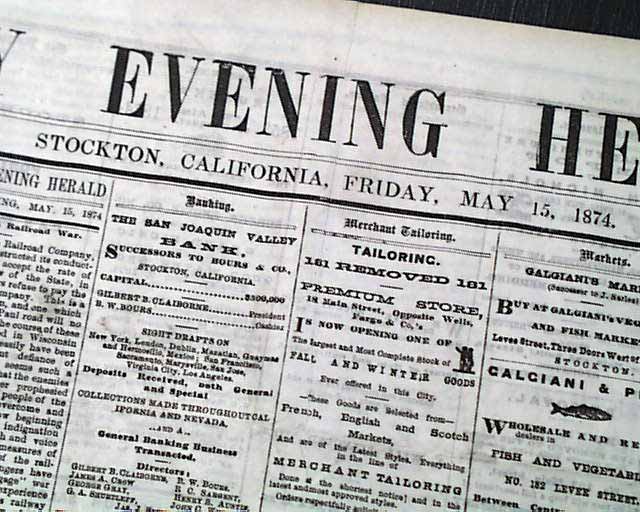
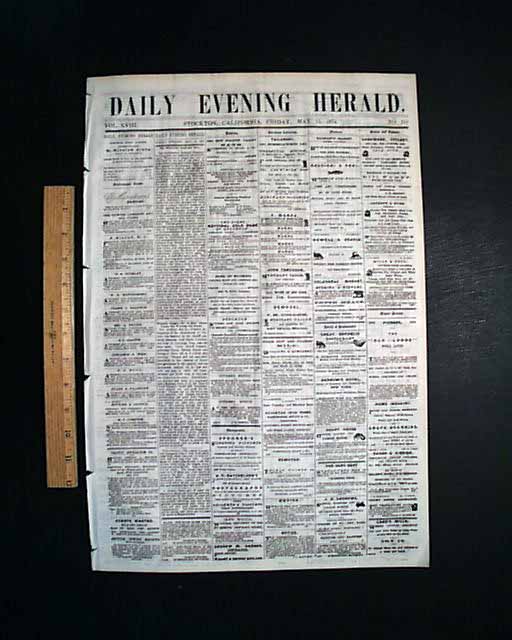
DAILY EVENING HERALD, Stockton, California, May 15, 1874
* Tiburcio Vasquez captured
* Mexican bandit
* California
Not only is it great to have the report of the capture of the infamous bandit Tiburcio Vasquez in a California newspaper but also to have it on the front page.
Vasquez was a Mexican bandit who was active in California from as early as 1857 until his capture. The Vasquez Rocks, the steep, sloped rocks about 40 miles north of Los Angeles, were one of his many hideouts and received their name from him.
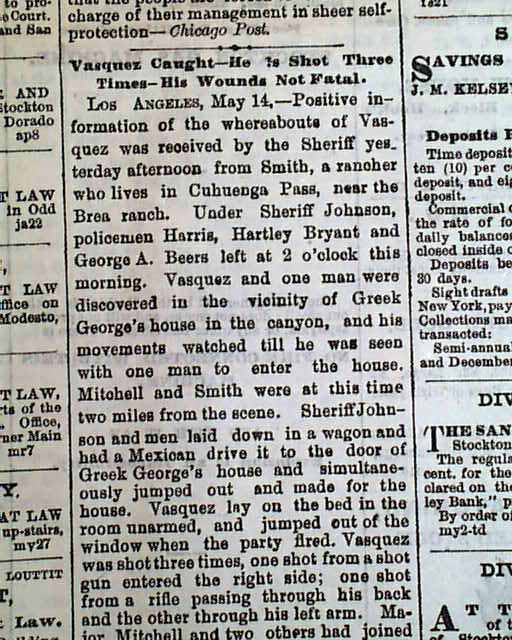
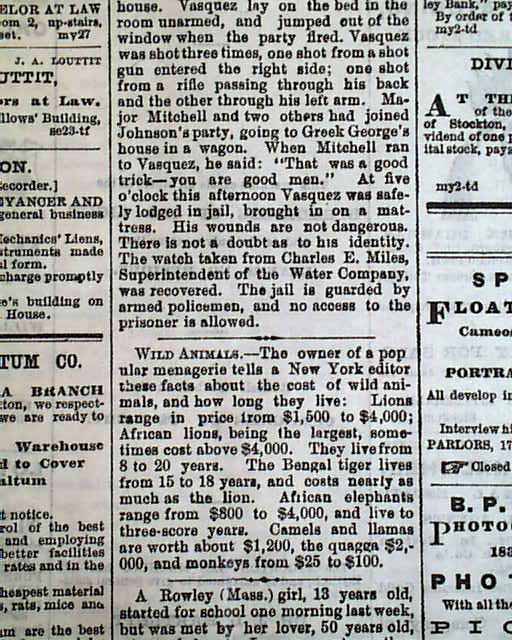
The front page has one column head reads: "Vasquez Caught--He Is Shot Three Times--His Wounds Not Fatal". With a dateline of Los Angeles, the report begins: "Positive information of the whereabouts of Vasquez was received by the Sheriff...Vasquez & one man were discovered in the vicinity of Greek George's house in the canyon..." with further particulars on his capture (see photos).
Complete in 4 pages and in very nice, clean condition.
wikipedia notes: Vásquez took up residence in the Hollywood Hills at "Greek George's" ranch, located on the San Fernando Valley side of the Cahuengas Mountains. Greek George was a former camel driver for General Beale in the Army Camel Corps. Allegedly, Vásquez seduced and impregnated his own niece. Either the girl's family or Greek George's wife's family betrayed Vásquez to Los Angeles Sheriff William Roland. Roland led a posse to the ranch and captured Vásquez on May 13, 1874.
Vásquez remained in the Los Angeles County jail for nine days. He had numerous requests for interviews by many newspaper reporters, but agreed to see only three: two from the San Francisco Chronicle and one from the Los Angeles Star. He told them his aim was to return California to Mexican rule. He insisted he was an honorable man and said he had never killed anyone.
In late May, Vásquez was moved by steamship to San Francisco, California. He would eventually stand trial in San Jose. Vásquez quickly became a celebrity among many of his fellow Hispanic Californians. He admitted he was an outlaw, but again denied he had ever killed anyone. A note written by Clovidio Chavez, one of his gang members, was dropped into a Wells Fargo box. Chavez wrote that he, not Vásquez, had shot the men at Tres Pinos. Nevertheless, in January 1875 Vásquez was sentenced to hang for murder. His trial had taken four days and the jury deliberated for two hours before finally finding him guilty of two counts of murder in the Tres Pinos robbery.
Visitors still flocked to Vásquez's jail cell, many of them women. He signed autographs and posed for photographs. Vásquez sold the photos from the window of his cell and used the money to pay for his legal defense. After his conviction, he appealed for clemency. It was denied by Governor Romualdo Pacheco. Vásquez calmly[citation needed] met his fate in San Jose on March 17, 1875. He was 39 years old.
* Tiburcio Vasquez captured
* Mexican bandit
* California
Not only is it great to have the report of the capture of the infamous bandit Tiburcio Vasquez in a California newspaper but also to have it on the front page.
Vasquez was a Mexican bandit who was active in California from as early as 1857 until his capture. The Vasquez Rocks, the steep, sloped rocks about 40 miles north of Los Angeles, were one of his many hideouts and received their name from him.
The front page has one column head reads: "Vasquez Caught--He Is Shot Three Times--His Wounds Not Fatal". With a dateline of Los Angeles, the report begins: "Positive information of the whereabouts of Vasquez was received by the Sheriff...Vasquez & one man were discovered in the vicinity of Greek George's house in the canyon..." with further particulars on his capture (see photos).
Complete in 4 pages and in very nice, clean condition.
wikipedia notes: Vásquez took up residence in the Hollywood Hills at "Greek George's" ranch, located on the San Fernando Valley side of the Cahuengas Mountains. Greek George was a former camel driver for General Beale in the Army Camel Corps. Allegedly, Vásquez seduced and impregnated his own niece. Either the girl's family or Greek George's wife's family betrayed Vásquez to Los Angeles Sheriff William Roland. Roland led a posse to the ranch and captured Vásquez on May 13, 1874.
Vásquez remained in the Los Angeles County jail for nine days. He had numerous requests for interviews by many newspaper reporters, but agreed to see only three: two from the San Francisco Chronicle and one from the Los Angeles Star. He told them his aim was to return California to Mexican rule. He insisted he was an honorable man and said he had never killed anyone.
In late May, Vásquez was moved by steamship to San Francisco, California. He would eventually stand trial in San Jose. Vásquez quickly became a celebrity among many of his fellow Hispanic Californians. He admitted he was an outlaw, but again denied he had ever killed anyone. A note written by Clovidio Chavez, one of his gang members, was dropped into a Wells Fargo box. Chavez wrote that he, not Vásquez, had shot the men at Tres Pinos. Nevertheless, in January 1875 Vásquez was sentenced to hang for murder. His trial had taken four days and the jury deliberated for two hours before finally finding him guilty of two counts of murder in the Tres Pinos robbery.
Visitors still flocked to Vásquez's jail cell, many of them women. He signed autographs and posed for photographs. Vásquez sold the photos from the window of his cell and used the money to pay for his legal defense. After his conviction, he appealed for clemency. It was denied by Governor Romualdo Pacheco. Vásquez calmly[citation needed] met his fate in San Jose on March 17, 1875. He was 39 years old.
Category: The Old West


