

George II's speech to Parliament...
Item # 554142Sorry, but this item is no longer available. Please be in touch at info@rarenewspapers.com if you would like to be placed on a want list or are interested in a potential alternate issue.
June 01, 1766
King George III speech to Parliament
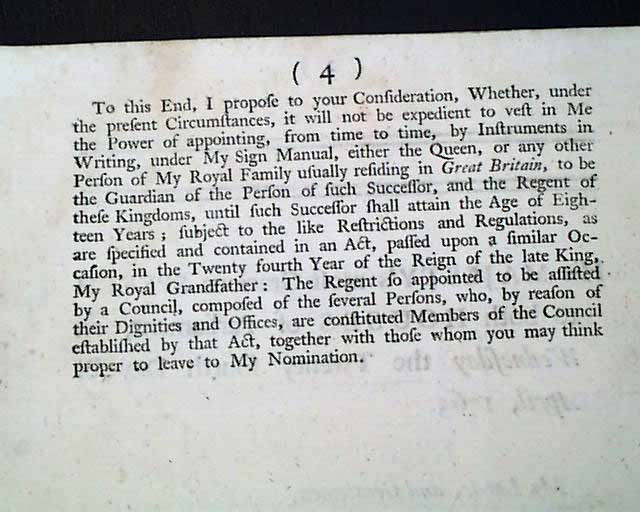
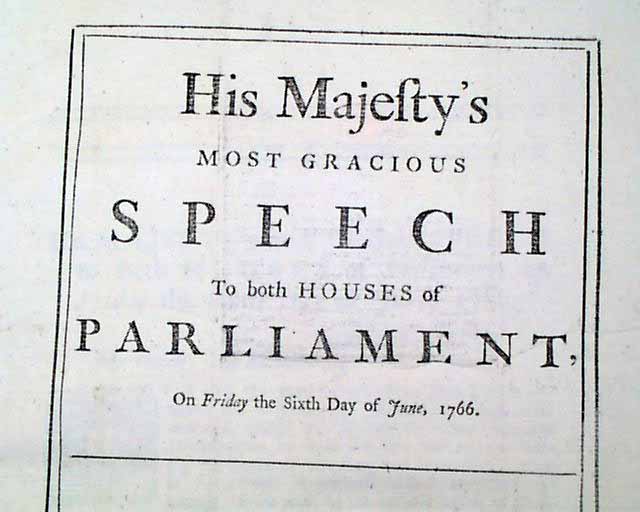
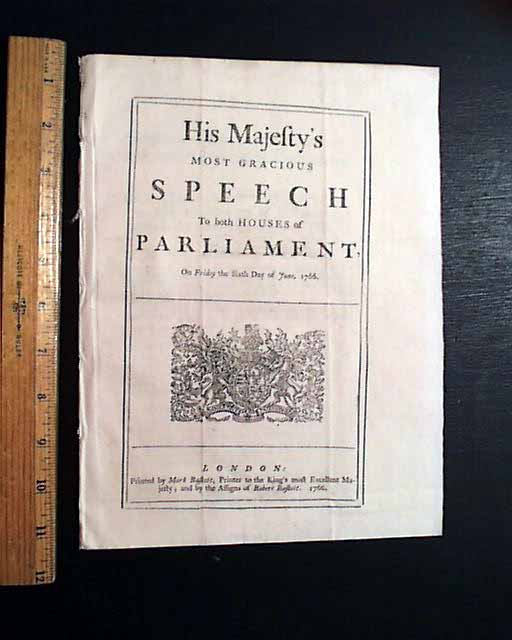
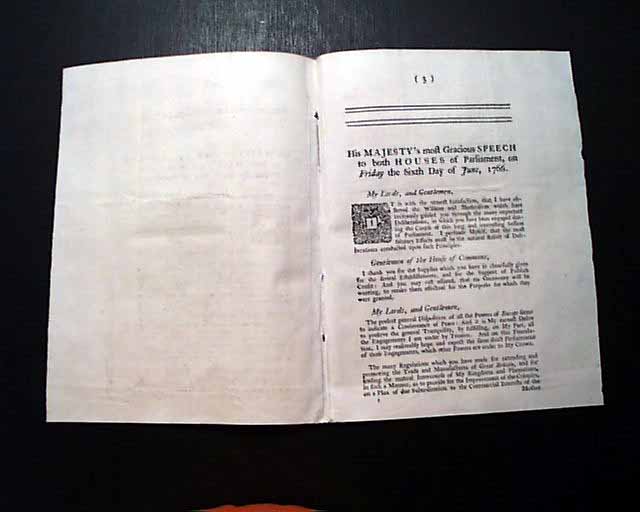
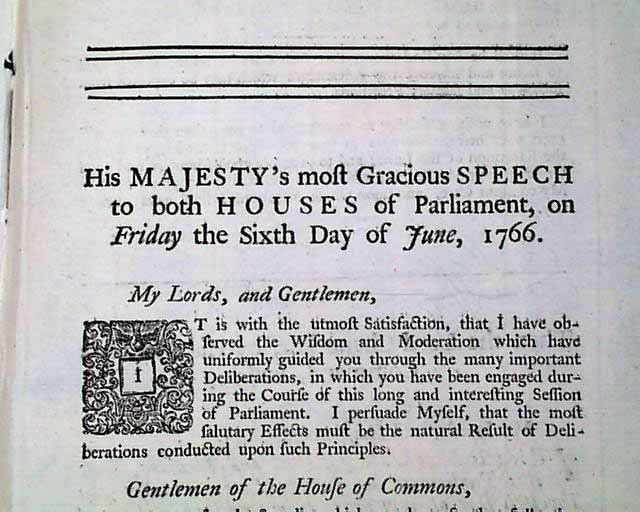
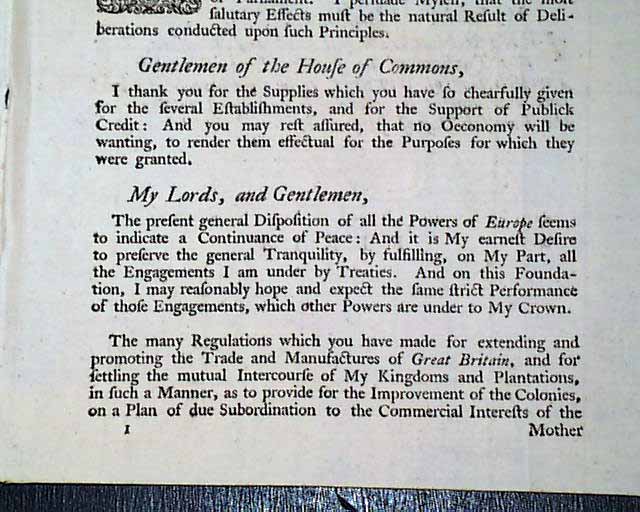
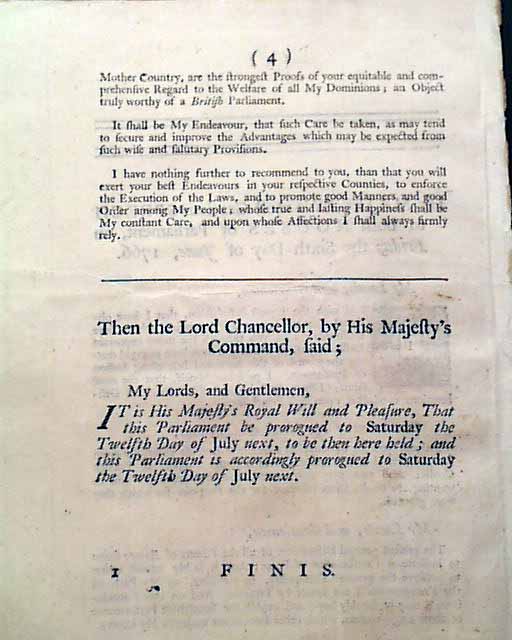
This is a four page pamphlet titled: "His Majesty's Most Gracious SPEECH to both Houses of PARLIAMENT on Wed. the sixth day of June, 1766" as noted in the full title page. In this address the king talks of some accomplishments of Parliament with mention of the Colonies, with:
* ...many regulations which you have made for extending & promoting the trade & manufactures...and for settling the mutual intercourse of my Kingdoms and Plantations, in such a manner as to provide for the improvement of the Colonies on a plan of due subordination to the commercial interests of the Mother Country..."
with more (see).
Complete in 4 pages, 8 1/4 by 10 3/4 inches, very nice condition.
wikipedia notes: George III (George William Frederick; 4 June 1738[2] – 29 January 1820 [N.S.]) was King of Great Britain and King of Ireland from 25 October 1760 until the union of these two countries on 1 January 1801, after which he was King of the United Kingdom of Great Britain and Ireland until his death. He was concurrently Duke of Brunswick-Lüneburg and prince-elector of Hanover in the Holy Roman Empire until his promotion to King of Hanover on 12 October 1814. He was the third British monarch of the House of Hanover, but unlike his two predecessors he was born in Britain and spoke English as his first language. Despite his long life, he never visited Hanover.
George III's long reign was marked by a series of military conflicts involving his kingdoms, much of the rest of Europe, and places further afield in Africa, the Americas and Asia. Early in his reign, Great Britain defeated France in the Seven Years' War, becoming the dominant European power in North America and India. However, many of its American colonies were soon lost in the American Revolutionary War, which led to the establishment of the United States. A series of wars against revolutionary and Napoleonic France, over a twenty-year period, finally concluded in the defeat of Napoleon in 1815.
In the later half of his life, George III suffered from recurrent and, eventually, permanent mental illness. Medical practitioners were baffled by this at the time, although it has since been suggested that he suffered from the blood disease porphyria. After a final relapse in 1810, a regency was established, and George III's eldest son, George, Prince of Wales, ruled as Prince Regent. On George III's death, the Prince Regent succeeded his father as George IV. Historical analysis of George III's life has gone through a "kaleidoscope of changing views" which have depended heavily on the prejudices of his biographers and the sources available to them.
This is a four page pamphlet titled: "His Majesty's Most Gracious SPEECH to both Houses of PARLIAMENT on Wed. the sixth day of June, 1766" as noted in the full title page. In this address the king talks of some accomplishments of Parliament with mention of the Colonies, with:
* ...many regulations which you have made for extending & promoting the trade & manufactures...and for settling the mutual intercourse of my Kingdoms and Plantations, in such a manner as to provide for the improvement of the Colonies on a plan of due subordination to the commercial interests of the Mother Country..."
with more (see).
Complete in 4 pages, 8 1/4 by 10 3/4 inches, very nice condition.
wikipedia notes: George III (George William Frederick; 4 June 1738[2] – 29 January 1820 [N.S.]) was King of Great Britain and King of Ireland from 25 October 1760 until the union of these two countries on 1 January 1801, after which he was King of the United Kingdom of Great Britain and Ireland until his death. He was concurrently Duke of Brunswick-Lüneburg and prince-elector of Hanover in the Holy Roman Empire until his promotion to King of Hanover on 12 October 1814. He was the third British monarch of the House of Hanover, but unlike his two predecessors he was born in Britain and spoke English as his first language. Despite his long life, he never visited Hanover.
George III's long reign was marked by a series of military conflicts involving his kingdoms, much of the rest of Europe, and places further afield in Africa, the Americas and Asia. Early in his reign, Great Britain defeated France in the Seven Years' War, becoming the dominant European power in North America and India. However, many of its American colonies were soon lost in the American Revolutionary War, which led to the establishment of the United States. A series of wars against revolutionary and Napoleonic France, over a twenty-year period, finally concluded in the defeat of Napoleon in 1815.
In the later half of his life, George III suffered from recurrent and, eventually, permanent mental illness. Medical practitioners were baffled by this at the time, although it has since been suggested that he suffered from the blood disease porphyria. After a final relapse in 1810, a regency was established, and George III's eldest son, George, Prince of Wales, ruled as Prince Regent. On George III's death, the Prince Regent succeeded his father as George IV. Historical analysis of George III's life has gone through a "kaleidoscope of changing views" which have depended heavily on the prejudices of his biographers and the sources available to them.
Category: Documents & Broadsides


