

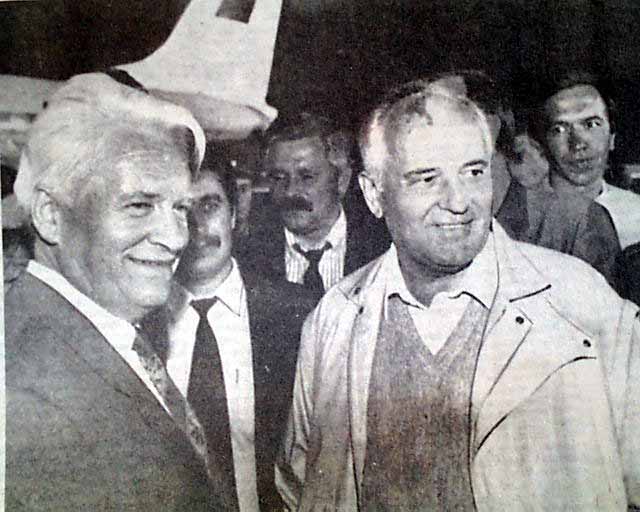
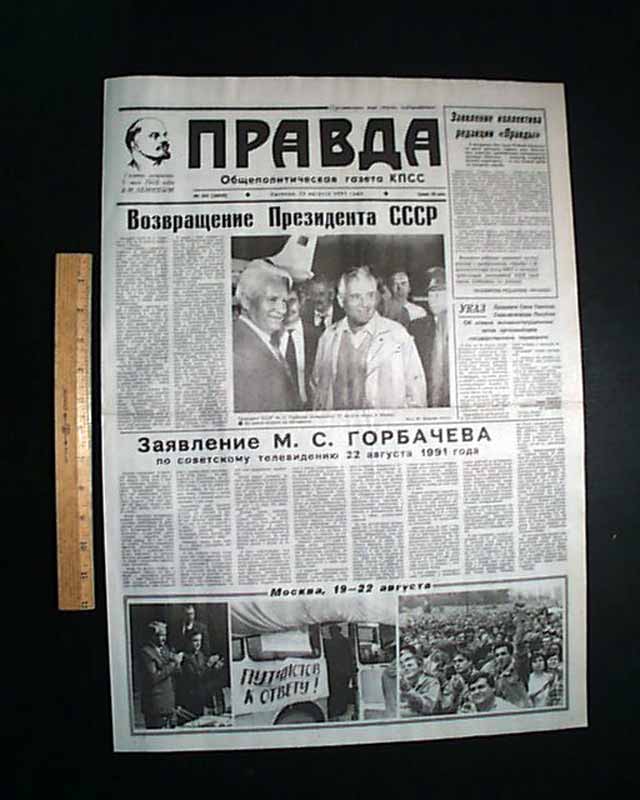
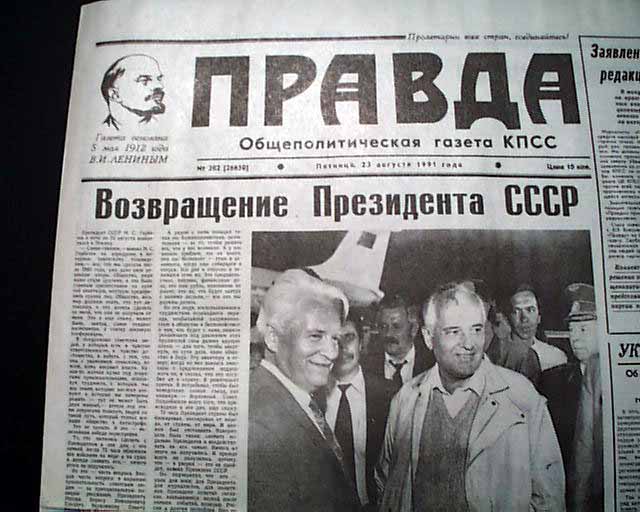
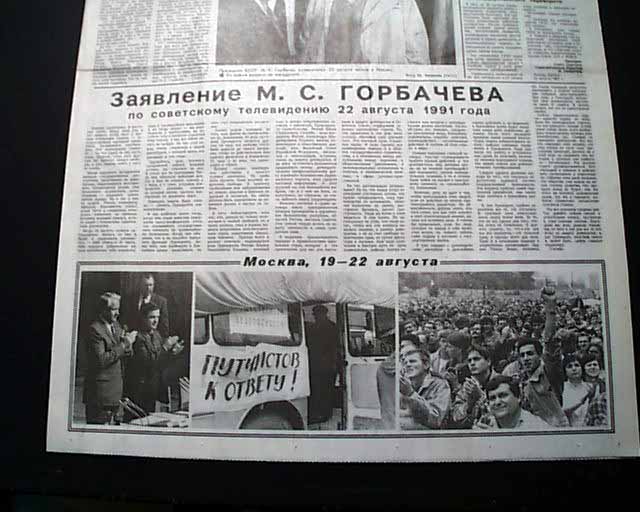
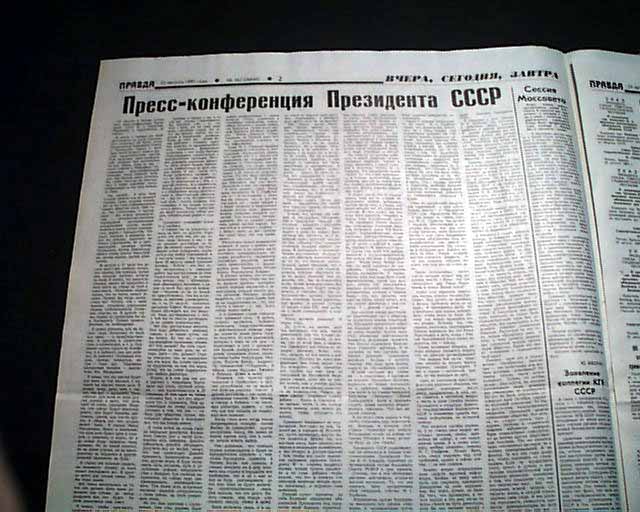
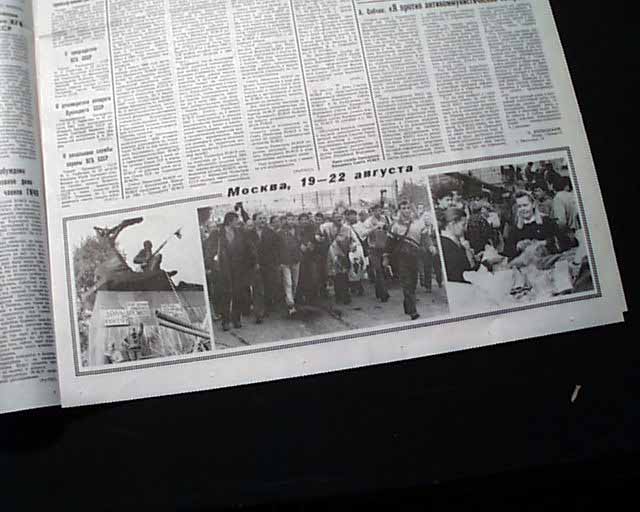
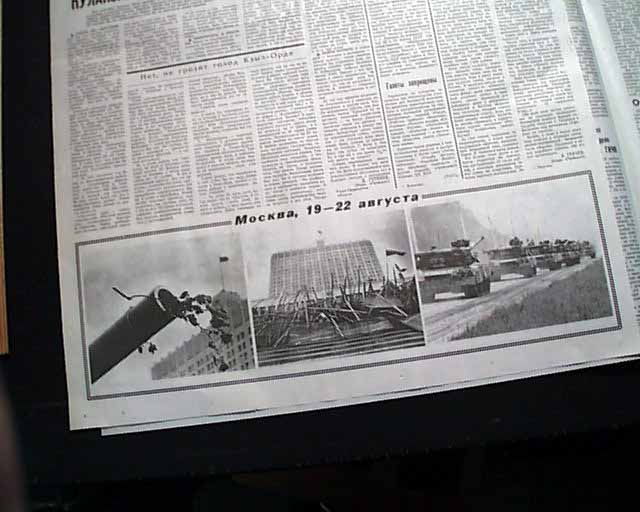
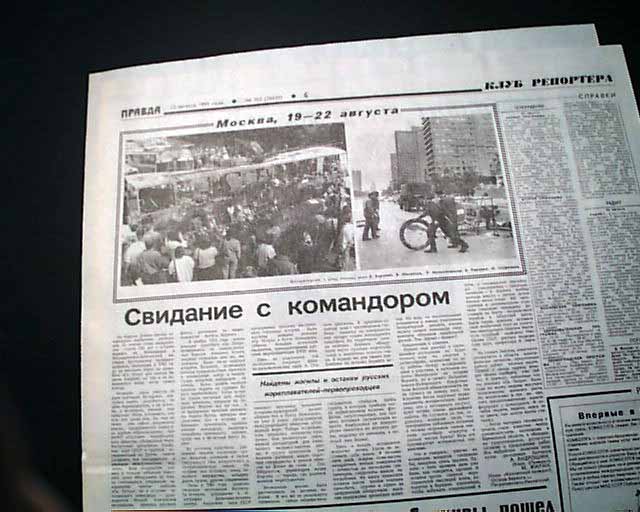
Gorbachev return from his forced exile...
Item # 551763Sorry, but this item is no longer available. Please be in touch at info@rarenewspapers.com if you would like to be placed on a want list or are interested in a potential alternate issue.
August 23, 1991
PRAVDA, from Moscow, Soviet Union, dated August 23, 1991
* Mikhail Sergeyevich Gorbachev returns
* From Moscow in the Russian language
A significant issue on the Soviet Union coup, as this is the newspaper noting the return of Gorbachev from his forced exile. The front page includes a photo of Gorbachev with Yeltsin at the airport.
Complete in 6 pages, excellent condition. Note the image of Lenin in the top left corner.
wikipedia notes: In contrast to the reformers' lukewarm approach to the new treaty, the hard-line apparatchiks, still strong within the CPSU and military establishment, were completely opposed to anything which might lead to the break-up of the Soviet Union. On the eve of the treaty's signing, the hardliners struck.
Hardliners in the Soviet leadership, calling themselves the 'State Emergency Committee', launched the August coup in 1991 in an attempt to remove Gorbachev from power and prevent the signing of the new union treaty. During this time, Gorbachev spent three days (19 August, 20 and 21) under house arrest at a dacha in the Crimea before being freed and restored to power. However, upon his return, Gorbachev found that neither union nor Russian power structures heeded his commands as support had swung over to Yeltsin, whose defiance had led to the coup's collapse. Furthermore, Gorbachev was forced to fire large numbers of his Politburo and, in several cases, arrest them. Those arrested for high treason included the "Gang of Eight" that had led the coup, including Kryuchkov, Yazov, Pavlov and Yanayev. Pugo was found shot; and Akhromeyev, who had offered his assistance but was never implicated, was found hanging in his Kremlin office. Most of these men had been former allies of Gorbachev's or promoted by him, which drew fresh criticism.[4]
Between 21 August and 22 September, Estonia, Latvia, Lithuania, Ukraine, Belarus, Moldova, Georgia, Armenia, Azerbaijan, Kazakhstan, Kyrgyzstan, Uzbekistan, Tajikstan, and Turkmenistan declared their independence. Simultaneously, Boris Yeltsin ordered the CPSU to suspend its activities on the territory of Russia and closed the Central Committee building at Staraya Ploschad. The Russian flag now flew beside the Soviet flag at the Kremlin. In light of these circumstances, Gorbachev resigned as General Secretary of the CPSU on 24 August and advised the Central Committee to dissolve. Gorbachev's hopes of a new Union were further hit when the Congress of People's Deputies dissolved itself on 5 September. Though Gorbachev and the representatives of 8 republics (excluding Azerbaijan, Georgia, Moldavia, Ukraine, Lithuania, Latvia and Estonia) signed an agreement on forming a new economic community on 18 October, events were overtaking Gorbachev.[4]
The final blow to Gorbachev's vision was effectively dealt by a Ukrainian referendum on 1 December, where the Ukrainian people voted for independence. The presidents of Russia, Ukraine and Belarus met in Belovezh Forest, near Brest, Belarus, on 8 December, founding the Commonwealth of Independent States and declaring the end of the Soviet Union in the Belavezha Accords. Gorbachev was presented with a fait accompli and reluctantly agreed with Yeltsin, on 17 December, to dissolve the Soviet Union. Gorbachev resigned on 25 December and the Soviet Union was formally dissolved the next day. Two days later, on 27 December, Yeltsin moved into Gorbachev's old office.[4]
Gorbachev had aimed to maintain the CPSU as a united party but move it in the direction of social democracy. The inherent contradictions in this approach, praising Lenin, admiring Sweden's social model and seeking to keep the three Baltic states, were difficult enough. But when the CPSU was proscribed after the August coup, Gorbachev was left with no effective power base beyond the armed forces. In the end, Yeltsin won them around with promises of better and, more important, guaranteed payment of their salaries and pensions at a time when, the military had just seen how the jobs of the CPSU's civil servants of the Soviet Union's central administration had disappeared, and they were afraid of losing their own jobs, salaries and pensions in the absence of a State that could guarantee them
* Mikhail Sergeyevich Gorbachev returns
* From Moscow in the Russian language
A significant issue on the Soviet Union coup, as this is the newspaper noting the return of Gorbachev from his forced exile. The front page includes a photo of Gorbachev with Yeltsin at the airport.
Complete in 6 pages, excellent condition. Note the image of Lenin in the top left corner.
wikipedia notes: In contrast to the reformers' lukewarm approach to the new treaty, the hard-line apparatchiks, still strong within the CPSU and military establishment, were completely opposed to anything which might lead to the break-up of the Soviet Union. On the eve of the treaty's signing, the hardliners struck.
Hardliners in the Soviet leadership, calling themselves the 'State Emergency Committee', launched the August coup in 1991 in an attempt to remove Gorbachev from power and prevent the signing of the new union treaty. During this time, Gorbachev spent three days (19 August, 20 and 21) under house arrest at a dacha in the Crimea before being freed and restored to power. However, upon his return, Gorbachev found that neither union nor Russian power structures heeded his commands as support had swung over to Yeltsin, whose defiance had led to the coup's collapse. Furthermore, Gorbachev was forced to fire large numbers of his Politburo and, in several cases, arrest them. Those arrested for high treason included the "Gang of Eight" that had led the coup, including Kryuchkov, Yazov, Pavlov and Yanayev. Pugo was found shot; and Akhromeyev, who had offered his assistance but was never implicated, was found hanging in his Kremlin office. Most of these men had been former allies of Gorbachev's or promoted by him, which drew fresh criticism.[4]
Between 21 August and 22 September, Estonia, Latvia, Lithuania, Ukraine, Belarus, Moldova, Georgia, Armenia, Azerbaijan, Kazakhstan, Kyrgyzstan, Uzbekistan, Tajikstan, and Turkmenistan declared their independence. Simultaneously, Boris Yeltsin ordered the CPSU to suspend its activities on the territory of Russia and closed the Central Committee building at Staraya Ploschad. The Russian flag now flew beside the Soviet flag at the Kremlin. In light of these circumstances, Gorbachev resigned as General Secretary of the CPSU on 24 August and advised the Central Committee to dissolve. Gorbachev's hopes of a new Union were further hit when the Congress of People's Deputies dissolved itself on 5 September. Though Gorbachev and the representatives of 8 republics (excluding Azerbaijan, Georgia, Moldavia, Ukraine, Lithuania, Latvia and Estonia) signed an agreement on forming a new economic community on 18 October, events were overtaking Gorbachev.[4]
The final blow to Gorbachev's vision was effectively dealt by a Ukrainian referendum on 1 December, where the Ukrainian people voted for independence. The presidents of Russia, Ukraine and Belarus met in Belovezh Forest, near Brest, Belarus, on 8 December, founding the Commonwealth of Independent States and declaring the end of the Soviet Union in the Belavezha Accords. Gorbachev was presented with a fait accompli and reluctantly agreed with Yeltsin, on 17 December, to dissolve the Soviet Union. Gorbachev resigned on 25 December and the Soviet Union was formally dissolved the next day. Two days later, on 27 December, Yeltsin moved into Gorbachev's old office.[4]
Gorbachev had aimed to maintain the CPSU as a united party but move it in the direction of social democracy. The inherent contradictions in this approach, praising Lenin, admiring Sweden's social model and seeking to keep the three Baltic states, were difficult enough. But when the CPSU was proscribed after the August coup, Gorbachev was left with no effective power base beyond the armed forces. In the end, Yeltsin won them around with promises of better and, more important, guaranteed payment of their salaries and pensions at a time when, the military had just seen how the jobs of the CPSU's civil servants of the Soviet Union's central administration had disappeared, and they were afraid of losing their own jobs, salaries and pensions in the absence of a State that could guarantee them
Category: The 20th Century


