

Over 290 years old...
Item # 547190Sorry, but this item is no longer available. Please be in touch at info@rarenewspapers.com if you would like to be placed on a want list or are interested in a potential alternate issue.
August 24, 1715
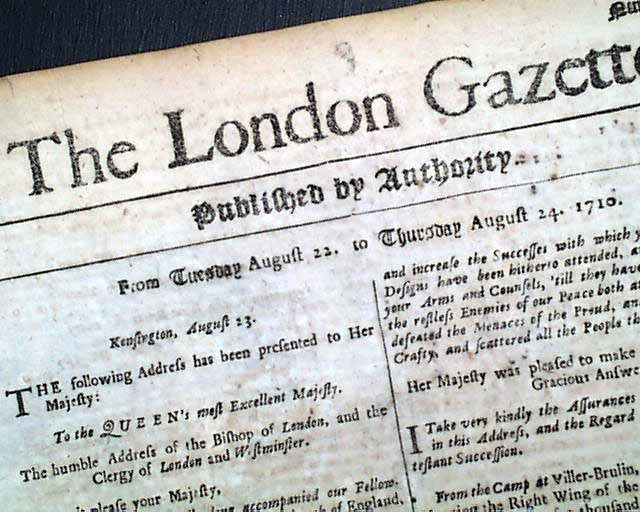
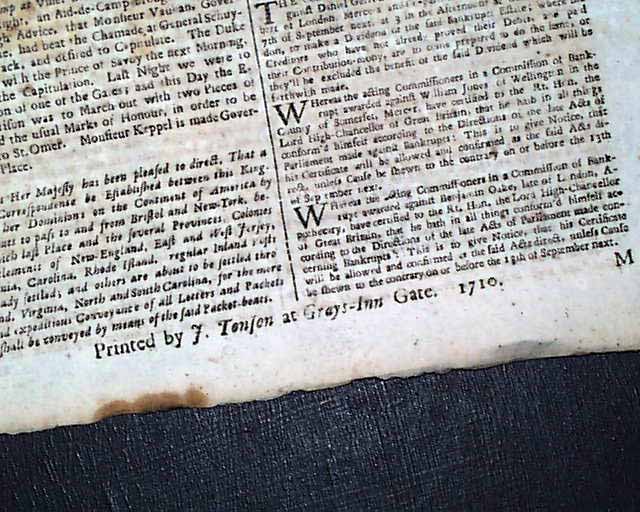
THE LONDON GAZETTE, England, August 24, 1710
* 18th Century original
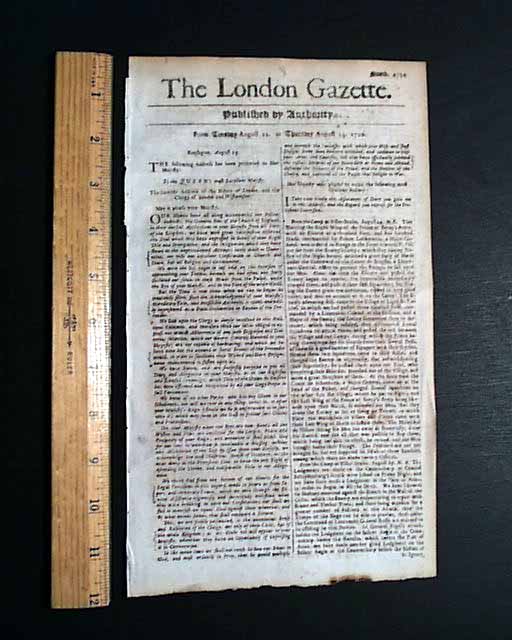
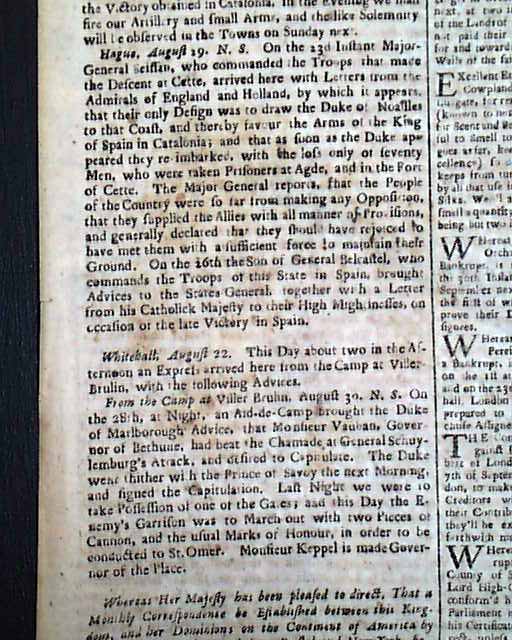
This single sheet issue is over 290 years old. Various news from London and other parts of Europe and more.
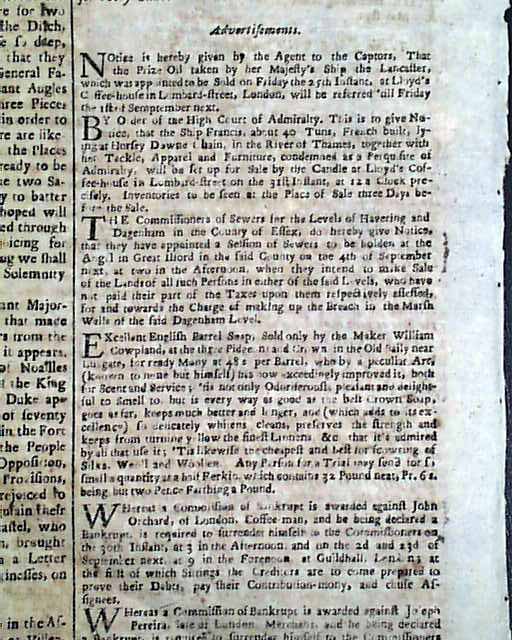
This title is the oldest continuously published newspaper in the world which began in 1665 and is still in existence today. Also with some interesting advertisements as well.
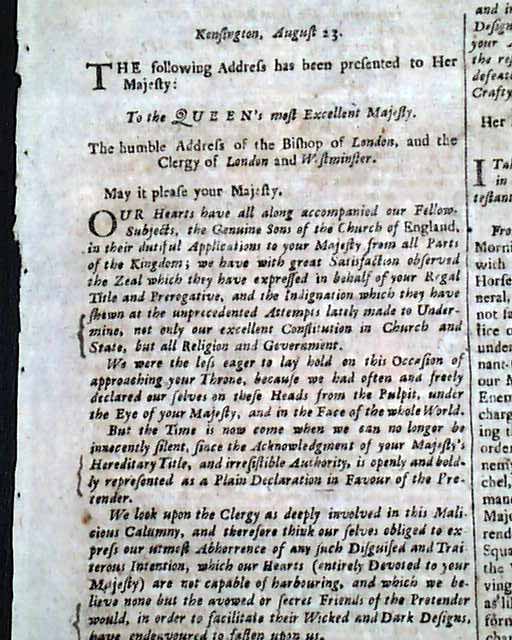
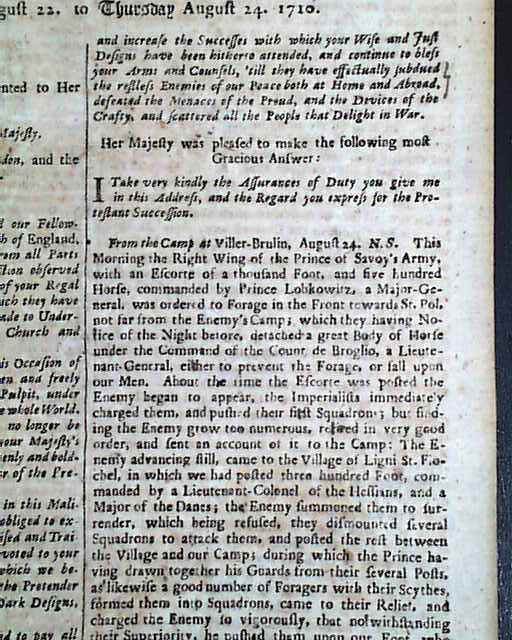
The front page has an address "To the Queen's most Excellent Majesty" from "The humble Address of the Bishops of London, and Clergy of London & Westminster", and her brief but gracious reply, reading: "I take very kindly Assurances of Duty you give me in this Address, and the Regard you express for the Protestant Succession."
A complete newspaper measuring about 7 by 11 1/2 inches and is in nice condition. Made of rag paper which was used back in the day (no wood pulp).
Background: "When in the autumn of 1665 Charles II sought shelter in Oxford from the Great Plague, he and his courtiers wanted newspapers to read, yet feared to touch "The Intelligencer" or "The News," which, coming from London, might be infected. Therefore Leonard Litchfeld, the university printer, was authorized and ordered to bring out a local paper. On Tuesday, November 14, 1665, the first number of "The Oxford Gazette" appeared, and it continued afterwords through eleven weeks on Thursdays and Mondays. It was meager enough, but, though comprised in only two double-columned pages of folio, each number contained nearly as much matter as one of Roger L'Estrange's papers, and it soon became a formidable rival to those papers, especially as Thomas Newcombe, the old printer of the Commonwealth organs, was allowed to reproduce its sheets in London "for the use of some members and gentlemen who desired them.
The plague was soon over and King Charles went back to Whitehall, but he was pleased with the Oxford effort and it was soon succeeded by "The London Gazette, which made its first appearance, labelled as No. 24, on February 5, 1666, and which has been kept alive, altering its size and character from time to time, down to this day."
* 18th Century original
This single sheet issue is over 290 years old. Various news from London and other parts of Europe and more.
This title is the oldest continuously published newspaper in the world which began in 1665 and is still in existence today. Also with some interesting advertisements as well.
The front page has an address "To the Queen's most Excellent Majesty" from "The humble Address of the Bishops of London, and Clergy of London & Westminster", and her brief but gracious reply, reading: "I take very kindly Assurances of Duty you give me in this Address, and the Regard you express for the Protestant Succession."
A complete newspaper measuring about 7 by 11 1/2 inches and is in nice condition. Made of rag paper which was used back in the day (no wood pulp).
Background: "When in the autumn of 1665 Charles II sought shelter in Oxford from the Great Plague, he and his courtiers wanted newspapers to read, yet feared to touch "The Intelligencer" or "The News," which, coming from London, might be infected. Therefore Leonard Litchfeld, the university printer, was authorized and ordered to bring out a local paper. On Tuesday, November 14, 1665, the first number of "The Oxford Gazette" appeared, and it continued afterwords through eleven weeks on Thursdays and Mondays. It was meager enough, but, though comprised in only two double-columned pages of folio, each number contained nearly as much matter as one of Roger L'Estrange's papers, and it soon became a formidable rival to those papers, especially as Thomas Newcombe, the old printer of the Commonwealth organs, was allowed to reproduce its sheets in London "for the use of some members and gentlemen who desired them.
The plague was soon over and King Charles went back to Whitehall, but he was pleased with the Oxford effort and it was soon succeeded by "The London Gazette, which made its first appearance, labelled as No. 24, on February 5, 1666, and which has been kept alive, altering its size and character from time to time, down to this day."
Category: The 1600's and 1700's


