Home >
Shortwave beam wireless radio experiments...
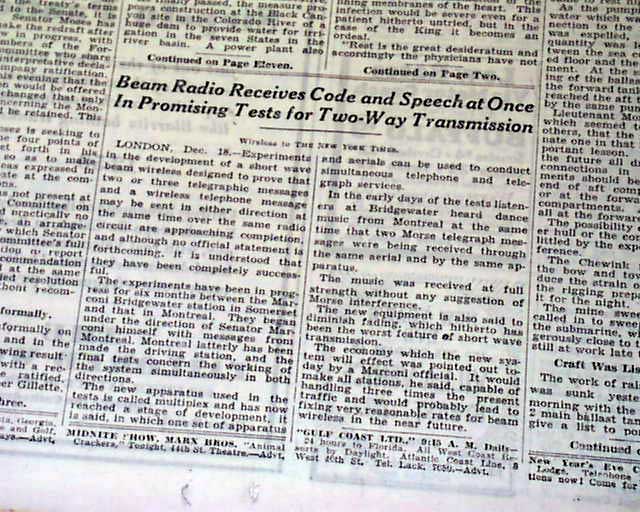
Shortwave beam wireless radio experiments...
Item # 725174
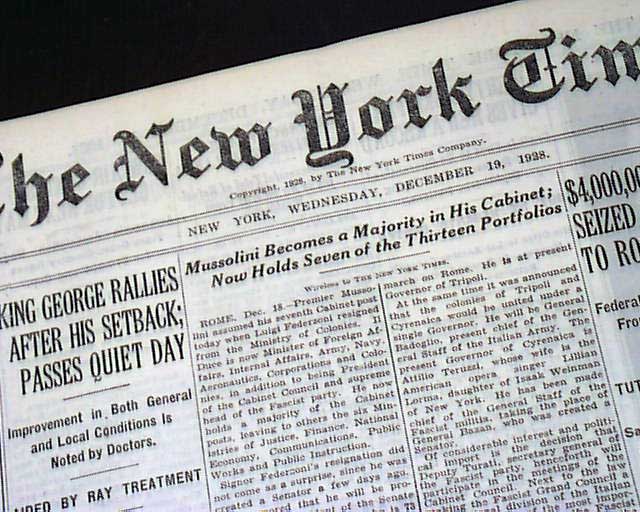
December 19, 1928
THE NEW YORK TIMES, December 19, 1928
* Shortwave radio advancements
* Beam wireless telephone
* Transmission both ways
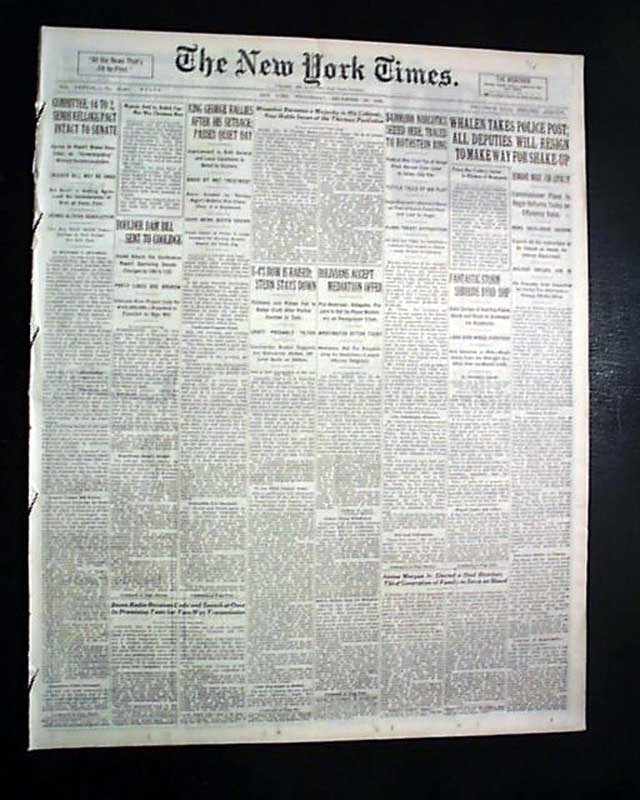
Near the bottom of the front page is a two column heading: "Beam Radio receives Code and Speech at Once In Promising Tests of Two-Way Transmission" (see)
Other news, sports and advertisements of the day. Complete in 56 pages, rag edition in nice condition.
background: In December 1928, the Marconi Beam Wireless Station at Bridgwater (Somerset) represented the pinnacle of commercial short-wave technology, serving as the critical receiving terminal for the UK-Canada link of the Imperial Wireless Chain. While John Logie Baird was concurrently struggling with the atmospheric "fading" of experimental television signals in London, Bridgwater’s massive, five-mast "curtain" antenna array was successfully harnessing the ionosphere to capture high-speed telegraphy from Drummondville, Quebec. This period marked a volatile transition for the station; the sheer efficiency of its short-wave "beam" system—which could transmit hundreds of words per minute at a fraction of the cost of undersea cables—had forced a massive industrial merger earlier that year, leading to the formation of Imperial and International Communications Limited (later Cable & Wireless). By mid-December, the station was a hive of activity, proving to the British government that short-wave radio was not merely an experimental curiosity but a robust, permanent replacement for the physical telegraph cables that had previously defined global empire communication.
Category: The 20th Century
Available Now
$48.00