Home > Back to Search Results >
Jehovah's Witnesses & the Manchester N.H. Parade
Jehovah's Witnesses & the Manchester N.H. Parade
Item # 724119
April 01, 1941
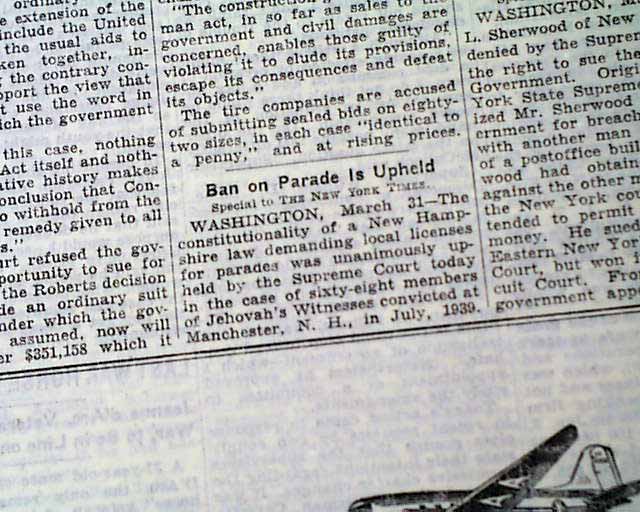
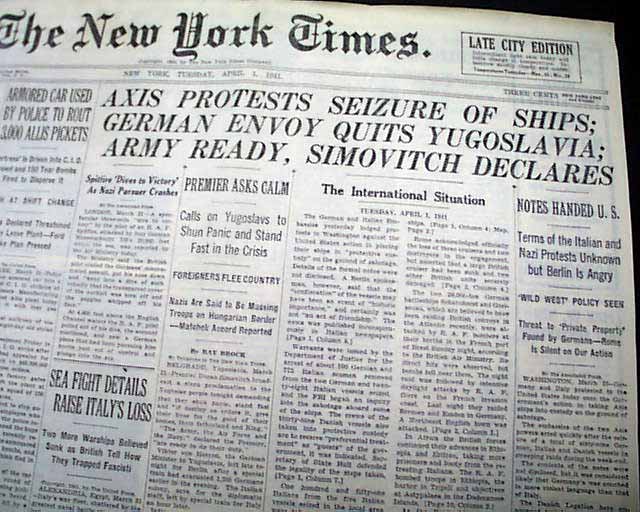
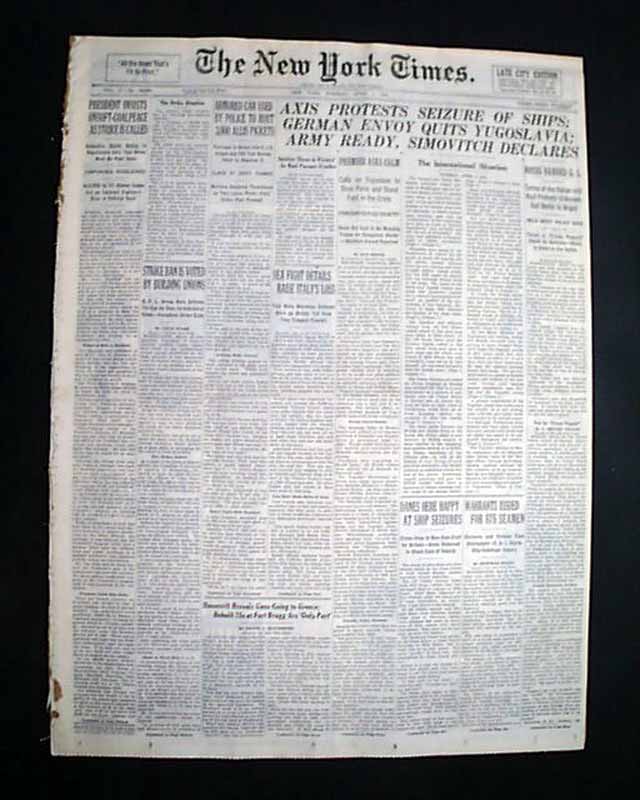
THE NEW YORK TIMES, April 1, 1941
* re. Manchester, New Hampshire parade
* Cox v. New Hampshire case upheld
* United States Supreme Court decision
* Watch Tower Bible and Tract Society member
* Jehovah's Witnesses movement stalled
* Charles Taze Russell followers - Bible Students
Page 26 has a brief and very discrete report with one column heading: "Ban on Parade Is Upheld". (see image)
I suspect this to be an extremely rare item because there was really no reason to save it at the time.
Much on the beginning World War II. Complete with all 48 pages, rag edition, a little residue along the spine from disbinding, nice condition.
background: On March 31, 1941, the U.S. Supreme Court decided Cox v. New Hampshire, a landmark First Amendment case involving Jehovah’s Witnesses. In 1939, a group of about 68 Witnesses held a “parade” in Manchester, New Hampshire, carrying signs and distributing literature to promote their religious views without obtaining a city-issued permit, as required by a local statute regulating public processions. They were convicted in municipal court, retried in superior court, and their convictions were upheld by the New Hampshire Supreme Court. The Witnesses argued that the licensing requirement violated their freedom of speech and assembly under the First Amendment. Writing for a unanimous Court, Chief Justice Charles E. Hughes held that the state’s permit law was a valid time, place, and manner regulation: it was content-neutral, served the public interest in safety and order, and did not grant arbitrary discretion to officials. The Court emphasized that while individuals have robust rights to express religious and political views, such expression may be subject to reasonable regulations when conducted in public spaces. This decision established a key precedent allowing states and municipalities to regulate parades and demonstrations through general, non-discriminatory rules without unduly infringing constitutional freedoms.
Category: The 20th Century
Available Now
$57.00