Home >
Jewish extermination speech....


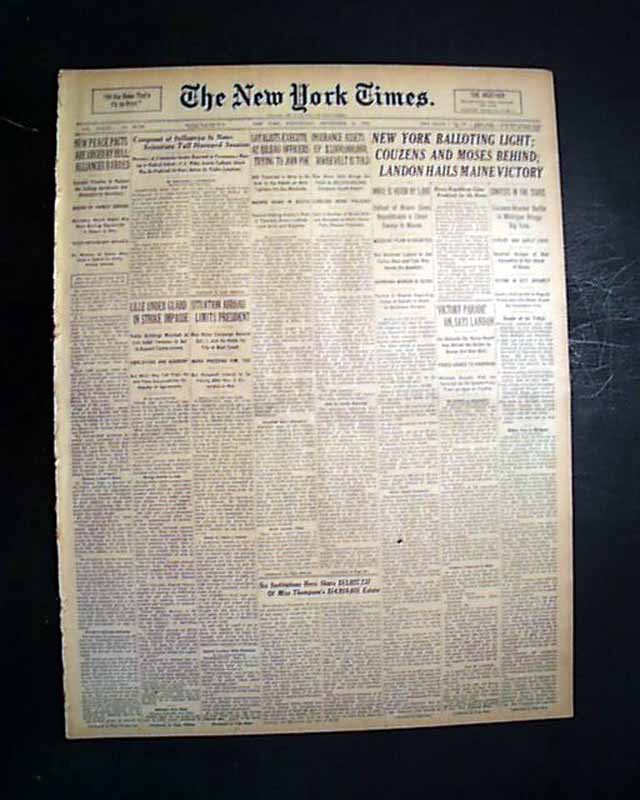
Jewish extermination speech....
Item # 721553
September 16, 1936
NEW YORK TIMES, Sept. 16, 1936
* Very early mention on exterminating the Jews
* Julius Streicher speech at Nuremberg
* Nazi propaganda figure
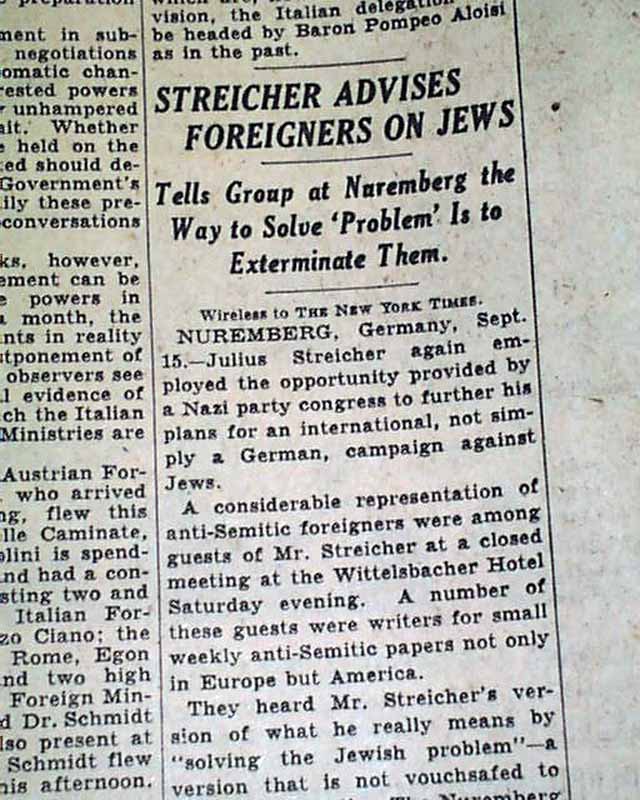
Page 14 contains one of the earliest reports of extermination as the solution to the "Jewish problem" not just in Germany but throughout the world. The report has one column heads: "Streicher Advises Foreigners On Jews" "Tells Group at Nurenberg the Way to Solve 'Problem' Is to Exterminate Them". The report focuses on Julius Streicher and his conference at Nuremberg (see for the full report). This report, which notes specifically: "...in the last analysis extermination is the only real solution of the Jewish problem..." is one of the earliest we have encountered in a newspaper, others appearing nearly 2 years later.
Complete in 52 pages, light toning, a bit irregular at the spine from disbinding, otherwise in nice condition.
AI notes: In Julius Streicher’s Nuremberg Rally speech of September 15, 1936 was significant as an early ideological precursor to genocide because it framed Jews as a biological and existential threat whose continued existence was incompatible with Germany’s survival. Streicher praised the Nuremberg Laws as a necessary act of racial self-defense and employed dehumanizing metaphors—Jews as disease, poison, or corrupters of blood—while speaking of their “elimination” from German life, language that went beyond legal discrimination toward the concept of total removal. This rhetoric stopped short of openly advocating mass killing, which the regime was not yet prepared to announce publicly in 1936, but it clearly advanced the idea that coexistence was impossible and that the Jewish “problem” required a permanent, radical solution. Historians view such speeches as part of the moral and psychological conditioning that made later extermination policies conceivable, a progression that became unmistakably explicit only during the war years—yet one for which Streicher’s earlier incitement laid crucial groundwork and ultimately contributed to his conviction and execution after 1945.
Category: The 20th Century
Available Now
$220.00