Home >
On Frederick Douglass's "Colored Men's Rights" speech...
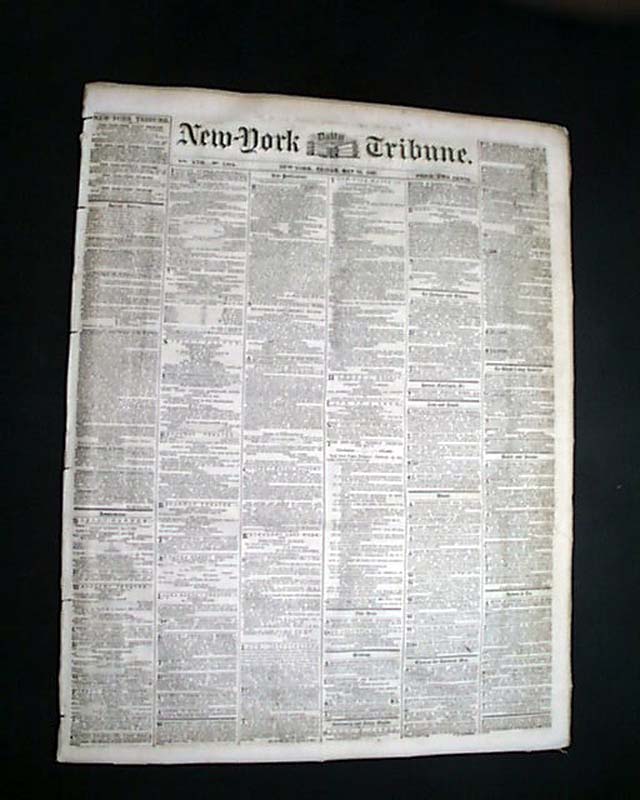
On Frederick Douglass's "Colored Men's Rights" speech...
Item # 719130
Currently Unavailable. Contact us if you would like to be placed on a want list or to be notified if a similar item is available.
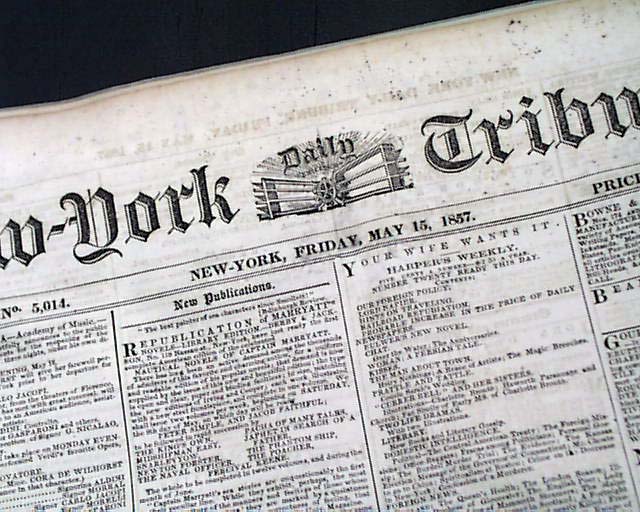
May 15, 1857
NEW YORK DAILY TRIBUNE, May 15, 1857
* Colored abolitionist Frederick Douglass
* “Colored Men’s Rights in This Republic”
* African Americans constitutional rights
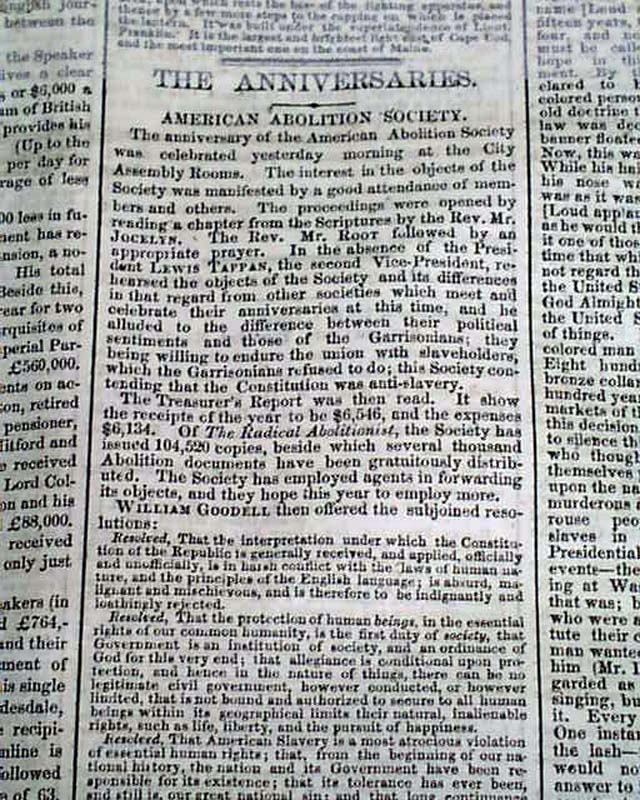
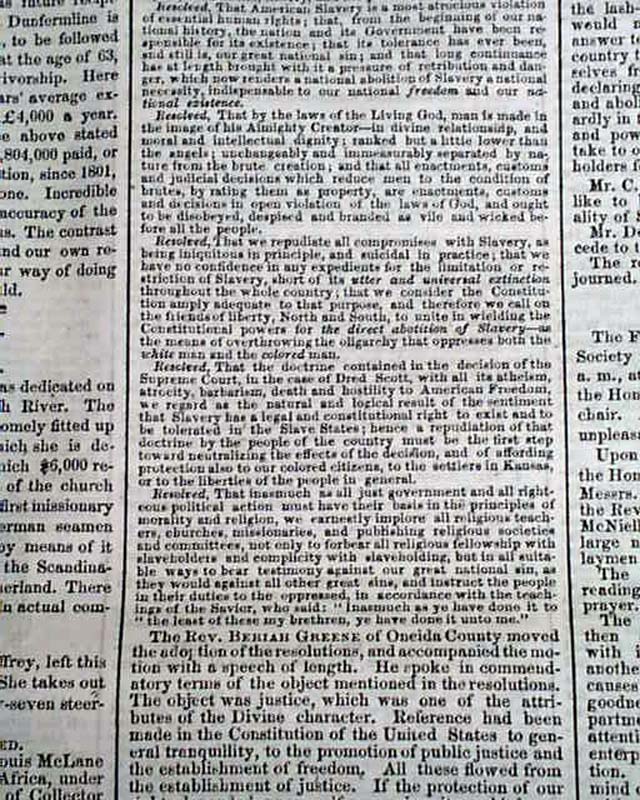
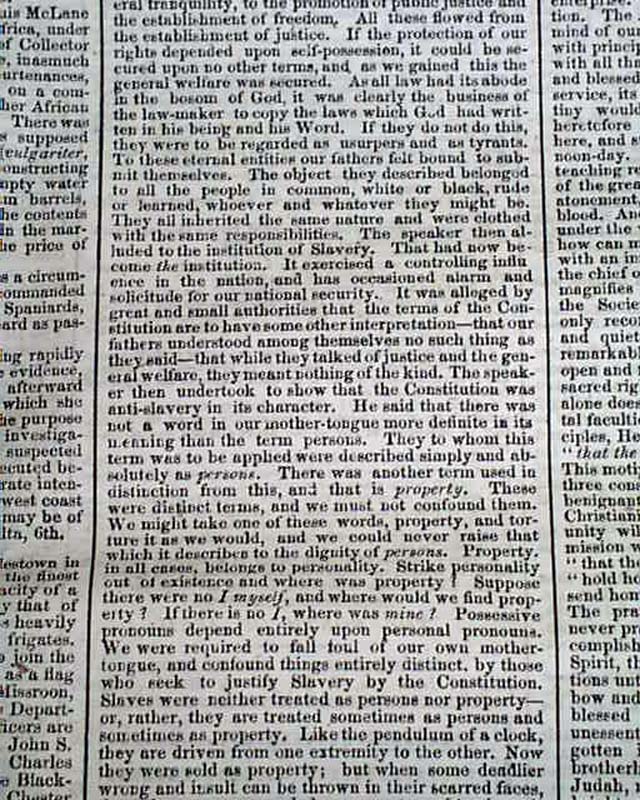
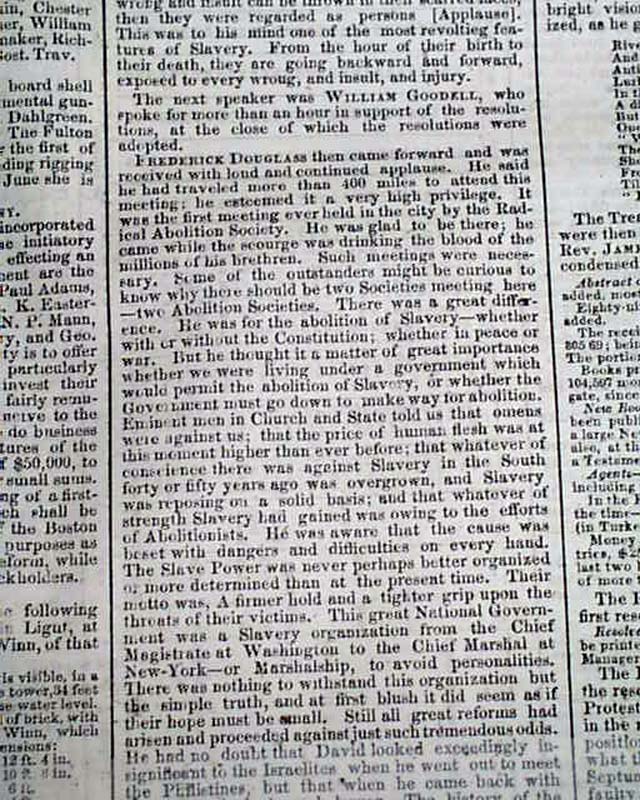
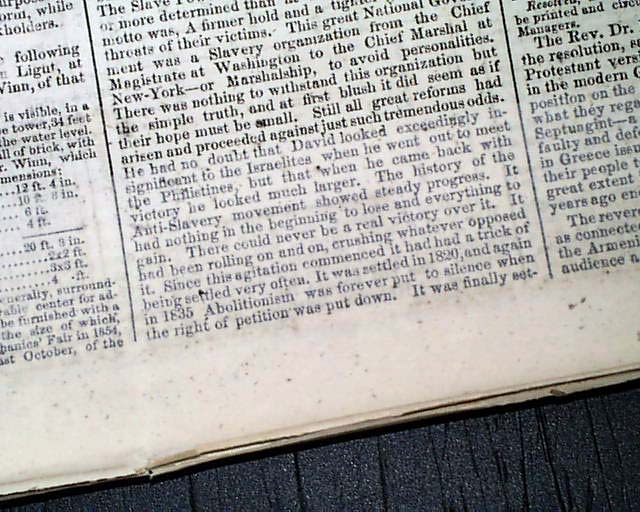
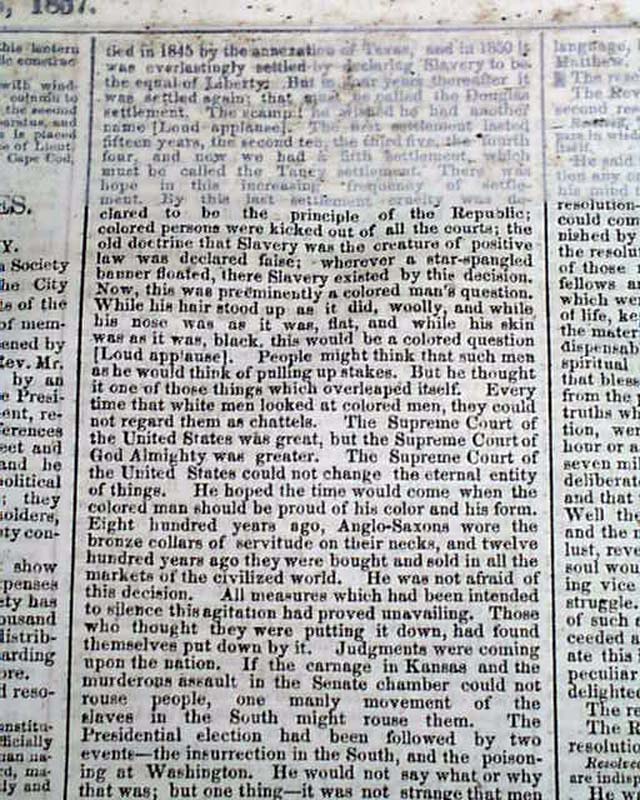
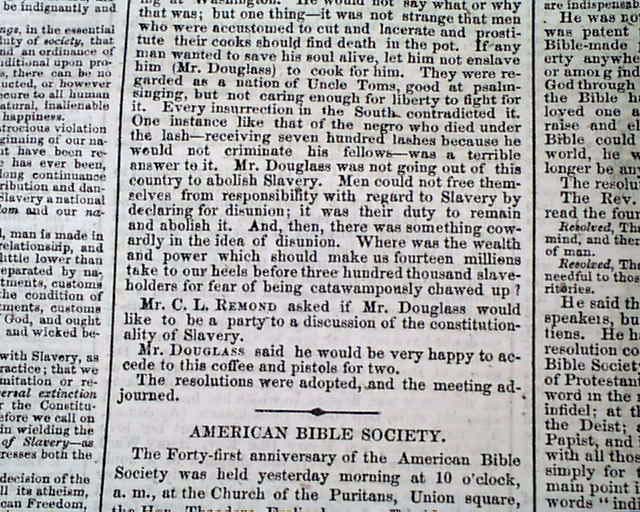
Page 6 has over a column taken up with a report headed: "American Abolition Society", the latter portion of which has a report of Frederick Douglass taking the podium. This report concerns his Dred Scott speech of the day prior, and was formally called "Colored Men's Rights in This Republic". Portions are alluded to in his talk, as the famous speech was quite lengthy.
Some bits include: "Frederick Douglass then came forward and was perceived with loud and continued applause...He was for the abolition of slavery--whether with or without the Constitution...He was aware that the cause was beset with dangers & difficulties on every hand. The slave power was never perhaps better organized or more determined than at the present time...Every time that white men looked at colored men, they could not regard them as chattels. The Supreme Court of the United States was great, but the Supreme Court of God Almighty was greater...He hoped the time would come when the colored man should be proud of his color and his form..." and much more.
Eight pages, transparent rice paper is around the perimeter of 4 of the pages overlapping some text (but still readable), minor binding indents at the blank spine, good condition.
AI notes: Frederick Douglass’s 1857 speech, commonly titled “Colored Men’s Rights in This Republic,” was delivered in the wake of the Dred Scott decision, which had declared that Black Americans had no constitutional rights. In the address, Douglass fiercely challenged both the Supreme Court’s ruling and the widespread notion that Black men were inherently excluded from citizenship, arguing that the Constitution’s language—“We, the people”—encompassed all men, regardless of race. He framed the struggle for Black rights as a moral and legal imperative, asserting that while human institutions might deny justice, a higher, divine law guaranteed equality and accountability. Douglass highlighted the historical reality that many states initially allowed Black men to vote and emphasized the longstanding opposition to slavery among religious denominations and some Founding Fathers, using these examples to counter claims of exclusionary intent. He condemned the federal government for protecting the powerful while neglecting the rights of the weak, yet he expressed enduring hope that the nation’s foundational principles of liberty and justice would ultimately prevail, envisioning the eventual overthrow of slavery as part of a moral arc toward equality.
Category: Pre-Civil War
No Longer Available