Home >
Supreme Court acts on the "Ironclad Oath" required of ex-Confederates...


Supreme Court acts on the "Ironclad Oath" required of ex-Confederates...
Item # 707353
January 16, 1867
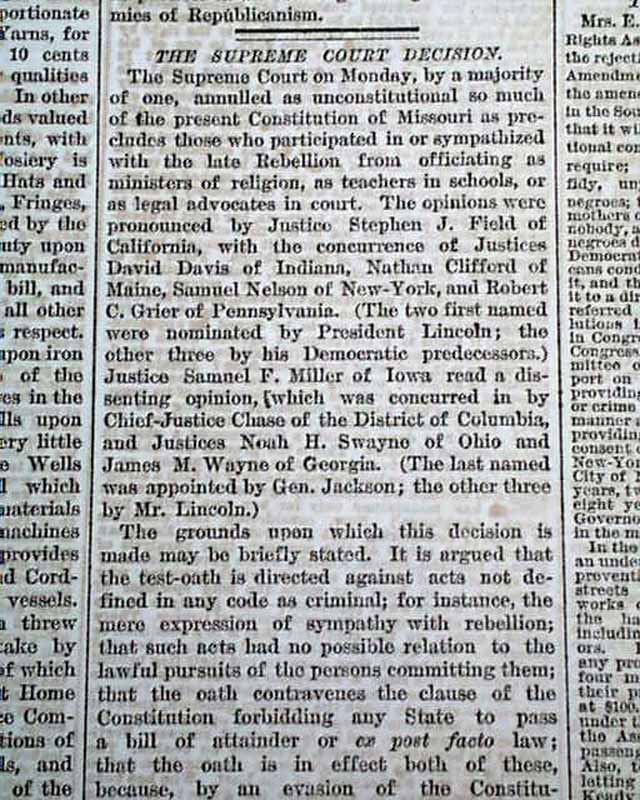
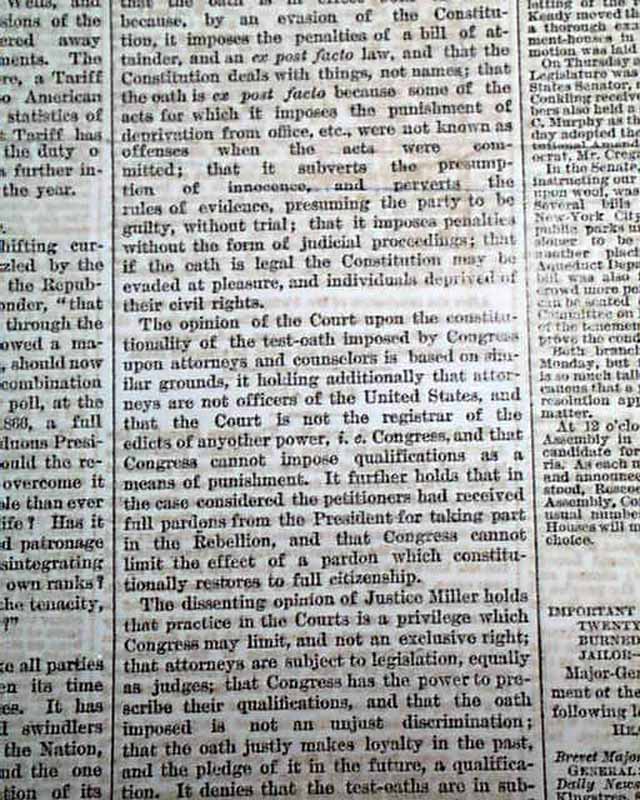
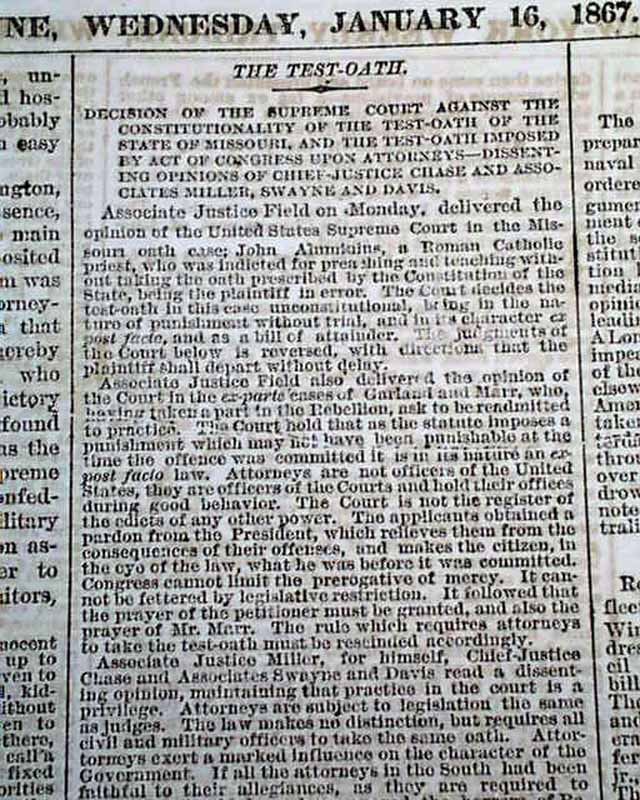
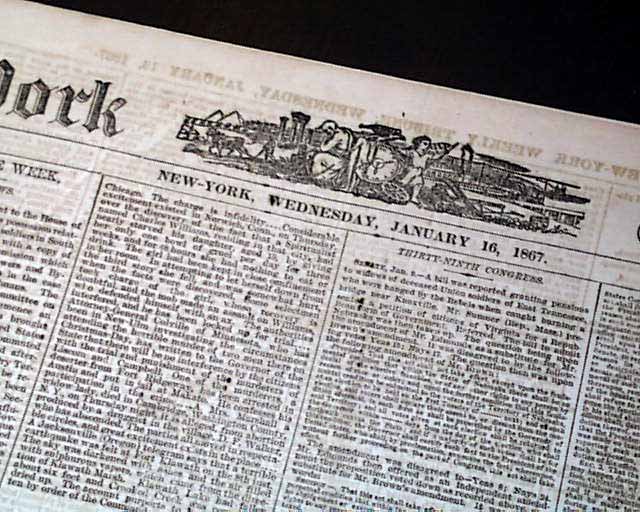
NEW YORK WEEKLY TRIBUNE, Jan. 16, 1867 Page 3 has two reports concerning the controversial "Ironclad Oath" which essentially prevented political activity of ex-Confederates soldiers & supporters by requiring all voters & officials to swear they had never supported the Confederacy.
A case arose in Missouri involving a Catholic priest who was indicted for preaching without taking the oath. The articles are headed: "The Supreme Court Decision" which takes over half a column, and: "The Test-Oath" "Decision of the Supreme Court Against the Constitutionality of the Test-oath of the State of Missouri, and the Test-Oath Imposed by Act of Congress Upon Attorneys--Dissenting Opinions of Chief Justice Case and Associates Miller, Swayne, and Davis".
Additional, under; "The New York Legislature" an article begins: "Mrs. E. Cady Stanton & others of the Equal Rights Association presented a petition...for the rejection by the Legislature of the Constitutional Amendment...".
Eight pages, very nice condition.
background: The Ironclad Oath of 1867 was a pivotal component of the Reconstruction effort following the Civil War, implemented to ensure loyalty to the Union among former Confederates. It required individuals seeking to hold public office in Southern states to swear they had never engaged in rebellion against the United States or supported the Confederacy. The oath was called "ironclad" because it was perceived as rigid and unbreakable, effectively barring many former Confederate officials and military leaders from participating in governance. This policy reflected the Radical Republicans' desire to exclude former Confederates from power and punish the South for its role in the rebellion. However, its harshness led to widespread resentment, as it disenfranchised a large portion of the white Southern population, hindering political reconciliation. Over time, the oath was replaced with more lenient requirements as part of a broader shift in Reconstruction policies, but its legacy remained a symbol of the deep divisions in post-war America, highlighting the challenges of reintegrating the Southern states into the Union while addressing the issue of former Confederates' roles in the new political order.
Category: The Old West
Available Now
$50.00