Home > Back to Search Results >
First election sermon preached after the Revolutionary War...



First election sermon preached after the Revolutionary War...
Item # 706749
May 26, 1784
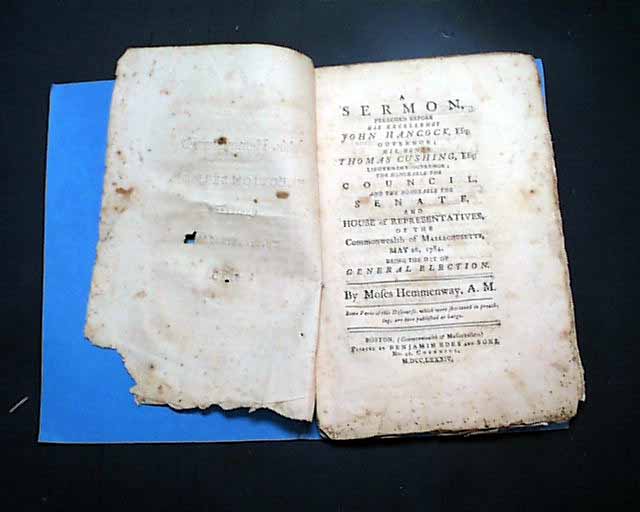
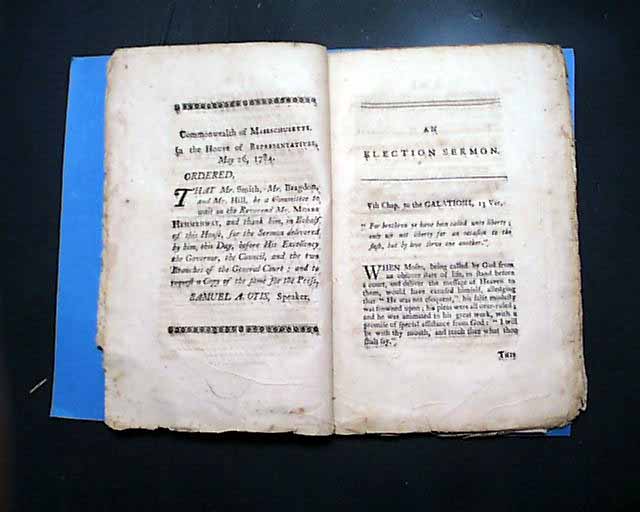
Pamphlet titled: "A SERMON, preached before His Excellency JOHN HANCOCK, Esq; governor; His Honor THOMAS CUSHING, Esq; lieutenant-governor; the Honorable the Council, and the Honorable the SENATE, and House of Representatives, of the Commonwealth of Massachusetts, May 26, 1784. Being the day of general election. By Moses Hemmenway, A.M., Boston, Printed by Benjamin Edes and Sons, M,DCC,LXXXXIV".
This was the first annual election sermon preached after the end of the Revolutionary War, just 8 months earlier. It is preached before the famed John Hancock.
Complete in 52 pages with the outer wrappers still present, the front wrapper containing: "Mr. Hemmenway's Election Sermon, Delivered Twenty-Sixth of May, 1784. Small hole to the front wrapper causes loss of the "y" in May". The back wrapper is blank.
With original string binding, wide, never-trimmed margins, scattered foxing throughout, 5 3/4 by 9 inches, very nice condition.
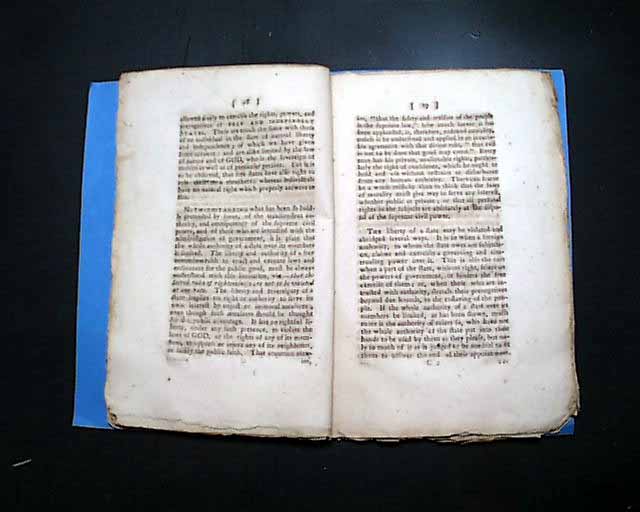
AI notes: Moses Hemmenway’s 1784 election sermon serves as a foundational philosophical bridge between the end of the American Revolution and the establishment of a stable, sovereign Commonwealth. Addressing a room filled with the architects of American independence—including John Hancock and Thomas Cushing—Hemmenway utilized the occasion to articulate a "Christian Republicanism" that prioritized the Social Compact. He argued that while all men are naturally free and equal, they voluntarily surrender a portion of that liberty to a civil government to ensure the protection of the whole. Hemmenway’s discourse was particularly notable for its sophisticated definition of Civil Liberty, which he framed not as the absence of restraint, but as the freedom to be governed by laws that are just, predictable, and conducive to the public good. By blending Enlightenment political theory with traditional Reformed theology, he reminded the newly elected officials that their authority was a "sacred trust" derived from the people and ultimately accountable to God, effectively setting the moral and intellectual expectations for the post-war governance of Massachusetts.
Category: Documents & Broadsides
Available Now
$175.00