Home > Back to Search Results >
Landmark event in women's history: former slave woman petitions as an heir to her brother's estate...
Landmark event in women's history: former slave woman petitions as an heir to her brother's estate...
Item # 705927
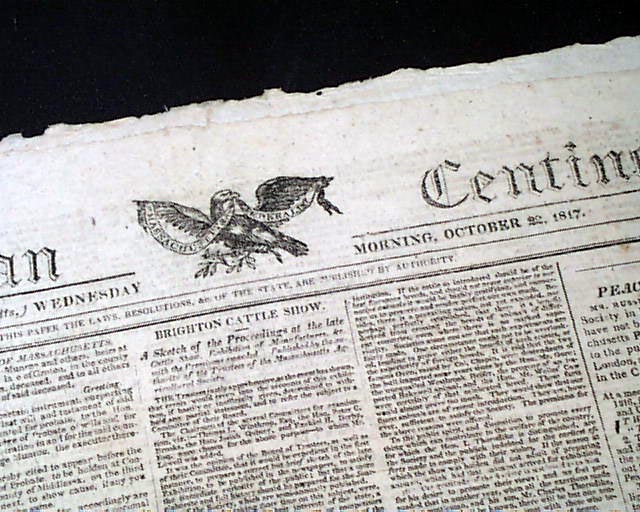
October 22, 1817
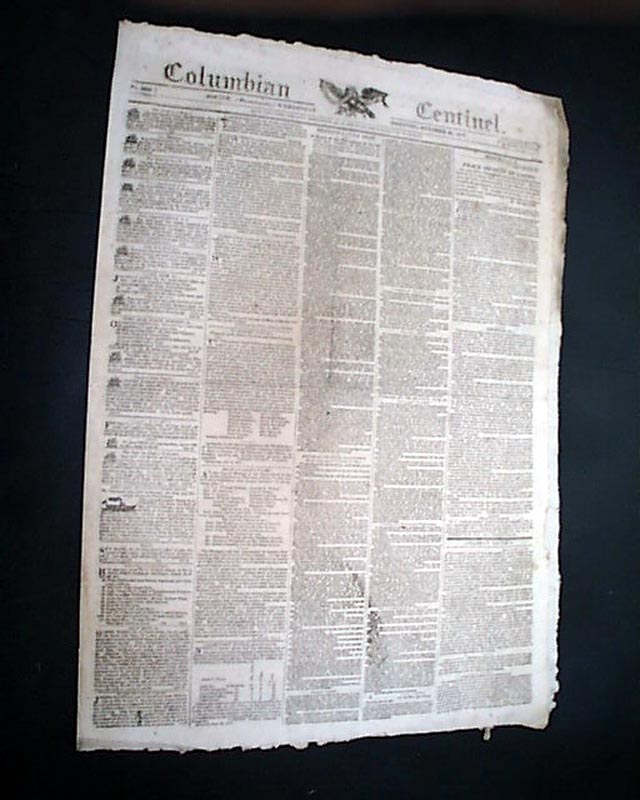
COLUMBIAN CENTINEL, Boston, Oct. 22, 1817
* Former Woman slave Pamela Sparhawk
* Newton, Massachusetts petition for estate
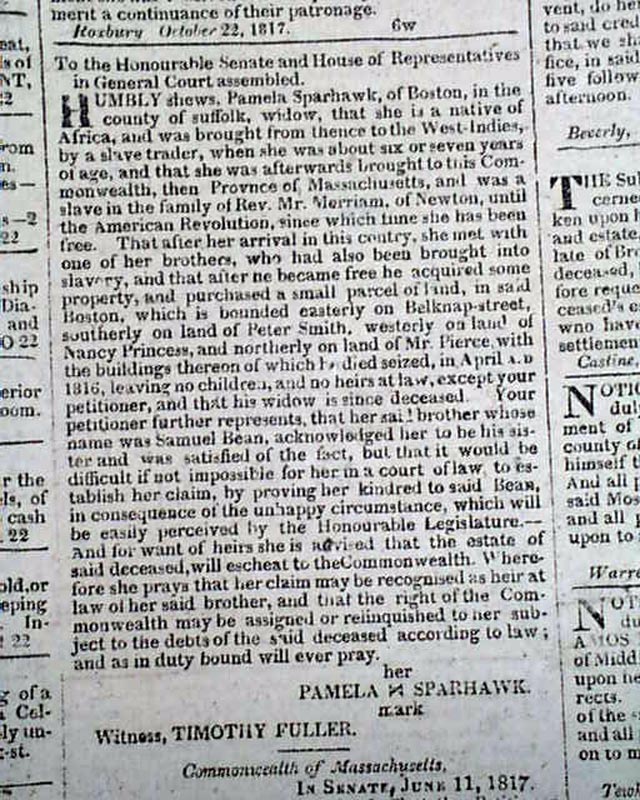
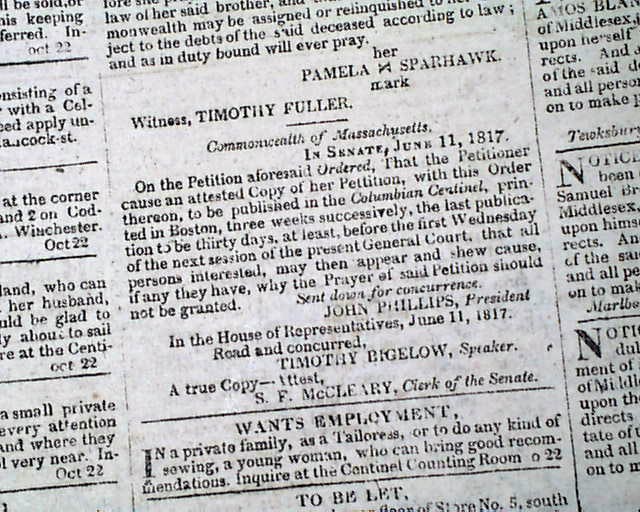
In 1818 a woman named Pamela Sparhawk petitioned the Mass. General Court to be recognized as heir to her brother’s estate.
What makes this remarkable? Pamela Sparhawk was a formerly enslaved Black woman.
Pamela separated from her brother in childhood. After more than a decade of bondage in Boston and nearby Newton, she was determined to build a life of her own in freedom. Through her petition, she was asking the state legislature to acknowledge who she was and what the institution of slavery had taken from them both.
Although her story is much longer than can be provided here, Pamela's brother Samuel--separated from each other early in their lives but eventually reconnected--also regained his freedom. He died in 1816, as did his wife some months later.
Her petition as seen in this page 3 notice offers much of the detail.
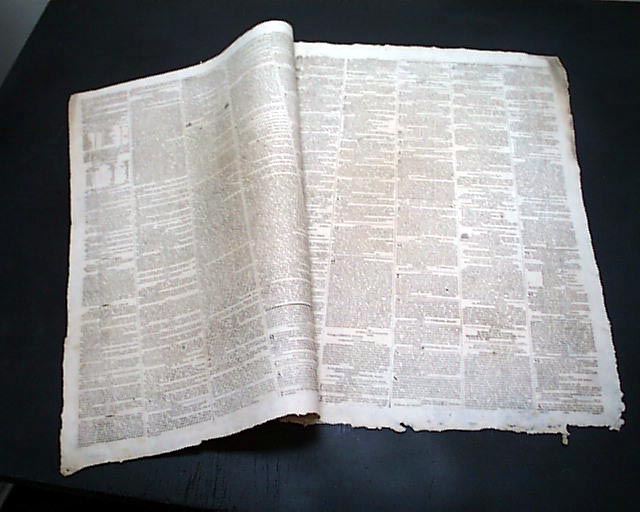
Four pages, never bound nor trimmed, nice condition.
AI notes: Pamela Sparhawk was an African-born woman who endured enslavement in Massachusetts during the late 18th century, later gaining her freedom as the state gradually abolished slavery. Brought to Boston as a child, she was owned by a wealthy family and eventually lived in Newton, Massachusetts, where she became part of the local Black community. In 1818, demonstrating remarkable courage and legal awareness for her time, she petitioned the Massachusetts General Court to be recognized as the heir to her brother’s estate, asserting her rights as a free Black woman in a society that systematically denied both racial and gender equality. While it is unclear whether her petition succeeded, her actions represent one of the earliest recorded efforts by an African American woman to claim legal and property rights in Massachusetts, and her story is remembered today in local Black history exhibits as an example of resilience, agency, and the pursuit of justice in early New England.
Her petition as seen in this page 3 notice offers much of the detail.
Four pages, never bound nor trimmed, nice condition.
AI notes: Pamela Sparhawk was an African-born woman who endured enslavement in Massachusetts during the late 18th century, later gaining her freedom as the state gradually abolished slavery. Brought to Boston as a child, she was owned by a wealthy family and eventually lived in Newton, Massachusetts, where she became part of the local Black community. In 1818, demonstrating remarkable courage and legal awareness for her time, she petitioned the Massachusetts General Court to be recognized as the heir to her brother’s estate, asserting her rights as a free Black woman in a society that systematically denied both racial and gender equality. While it is unclear whether her petition succeeded, her actions represent one of the earliest recorded efforts by an African American woman to claim legal and property rights in Massachusetts, and her story is remembered today in local Black history exhibits as an example of resilience, agency, and the pursuit of justice in early New England.
Category: Pre-Civil War
Available Now
$198.00