Home >
Short-lived newspaper with an interesting title...
Short-lived newspaper with an interesting title...
Item # 705748
Currently Unavailable. Contact us if you would like to be placed on a want list or to be notified if a similar item is available.
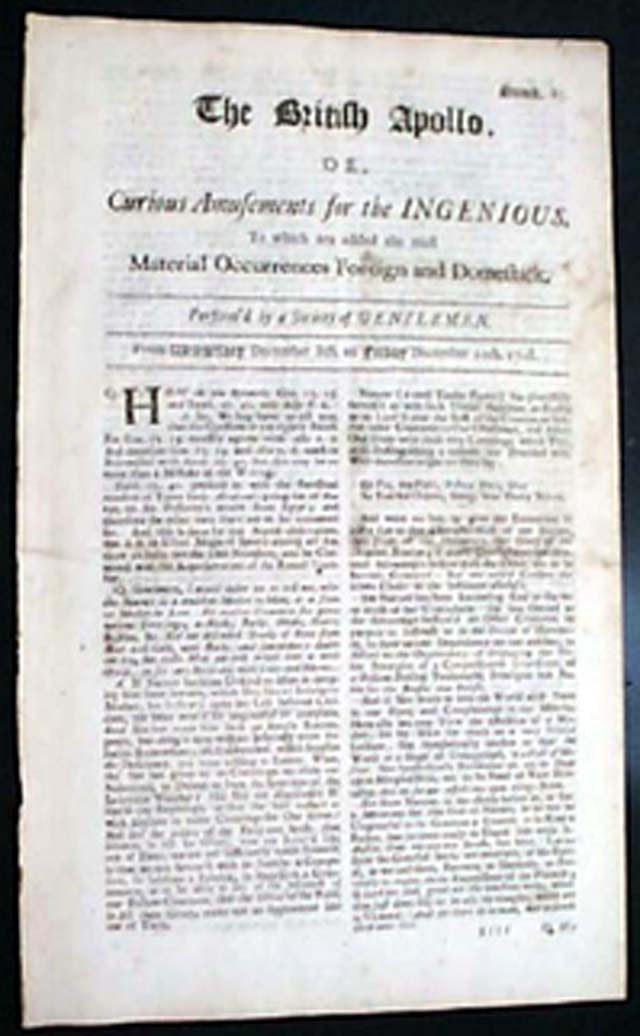
December 10, 1708
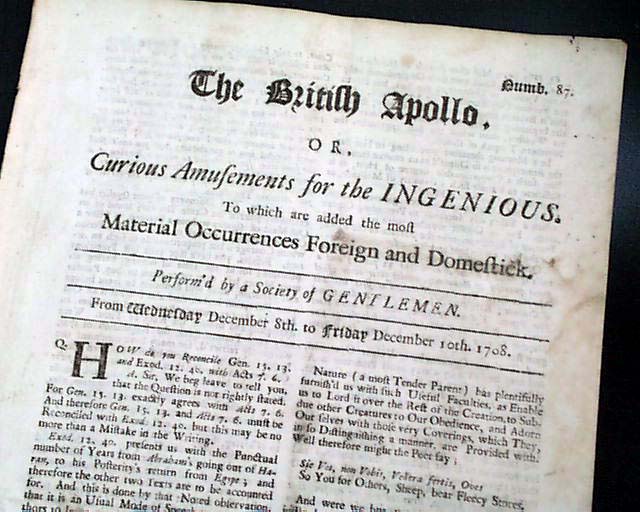
THE BRITISH APOLLO, OR CURIOUS AMUSEMENTS FOR THE INGENIOUS and subtitled: "To Which are Added the Most Material Occurrences Foreign and Domestick". Published in London, and "Perform'd by a Society of Gentlemen" as noted in the masthead Dec. 10, 1708.
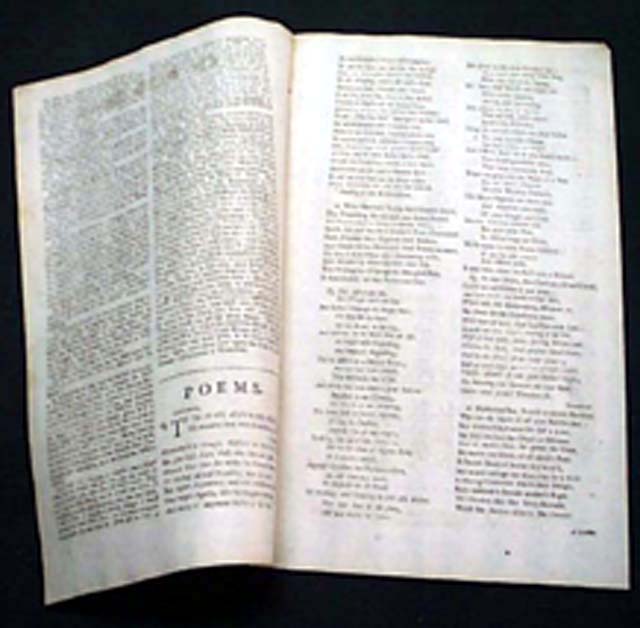
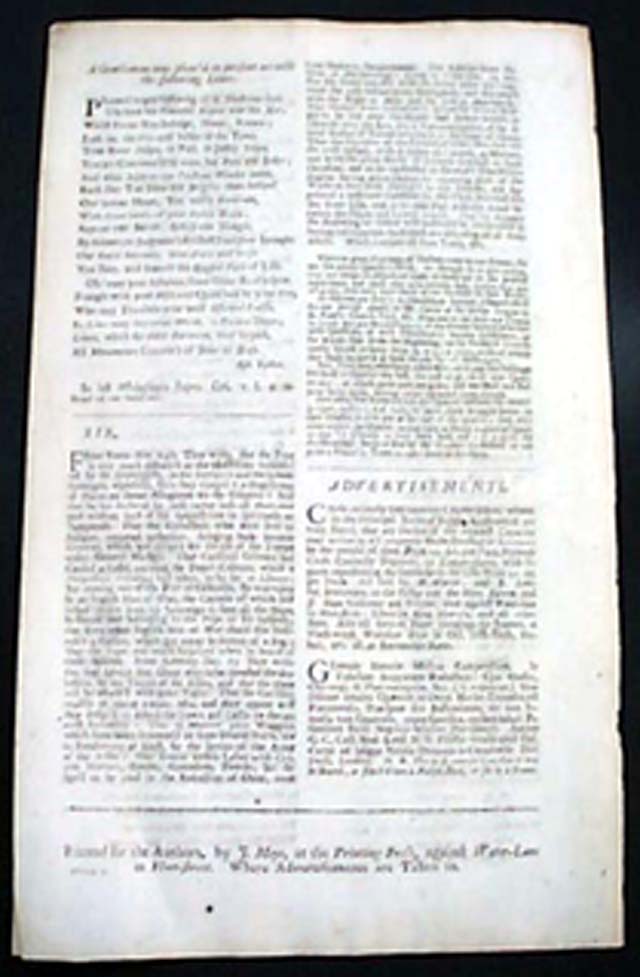
This newspaper existed for less than 4 years. Readers were invited to send in questions on any subject whatsoever, and the editors would contrive to provide answers, which took most of the first half of each issue. The balance of the issue was devoted to poetry, snippets of news, announcements of new books, and various advertisements.
An interesting & curious title for a newspaper, complete in 4 pages, 13 by 8 inches, some minor foxing, nice condition.
AI notes: The British Apollo, or Curious Amusements for the Ingenious was a London periodical published from 1708 to 1711 that combined news, literary amusements, and scholarly inquiry in a compact four-page format. Modeled on earlier question-and-answer periodicals like The Athenian Mercury, it featured a “Society of Gentlemen” responding to reader-submitted questions on a wide range of topics, including theology, science, philosophy, mathematics, language, and everyday curiosities, blending serious instruction with wit and entertainment. Each issue also included domestic and foreign news, book announcements, poetry, and advertisements, making it both a source of current intelligence and intellectual engagement. Contributors, though usually anonymous, likely included prominent London literati such as Aaron Hill, Marshall Smith, John Gay, and Samuel Garth. By combining practical information with learned discourse and playful curiosity, The British Apollo served as an innovative bridge between early newspapers and literary or advice journals, appealing to readers interested in both knowledge and amusement.
Category: The 1600's and 1700's
No Longer Available