Home >
General St. Clair's defeat against the Indians...
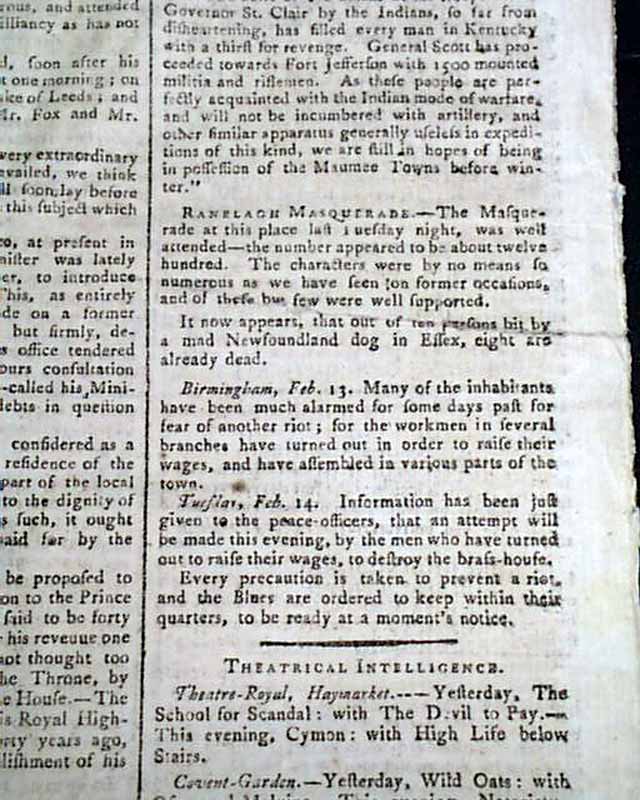
General St. Clair's defeat against the Indians...
Item # 700812
February 16, 1792
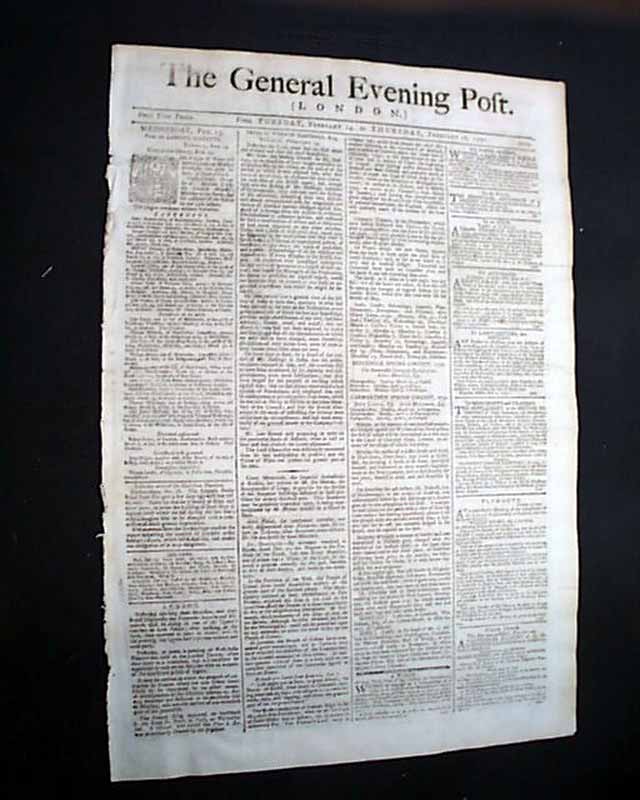
THE GENERAL EVENING POST, London, Feb. 16, 1792
* St. Clair's Defeat - Battle of the Wabash
* Native American forces vs. U.S. Army
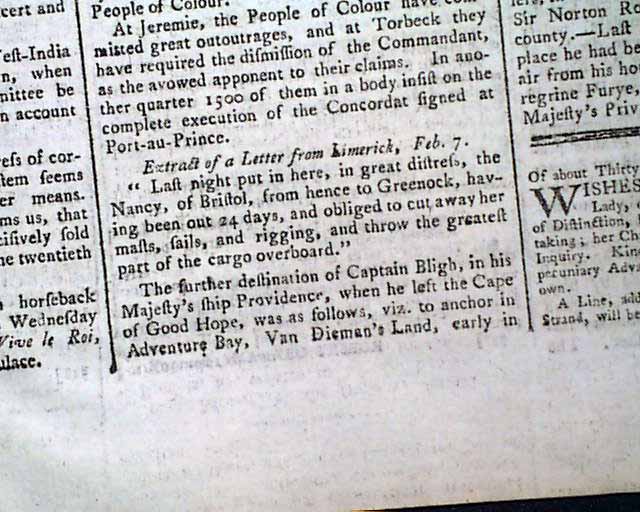
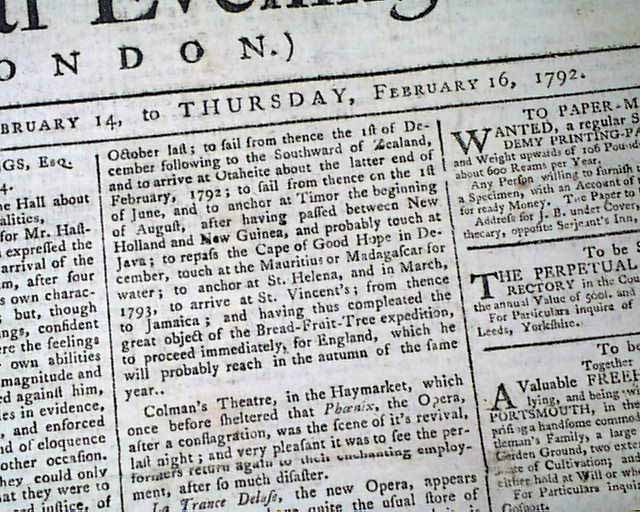
The front page has a report mentioning Captain Bligh, of mutiny on the Bounty fame, concerning his travels in the South Pacific.
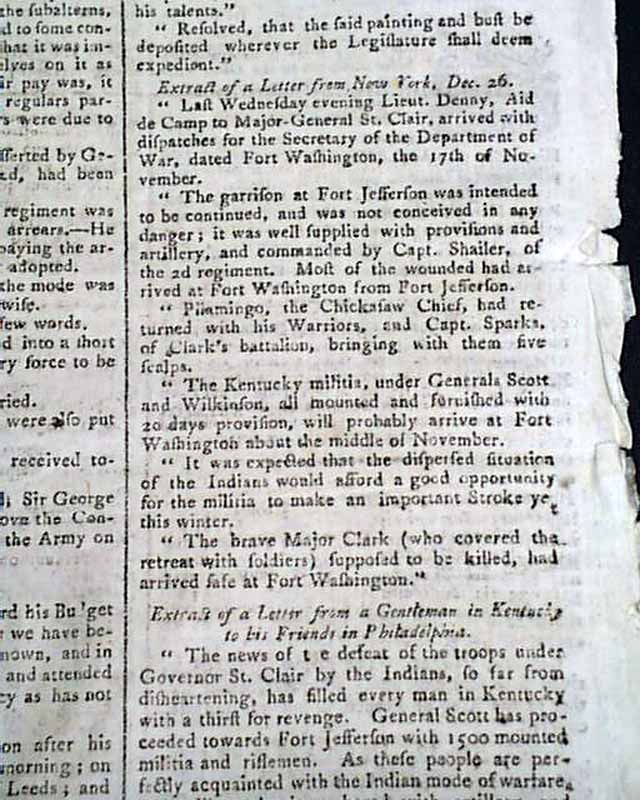
The back page has a letter from New York concerning General St. Clair at Fort Washington & Fort Jefferson. Also, a letter from Kentucky beginning: "The news of the defeat of the troops under Governor St. Clair by the Indians, so far from disheartening, has filled every man in Kentucky with a thirst for revenge..." with more.
This was one of the worst defeats ever suffered by U.S. forces in Indian warfare, precipitated by British-Indian confrontation with settlers and militia in the Northwest Territory following the Revolutionary War.
Four pages, good condition.
background: In 1791, Major General Arthur St. Clair, governor of the Northwest Territory and commander of U.S. forces in the Old Northwest, operated primarily from Fort Washington, located at present-day Cincinnati, Ohio, which served as the principal American military headquarters during the Northwest Indian War. From Fort Washington, St. Clair organized and launched his ill-fated autumn campaign against the Western Confederacy of Native American tribes resisting U.S. expansion into the Ohio Country. As his army advanced northward, it constructed a chain of forts for supply and communication, including Fort Jefferson, built in October 1791 near what is now Greenville, Ohio. Fort Jefferson functioned as an advanced supply post and fallback position. After pushing further north, St. Clair’s force was surprised and overwhelmingly defeated on November 4, 1791, near the headwaters of the Wabash River in what became known as St. Clair’s Defeat (or the Battle of the Wabash), the worst defeat ever suffered by the U.S. Army at the hands of Native American forces. The shattered remnants of his army retreated back to Fort Jefferson and then to Fort Washington, marking a turning point that ultimately led to military reforms and General “Mad” Anthony Wayne’s later campaign.
Category: The 1600's and 1700's
Available Now
$48.00