

Freemasons & the abduction of Morgan...
Item # 685031Sorry, but this item is no longer available. Please be in touch at info@rarenewspapers.com if you would like to be placed on a want list or are interested in a potential alternate issue.
August 30, 1828
NILES' WEEKLY REGISTER, Baltimore, Aug. 30, 1828
* The Abduction of William Morgan
* Anti Masonic - Freemasons scandal
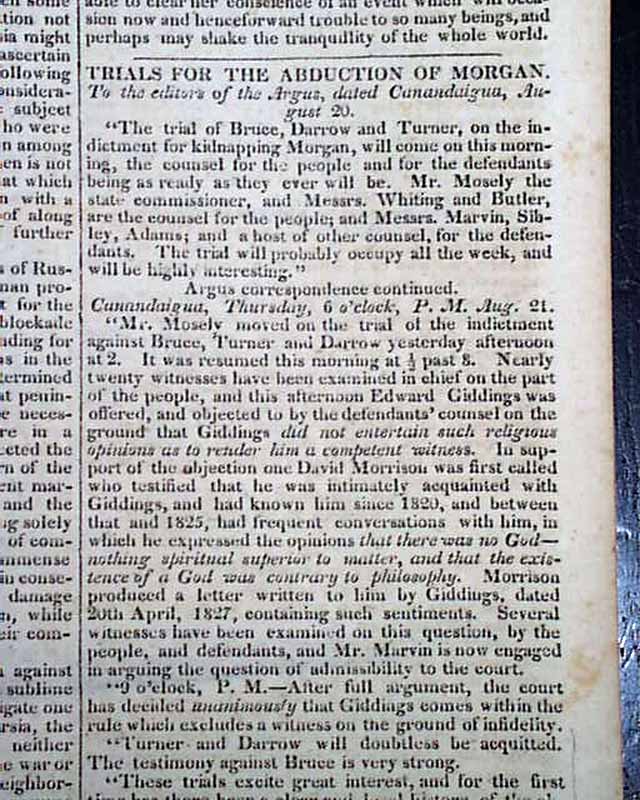
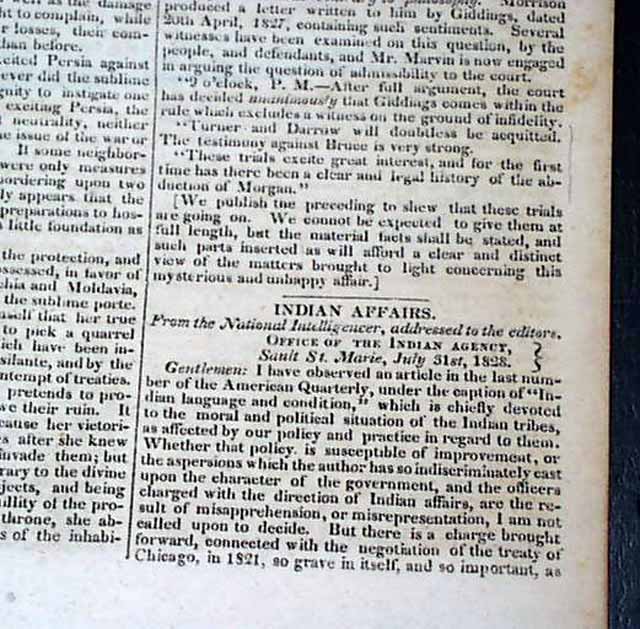
Inside has a report headed: "Trials For the Abduction of Morgan".
The disappearance of William Morgan, an anti-Mason, and his presumed murder in 1826 ignited a powerful movement against the Freemasons, a fraternal society that had become influential in the United States. After Morgan announced his intention to publish a book exposing Freemasonry's secrets, he was arrested on trumped-up charges. He disappeared soon after and was believed to have been kidnapped and killed by Masons from western New York.
Sixteen pages, 6 by 9 1/2 inches, good condition.
Background: The abduction of William Morgan in 1828—more accurately rooted in events beginning in 1826—became one of the most explosive scandals of early American history and sparked a national backlash against Freemasonry. Morgan, a stonemason living in Batavia, New York, had threatened to publish Illustrations of Masonry, a book exposing Masonic rituals, which enraged local Freemasons who attempted to silence him through harassment and spurious legal charges; on September 11, 1826, he was arrested on a trivial debt, released, then immediately seized by a group of men and transported westward through a chain of Masonic lodges, last being seen near Fort Niagara, after which he vanished permanently. Although his body was never conclusively identified and his precise fate remains uncertain, widespread belief held that Morgan was murdered, most likely drowned in the Niagara River, to prevent publication of his revelations. The perceived failure of courts to punish those responsible—despite convictions for kidnapping and conspiracy—fueled public outrage, devastated the reputation of Freemasonry across the northern United States, and directly led to the formation of the Anti-Masonic Party, the nation’s first significant third party, which profoundly influenced American political culture by promoting moral reform, transparency, and the use of national nominating conventions.
* The Abduction of William Morgan
* Anti Masonic - Freemasons scandal
Inside has a report headed: "Trials For the Abduction of Morgan".
The disappearance of William Morgan, an anti-Mason, and his presumed murder in 1826 ignited a powerful movement against the Freemasons, a fraternal society that had become influential in the United States. After Morgan announced his intention to publish a book exposing Freemasonry's secrets, he was arrested on trumped-up charges. He disappeared soon after and was believed to have been kidnapped and killed by Masons from western New York.
Sixteen pages, 6 by 9 1/2 inches, good condition.
Background: The abduction of William Morgan in 1828—more accurately rooted in events beginning in 1826—became one of the most explosive scandals of early American history and sparked a national backlash against Freemasonry. Morgan, a stonemason living in Batavia, New York, had threatened to publish Illustrations of Masonry, a book exposing Masonic rituals, which enraged local Freemasons who attempted to silence him through harassment and spurious legal charges; on September 11, 1826, he was arrested on a trivial debt, released, then immediately seized by a group of men and transported westward through a chain of Masonic lodges, last being seen near Fort Niagara, after which he vanished permanently. Although his body was never conclusively identified and his precise fate remains uncertain, widespread belief held that Morgan was murdered, most likely drowned in the Niagara River, to prevent publication of his revelations. The perceived failure of courts to punish those responsible—despite convictions for kidnapping and conspiracy—fueled public outrage, devastated the reputation of Freemasonry across the northern United States, and directly led to the formation of the Anti-Masonic Party, the nation’s first significant third party, which profoundly influenced American political culture by promoting moral reform, transparency, and the use of national nominating conventions.
Category: Pre-Civil War


