Home >
President Zachary Taylor and the Wilmot Proviso... Early Florida...
President Zachary Taylor and the Wilmot Proviso... Early Florida...
Item # 542907
Currently Unavailable. Contact us if you would like to be placed on a want list or to be notified if a similar item is available.
November 25, 1848
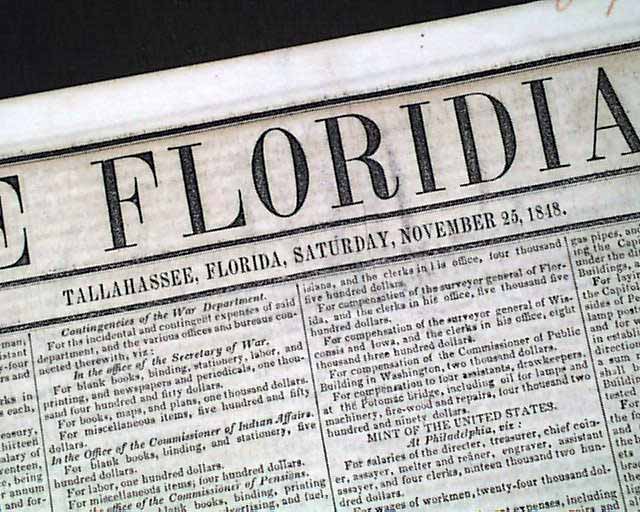
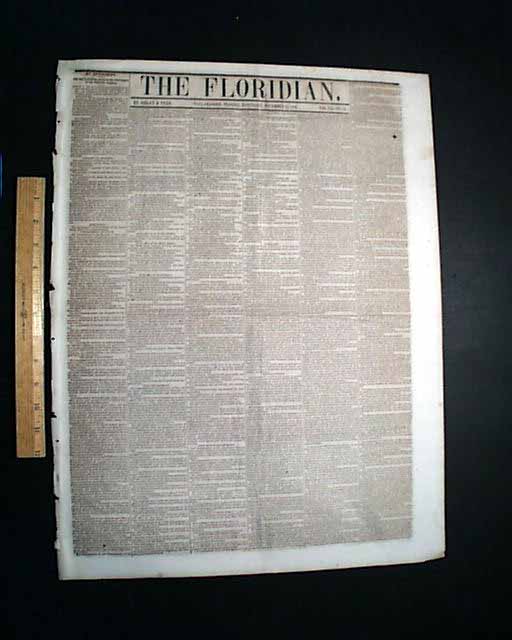
THE FLORIDIAN, Tallahassee, Florida, November 25, 1848
* Rare title from Tallahassee, Florida
* President Zachary Taylor
* Wilmot Proviso
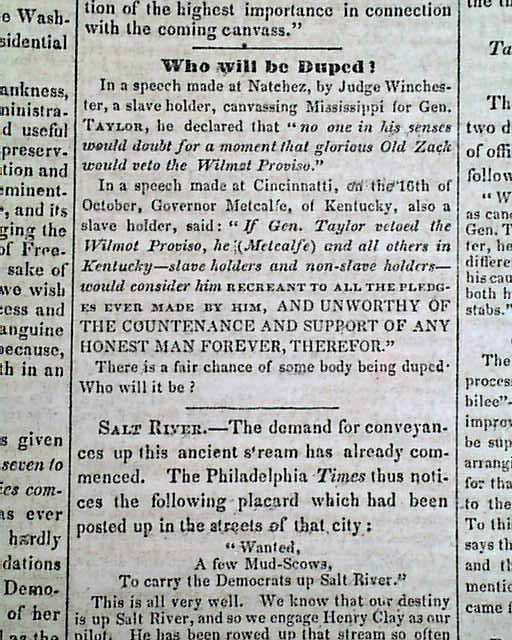
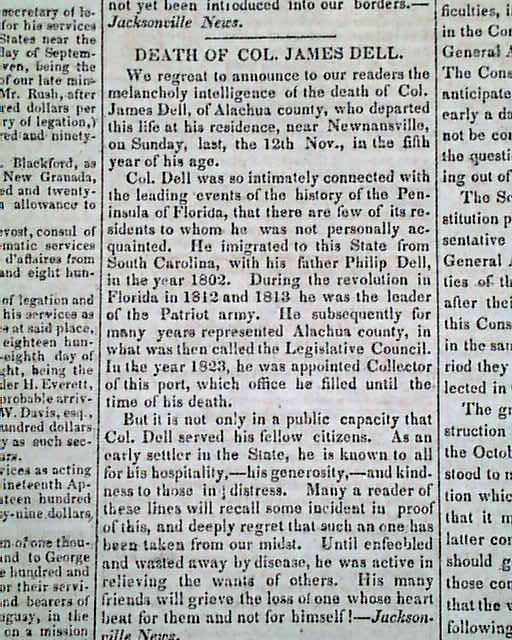
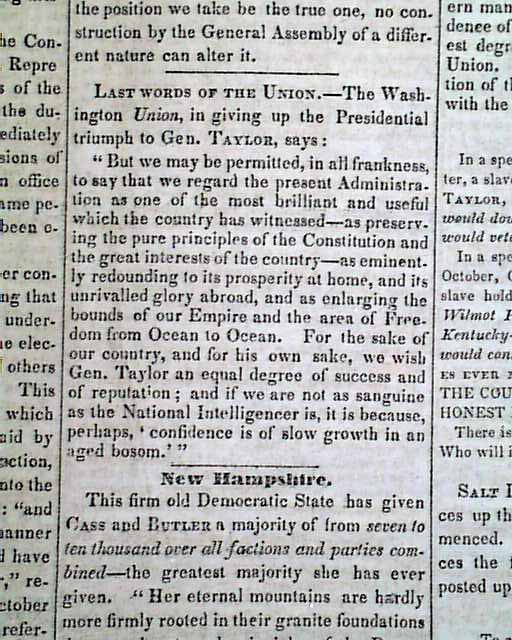
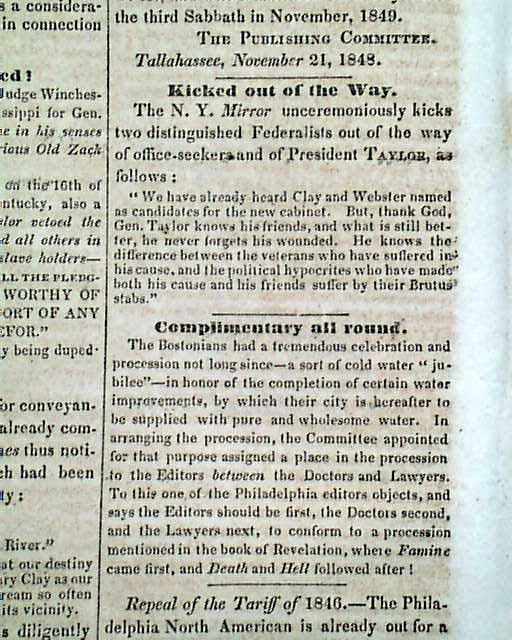
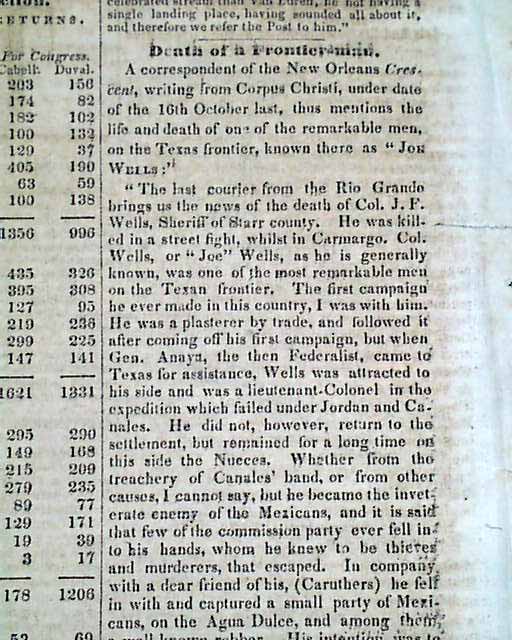
This issue from Tallahassee, the capital of Florida, includes many articles and advertisements: "Death of Colonel James Dell", "Who Killed Clay?" (Henry Clay, Sr.), considerable follow-up coverage concerning the election of President Zachary Taylor, and much more. Included is an article which reveals Gen. Taylor's support for AND against the Wilmot Proviso - related to the slavery question, indicating that "flip-flopping" on hot-bed political issues is not just a current practice.
Nineteenth century newspapers from Florida are uncommon, particularly rare are those from before the Civil War. Here is such an issue from the capital city of Florida, and from over 13 years before the outbreak of the Civil War. The format is typical of most newspapers of the day, being four pages of folio size with a wealth of news of the day and many advertisements as well. This issue is complete, and in good condition.
Background (Wikipedia): Southerner Whigs looked hopefully to slaveholder and Mexican war hero General Zachary Taylor as the solution to the widening sectional divide even though he took no public stance on the Wilmot Proviso. However Taylor, once nominated and elected, showed that he had his own plans. Taylor hoped to create a new non-partisan coalition that would once again remove slavery from the national stage. He expected to be able to accomplish this by freezing slavery at its 1849 boundaries and by immediately bypassing the territory stage and creating two new states out of the Mexican Cession.[22]
The opening salvo in a new level of sectional conflict occurred on December 13, 1848 when John G. Palfrey (W) of Massachusetts introduced a bill to abolish slavery in the District of Columbia. Throughout 1849 in the South "the rhetoric of resistance to the North escalated and spread". The potentially secessionist Nashville Convention was scheduled for June 1850.[23] When President Taylor in his December 1849 message to Congress urged the admission of California as a free state, a state of crisis was further aggravated. Historian Allan Nevins sums up the situation which had been created by the Wilmot Proviso:
“Thus the contest was joined on the central issue which was to dominate all American history for the next dozen years, the disposition of the Territories. Two sets of extremists had arisen: Northerners who demanded no new slave territories under any circumstances, and Southerners who demanded free entry for slavery into all territories, the penalty for denial to be secession. For the time being, moderates who hoped to find a way of compromise and to repress the underlying issue of slavery itself – its toleration or non-toleration by a great free Christian state – were overwhelmingly in the majority. But history showed that in crises of this sort the two sets of extremists were almost certain to grow in power, swallowing up more and more members of the conciliatory center. [24] ”
Combined with other slavery related issues, the Wilmot Proviso led to the Compromise of 1850, which helped buy another shaky decade of peace. Radical secessionists were temporarily at bay as the Nashville Convention failed to endorse secession. Moderates rallied around the Compromise as the final solution to the sectional issues involving slavery and the territories. At the same time, however, the language of the Georgia Platform, widely accepted throughout the South, made it clear that the South’s commitment to Union was not unqualified; they fully expected the North to adhere to their part of the agreement.
Category: Pre-Civil War
No Longer Available